Robert Silverberg - Nightwings
Здесь есть возможность читать онлайн «Robert Silverberg - Nightwings» весь текст электронной книги совершенно бесплатно (целиком полную версию без сокращений). В некоторых случаях можно слушать аудио, скачать через торрент в формате fb2 и присутствует краткое содержание. Год выпуска: 1969, ISBN: 1969, Издательство: Avon Books, Жанр: Фантастика и фэнтези, на английском языке. Описание произведения, (предисловие) а так же отзывы посетителей доступны на портале библиотеки ЛибКат.
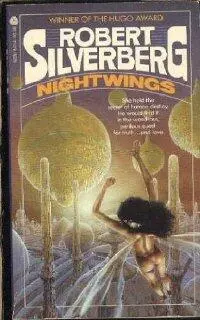
- Название:Nightwings
- Автор:
- Издательство:Avon Books
- Жанр:
- Год:1969
- ISBN:0-380-64154-2
- Рейтинг книги:4 / 5. Голосов: 1
-
Избранное:Добавить в избранное
- Отзывы:
-
Ваша оценка:
Nightwings: краткое содержание, описание и аннотация
Предлагаем к чтению аннотацию, описание, краткое содержание или предисловие (зависит от того, что написал сам автор книги «Nightwings»). Если вы не нашли необходимую информацию о книге — напишите в комментариях, мы постараемся отыскать её.
Three parts of this books were earlier published as separate novellas:
Nightwings Perris Way To Jorslem
Nightwings — читать онлайн бесплатно полную книгу (весь текст) целиком
Ниже представлен текст книги, разбитый по страницам. Система сохранения места последней прочитанной страницы, позволяет с удобством читать онлайн бесплатно книгу «Nightwings», без необходимости каждый раз заново искать на чём Вы остановились. Поставьте закладку, и сможете в любой момент перейти на страницу, на которой закончили чтение.
Интервал:
Закладка:
The Second Cycle endeavor involved the erection of enormous columns at more than one hundred locations around the globe. We do not know the heights of these columns, since none has survived intact and the specifications are lost, but it is thought that they equaled or exceeded the highest buildings previously constructed, and perhaps attained altitudes of two miles or more. Within these columns was equipment which was designed, among other things, to effect displacements of the poles of Earth’s magnetic field.
As we understand the aim of the weather machines, it was to modify the planet’s geography according to a carefully conceived plan arising from the division of what we call Earth Ocean into a number of large bodies. Although interconnected, these suboceans were considered to have individual existences, since along most of their boundary region they were cut off from the rest of Earth Ocean by land masses. In the north polar region, for example, the joining of Ais to the northern Lost Continent (known as Usa-amrik) in the west and the proximity of Usa-amrik to Eyrop in the east left only narrow straits through which the polar waters could mingle with those of the warmer oceans flanking the Lost Continents.
Manipulation of magnetic forces produced a libration of Earth on its orbit, calculated to break up the north polar ice pack and permit the cold water trapped by this pack to come in contact with warmer water from elsewhere. By removing the northern ice pack and thus exposing the northern ocean to evaporation, precipitation would be greatly increased there. To prevent this precipitation from falling in the north as snow, additional manipulations were to be induced to change the pattern of the prevailing westerly winds which carried precipitation over temperate areas. A natural conduit was to be established that would bring the precipitation of the polar region to areas in lower latitudes lacking in proper moisture.
There was much more to the plan than this. Our knowledge of the details is hazy. We are aware of schemes to shift ocean currents by causing land subsidence or emergence, of proposals to deflect solar heat from the tropics to the poles, and of other rearrangements. The details are unimportant. What is significant to us are the consequences of this grandiose plan.
After a period of preparation lasting centuries and after absorbing more effort and wealth than any other project in human history, the weather machines were put into operation.
The result was devastation.
The disastrous experiment in planetary alteration resulted in a shifting of the geographical poles, a lengthy period of glacial conditions throughout most of the northern hemisphere, the unexpected submergence of Usa-amrik and Sud-amrik, its neighbor, the creation of Land Bridge joining Afreek and Eyrop, and the near destruction of human civilization. These upheavals did not take place with great speed. Evidently the project went smoothly for the first several centuries; the polar ice thawed, and the corresponding rise in sea levels was dealt with by constructing fusion evaporators—small suns, in effect—at selected oceanic points. Only slowly did it become clear that the weather machines were bringing about architectonic changes in the crust of Earth. These, unlike the climatic changes, proved irreversible.
It was a time of furious storms followed by unending droughts; of the loss of hundreds of millions of lives; of the disruption on all communications; of panicky mass migrations out of the doomed continents. Chaos triumphed. The splendid civilization of the Second Cycle was shattered. The compounds of alien life were destroyed.
For the sake of saving what remained of its population, several of the most powerful galactic races took command of our planet. They established energy pylons to stabilize Earth’s axial wobble; they dismantled those weather machines that had not been destroyed by the planetary convulsions; they fed the hungry, clothed the naked, and offered reconstruction loans. For us it was a Time of Sweeping, when all the structures and conventions of society were expunged. No longer masters in our own world, we accepted the charity of strangers and crept pitifully about.
Yet, because we were still the same race we had been, we recovered to some extent. We had squandered our planet’s capital and so could never again be anything but bankrupts and paupers, but in a humbler way we entered into our Third Cycle. Certain scientific techniques of earlier days still remained to us. Others were devised, working generally on different principles. Our guilds were formed to give order to society: Dominators, Master, Merchants, and the rest. The Rememberers strove to salvage what could be pulled from the wreck of the past.
Our debts to our rescuers were enormous. As bankrupts, we had no way of repaying those debts; we hoped instead for a quitclaim, a statement of absolution. Negotiations to that effect were already under way when an unexpected intervention occurred. The inhabitants of H362 approached the committee of Earth’s receivers and offered to reimburse them for their expenses—in return for an assignment of all rights and claims in Earth to H362.
It was done.
H362 now regarded itself the owner by treaty of our world. It served notice to the universe at large that it reserved the right to take possession at any future date. As well it might, since at that time H362 was still incapable of interstellar travel. Thereafter, though, H362 was deemed legal possessor of the assets of Earth, as purchaser in bankruptcy.
No one failed to realize that this was H362’s way of fulfilling its threat to “turn Earth itself into a gigantic compound,” as revenge for the injury inflicted by our collecting team long before.
On Earth, Third Cycle society constituted itself along the lines it now holds, with its rigid stratification of guilds. The threat of H362 was taken seriously, for ours was a chastened world that sneered at no menace, however slight; and a guild of Watchers was devised to scan the skies for attackers. Defenders and all the rest followed. In some small ways we demonstrated our old flair for imagination, particularly in the Years of Magic, when a fanciful impulse created the self-perpetuating mutant guild of Fliers, a parallel guild of Swimmers, of whom little is heard nowadays, and several other varieties, including a troublesome and unpredictable guild of Changelings whose genetic characteristics were highly erratic.
The Watchers watched. The Dominators ruled. The Fliers soared. Life went on, year after year, in Eyrop and in Ais, in Stralya, in Afreek, in the scattered islands that were the only remnants of the Lost Continents of Usa-am-rik and Sud-amrik. The vow of H362 receded into mythology, but yet we remained vigilant. And far across the cosmos our enemies gathered strength, attaining some measure of the power that had been ours in our Second Cycle. They never forgot the day when their kinsmen had been held captive in our compounds.
In a night of terror they came to us. Now they are our masters, and their vow is fulfilled, their claim asserted.
All this, and much more, I learned as I burrowed in the accumulated knowledge of the guild of Rememberers.
5
Meanwhile the former Prince of Roum was wantonly abusing the hospitality of our co-sponsorer, the Rememberer Elegro. I should have been aware of what was going on, for I knew the Prince and his ways better than any other man in Perris. But I was too busy in the archives, learning of the past. While I explored the details of the Second Cycle’s protoplasm files and regeneration nodules, its time-wind blowers and its photonic-flux fixers, Prince Enric was seducing the Rememberer Olmayne.
Like most seductions, I imagine that this was no great contest of wills. Olmayne was a woman of sensuality, whose attitude toward her husband was affectionate but patronizing. She regarded Elegro openly as ineffectual, a bumbler; and Elegro, whose haughtiness and stern mien did not conceal his underlying weakness of purpose, seemed to merit her disdain. What kind of marriage they had was not my business to observe, but clearly she was the stronger, and just as clearly he could not meet her needs.
Читать дальшеИнтервал:
Закладка:
Похожие книги на «Nightwings»
Представляем Вашему вниманию похожие книги на «Nightwings» списком для выбора. Мы отобрали схожую по названию и смыслу литературу в надежде предоставить читателям больше вариантов отыскать новые, интересные, ещё непрочитанные произведения.

Обсуждение, отзывы о книге «Nightwings» и просто собственные мнения читателей. Оставьте ваши комментарии, напишите, что Вы думаете о произведении, его смысле или главных героях. Укажите что конкретно понравилось, а что нет, и почему Вы так считаете.