Robert Silverberg - Dying Inside
Здесь есть возможность читать онлайн «Robert Silverberg - Dying Inside» весь текст электронной книги совершенно бесплатно (целиком полную версию без сокращений). В некоторых случаях можно слушать аудио, скачать через торрент в формате fb2 и присутствует краткое содержание. Год выпуска: 1972, ISBN: 1972, Издательство: Charles Scribner's Sons, Жанр: Фантастика и фэнтези, на английском языке. Описание произведения, (предисловие) а так же отзывы посетителей доступны на портале библиотеки ЛибКат.
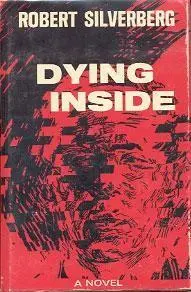
- Название:Dying Inside
- Автор:
- Издательство:Charles Scribner's Sons
- Жанр:
- Год:1972
- ISBN:0-684-13083-1
- Рейтинг книги:5 / 5. Голосов: 1
-
Избранное:Добавить в избранное
- Отзывы:
-
Ваша оценка:
Dying Inside: краткое содержание, описание и аннотация
Предлагаем к чтению аннотацию, описание, краткое содержание или предисловие (зависит от того, что написал сам автор книги «Dying Inside»). Если вы не нашли необходимую информацию о книге — напишите в комментариях, мы постараемся отыскать её.
As the novel progresses, Selig’s power grows more and more weak, working sporadically and sometimes not at all, and Selig struggles to maintain his grip on reality as he begins to lose an ability on which he has long since grown dependent.
Nominated for Nebula Award for Best Novel in 1972.
Nominated for Hugo Award for Best Novel in 1973.
Nominated for Locus Award in 1973.
Dying Inside — читать онлайн бесплатно полную книгу (весь текст) целиком
Ниже представлен текст книги, разбитый по страницам. Система сохранения места последней прочитанной страницы, позволяет с удобством читать онлайн бесплатно книгу «Dying Inside», без необходимости каждый раз заново искать на чём Вы остановились. Поставьте закладку, и сможете в любой момент перейти на страницу, на которой закончили чтение.
Интервал:
Закладка:
I hesitate briefly. The icy glare in her eyes gives her away. The aggressiveness. The resentment she feels. Even when she tries to be loving she can’t help hating. How fragile our relationship is! We’re locked in a kind of marriage, Judith and I, an old burned-out marriage held together with skewers. What the hell, though. “Yes,” I tell her. “I knew about it.”
“I thought so. You’ve never stopped probing me.” Her smile is all hateful glee now. She’s glad I’m losing it. She’s relieved. “I’m always wide open to you, Duv.”
“Don’t worry, you won’t be much longer.” Oh, you sadistic bitch! Oh, you beautiful ball-buster! And you’re all I’ve got. “How about some more spaghetti, Jude?” Sister. Sister. Sister.
FOURTEEN.
Yahya Lumumba
Humanities 2A, Dr. Katz
November 10. 1976
The use of the “Electra” motif by Aeschylus, Sophocles, and Euripides is a study in varying dramatic methods and modes of attack. The plot is basically the same in Aeschylus’ Choephori and the Electras of Sophocles and Euripides: Orestes, exiled son of murdered Agamemnon, returns to his native Mycenae, where he discovers his sister Electra. She persuades him to avenge Agamemnon’s murder by killing Clytemnestra and Aegisthus, who had slain Agamemnon on his return from Troy. The treatment of the plot varies greatly at the hands of each dramatist.
Aeschylus, unlike his later rivals, held as prime consideration the ethical and religious aspects of Orestes’ crime. Characterization and motivation in The Choephori are simple to the point of inviting ridicule—as, indeed, can we see when the more worldly-minded Euripides ridicules Aeschylus in the recognition scene of his Electra. In Aeschylus’ play Orestes appears accompanied by his friend Pylades and places an offering on Agamemnon’s tomb: a lock of his hair. They withdraw, and lamenting Electra comes to the tomb. Noticing the lock of hair, she recognizes it as being “like unto those my father’s children wear,” and decides Orestes has sent it to the tomb as a token of mourning. Orestes then reappears, and identifies himself to Electra. It is this implausible means of identification which was parodied by Euripides.
Orestes reveals that Apollo’s oracle had commanded him to avenge Agamemnon’s murder. In a long poetic passage, Electra steels Orestes’ courage, and he goes forth to kill Clytemnestra and Aegisthus. He obtains entrance to the palace by deception, pretending to his mother Clytemnestra that he is a messenger from far-off Phocis, bearing news of Orestes’ death. Once inside, he slays Aegisthus, and then, confronting his mother, he accuses her of the murder and kills her.
The play ends with Orestes, maddened by his crime, seeing the Furies coming to pursue him. He takes refuge in the temple of Apollo. The mystic and allegorical sequel, The Eumenides, sees Orestes absolved of blame.
Aeschylus, in short, was not overly concerned with the credibility of his play’s action. His purpose in the Oresteia trilogy was a theological one: to examine the actions of the gods in placing a curse upon a house, a curse stemming from murder and leading to further murder. The keynote of his philosophy is perhaps the line, “’Tis Zeus alone who shows the perfect way of knowledge. He hath ruled, men shall learn wisdom, by affliction schooled.” Aeschylus sacrifices dramatic technique, or at least holds it in secondary importance, in order to focus attention on the religious and psychological aspects of the matricide.
The Electra of Euripides is virtually at an opposite pole from the concept of Aeschylus; though he uses the same plot, he elaborates and innovates to provide far richer texture. Electra and Orestes stand out in relief in Euripides: Electra a near-mad woman, banished from the court, married to a peasant, craving vengeance; Orestes a coward, sneaking into Mycenae the back way, abjectly stabbing Aegisthus from behind, luring Clytemnestra to her doom by a ruse. Euripides is concerned with dramatic credibility, whereas Aeschylus is not. After the famous parody of the Aeschylean recognition scene, Orestes makes himself known to Electra not by his hair or the size of his foot, but rather by
Oh God. Oh shit. Shit shit shit. This is deadly. This is no fucking good at all. Could Yahya Lumumba have written any of this crap? Phony from Word One. Why should Yahya Lumumba give a shit about Greek tragedy? Why should I? What’s Hecuba to him or he to Hecuba, that he should weep for her? I’ll tear this up and start again. I’ll write it jivey, man. I’ll give it dat ole watermelon rhythm. God help me to think black. But I can’t. But I can’t. But I can’t. Christ, I’d like to throw up. I think I’m getting a fever. Wait. Maybe a joint would help some. Yeah. Let’s get high and try again. A lil ole stick of mootah. Get some soul into it, man. Smartass white Jew-bastard, get some soul into it, you hear? Okay, now. There was this cat Agamemnon, he was one big important fucker, you hear, he was The Man, but he got fucked all the same. His old lady Clytemnestra, she was makin’ it with this chickenshit muthafuck Aegisthus, and one day she say, Baby, let’s waste old Aggie, you and me, and then you gonna be king—gwine be king?—gonna—and we have a high ole time. Aggie, he off in the Nam runnin’ the show, but he come home for some R R and before he know what happenin’ they stick him good, right, they really cut him, and that all for him. Now there this crazy cunt Electra, dig, she the daughter of ole Aggie, and she get real uptight when they use him up, so she say to her brother, his name Orestes, she say, listen, Orestes, I want you to get them two muthafucks, I want you to get them real good. Now, this cat Orestes he been out of town for a while, he don’t know the score, but -
Yeah, that’s it, man! You’re digging it! Now go on to explain about Euripides’ use of the deus ex machina and the cathartic virtues of Sophocles’ realistic dramatic technique. Sure. What a dumb schmuck you are, Selig. What a dumb schmuck.
FIFTEEN.
I tried to be good to Judith, I tried to be kind and loving, but our hatred kept coming between us. I said to myself, She’s my kid sister, my only sibling, I must love her more. But you can’t will love. You can’t conjure it into existence on nothing more than good intentions. Besides, my intentions had never been that good. I saw her as a rival from the word go. I was the firstborn, I was the difficult one, the maladjusted one. I was supposed to be the center of everything. Those were the terms of my contract with God: I must suffer because I am different, but by way of compensation the entire universe will revolve about me. The girlbaby who was brought into the household was intended to be nothing more than a therapeutic aid designed to help me relate better to the human race. That was the deal: she wasn’t supposed to have independent reality as a person, she wasn’t supposed to have her own needs or make demands or drain away their love. Just a thing, an item of furniture. But I knew better than to believe that. I was ten years old, remember, when they adopted her. Your ten-year-old, he’s no fool. I knew that my parents, no longer feeling obliged now to direct all their concern exclusively toward their mysteriously intense and troubled son, would rapidly and with great relief transfer their attention and their love—yes, particularly their love—to the cuddly, uncomplicated infant. She would take my place at the center; I’d become a quirky obsolescent artifact. I couldn’t help resenting that. Do you blame me for trying to kill her in her bassinet? On the other hand you can understand the origin of her lifelong coldness toward me. I offer no defense at this late date. The cycle of hatred began with me. With me, Jude, with me, with me, with me. You could have broken it with love, though, if you wanted to. You didn’t want to.
Читать дальшеИнтервал:
Закладка:
Похожие книги на «Dying Inside»
Представляем Вашему вниманию похожие книги на «Dying Inside» списком для выбора. Мы отобрали схожую по названию и смыслу литературу в надежде предоставить читателям больше вариантов отыскать новые, интересные, ещё непрочитанные произведения.





Обсуждение, отзывы о книге «Dying Inside» и просто собственные мнения читателей. Оставьте ваши комментарии, напишите, что Вы думаете о произведении, его смысле или главных героях. Укажите что конкретно понравилось, а что нет, и почему Вы так считаете.