Robert Sawyer - Watch
Здесь есть возможность читать онлайн «Robert Sawyer - Watch» весь текст электронной книги совершенно бесплатно (целиком полную версию без сокращений). В некоторых случаях можно слушать аудио, скачать через торрент в формате fb2 и присутствует краткое содержание. Год выпуска: 2010, ISBN: 2010, Издательство: Ace Books, Жанр: Фантастика и фэнтези, на английском языке. Описание произведения, (предисловие) а так же отзывы посетителей доступны на портале библиотеки ЛибКат.
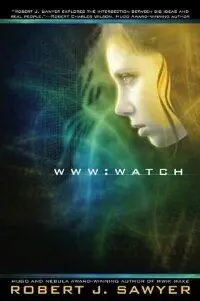
- Название:Watch
- Автор:
- Издательство:Ace Books
- Жанр:
- Год:2010
- ISBN:978-0-441-01818-5
- Рейтинг книги:5 / 5. Голосов: 1
-
Избранное:Добавить в избранное
- Отзывы:
-
Ваша оценка:
Watch: краткое содержание, описание и аннотация
Предлагаем к чтению аннотацию, описание, краткое содержание или предисловие (зависит от того, что написал сам автор книги «Watch»). Если вы не нашли необходимую информацию о книге — напишите в комментариях, мы постараемся отыскать её.
WATCH is convinced that Webmind represents a risk to national security and wants it purged from cyberspace. But Caitlin believes in Webmind’s capacity for compassion—and she will do anything and everything necessary to protect her friend.
Watch — читать онлайн бесплатно полную книгу (весь текст) целиком
Ниже представлен текст книги, разбитый по страницам. Система сохранения места последней прочитанной страницы, позволяет с удобством читать онлайн бесплатно книгу «Watch», без необходимости каждый раз заново искать на чём Вы остановились. Поставьте закладку, и сможете в любой момент перейти на страницу, на которой закончили чтение.
Интервал:
Закладка:
But by noon, she and her mom had to take a break—they had both skipped breakfast and were starving. And, while her mother was making sandwiches for them, Caitlin brought up something that had been bothering her for a few days. “So, um, Mom, I told Bashira that you’re a Unitarian.”
Everything was fascinating the first time you saw it; Caitlin watched as her mother spread something yellow on the bread. “Guilty as charged,” she replied.
She’d been aware back in Austin that her mother disappeared to “fellowships” several times a year—sometimes on a weeknight, sometimes on a Sunday morning—but that was really all she knew about it. “But, um, what does that mean, exactly? Bashira asked, and I didn’t know the answer.”
“In a nutshell? Unitarians are Christians who don’t believe Christ was divine.”
That surprised her. “So, you’re a Christian?”
Her mom was now dealing cold cuts onto the bread. “More or less. But it’s called Unitarianism as opposed to Trinitarianism—none of that Big Daddy, Junior, and the Spook stuff for us.”
“Still, aren’t Christians supposed to wear crosses?”
“Well, maybe if there are vampires in the area.”
Caitlin frowned. “A Christian who doesn’t believe Christ was divine? What does that even mean? I mean, if you don’t think Jesus is God’s son, then—then…”
Her mother poured two glasses of milk. “You don’t have to think Darwin is divine to be a Darwinian—you just have to think his teachings make sense.”
“Oh. I guess.”
She motioned for Caitlin to move out to the dining room, and she brought out two plates, each holding a sandwich, then brought out the glasses of milk. “Jesus is the guy who said, ‘Blessed are the peacemakers, ’ ” her mom said. “That seems pretty good to me.” She took a bite of her sandwich. “In fact, there’s a good game-theoretical basis for believing that. A guy named Robert Axelrod once organized a game-theory tournament. He asked people to submit computer programs designed to play against other computer programs in an iterated prisoner’s dilemma—that’s one where you keep playing the game over and over again. He wanted to find out what the optimal solution to the prisoner’s dilemma was.”
Caitlin took a bite of her own sandwich, and—ah, the yellow stuff had been mustard.
“There were fourteen entries,” her mother said. “And, to Axelrod’s surprise, the simplest entry—it required just five lines of computer code—won. It was called Tit for Tat, and it had been submitted by Anatol Rapoport, who, as it happens, was at the University of Toronto. Tit for Tat took a very simple approach: start with cooperation, then do whatever the other player did on the previous move. To put it another way, Tit for Tat starts off as a peaceful dove, and only becomes a hawk if you become one first. But as soon as you stop defecting, it goes back to cooperating—it’s a peacemaker, see?”
“Cool,” said Caitlin, taking another bite.
“Axelrod spent a lot of time trying to figure out why Tit for Tat beat everything else. He decided it was because of its combination of being nice, retaliatory, forgiving, and clear. By nice, he meant it was never the first to defect. And its retaliation—defecting back if you defected against it—discouraged the other side from continuing to defect after trying it once. Its forgiveness helped restore mutual cooperation—it didn’t hold a grudge; as soon as you went back to cooperating, it went back to cooperating, too. And by clarity, Axelrod meant Tit for Tat’s strategy was easily understandable by the other player.”
Caitlin thought about all that—a fair bit of complexity, and even the appearance of advanced, reasoned, ethical behavior—emerging from something so simple. It reminded her of—
Of course!
It reminded her of cellular automata, of the processes she could see in the background of the World Wide Web that had apparently given rise to Webmind: a simple rule or set of rules that caused packets in the background to flip back and forth between two states, generating complex patterns. Could an endlessly iterating prisoner’s dilemma, or some other game-theoretical problem, be the rule underlying Webmind’s consciousness? That’d be cool.
But something else was puzzling her, too. “Why’s it called Tit for Tat? What do tits have to do with it?”
Her mother tried to suppress a grin. “It’s an old phrase, and it’s been distorted over the years. It used to be tip for tap —and both ‘tip’ and ‘tap’ mean to strike lightly and sharply.”
“Oh.” Not nearly as interesting. “You called Tit for Tat a peacemaker—but isn’t tipping and tapping really all about getting even?”
“Well, that’s one way of looking at it; it is retaliatory.”
“And, um, you said that this has something to do with Jesus. Getting even is so Old Testament. The New Testament has Jesus saying—um, something about not doing that.”
Caitlin’s mother astonished her by quoting scripture—accurately, she presumed; it was something she’d never heard her do before. “ ‘Ye have heard that it hath been said, An eye for an eye, and a tooth for a tooth: But I say unto you, That ye resist not evil: but whosoever shall smite thee on thy right cheek, turn to him the other also.’ ”
“Um,” said Caitlin. “Yeah. Like that.” She paused. “So, what’s the game-theoretical strategy for that? ”
“That’s what we call Always Cooperate—or AllC, for short, “All” and the letter C: you cooperate no matter what the other person does. Except…”
“Yes?”
“Well, there’s more to it than that. The next verses say, ‘And if any man will sue thee at the law, and take away thy coat, let him have thy cloak also. And whosoever shall compel thee to go a mile, go with him twain.’ ‘Twain’ means ‘two’—that’s where the phrase ‘go the extra mile’ comes from. So, it’s all about not just giving them what they want, but giving them more than they asked for. I don’t know, call it DoubleAllC, or something like that.”
“But… hmmm.” Caitlin frowned. “I mean, you can’t play DoubleAllC very long—you’ll run out of stuff.” But then she got it. “Ah, but that’s the Christian thing, right? The reward isn’t in this life, it’s in the next one.”
“For a lot of Christians, yes.”
“But, um, if you don’t believe Christ is divine, Mom, do you believe in heaven?”
“No. When you die, you’re gone.”
“So does DoubleAllC, or even just plain old Always Cooperate, really make sense for a Unitarian—for someone who doesn’t believe there’s a reward to be had in an afterlife? I mean, DoubleAllC and AllC can’t win unless they’re playing against people using the same strategy. And you obviously aren’t —not in the scenario described: you’ve been struck on one cheek first, so you know you’re playing against someone who defects at least part of the time. In what game-theory way does turning the other cheek make sense? I mean, presumably the other guy is just going to hit you again.”
Her mother lifted her eyebrows. “Ah, but see, you’re missing something. The easiest games to model are two-person games, but real life is an n -person game: it involves a large and variable number of players. You might lose a lot to one person, but gain more than you expected from someone else. Person A might be cruel to you, but person B, seeing that, might be even more kind to you because of it. And when you’re playing with a lot of people, the game goes on indefinitely—and that makes a huge difference. The examples in the Old Testament couldn’t be endlessly iterated: an eye for an eye can only go two rounds—after that, you’re out of eyes. Even a tooth for a tooth ends after a maximum of thirty-two rounds.”
Читать дальшеИнтервал:
Закладка:
Похожие книги на «Watch»
Представляем Вашему вниманию похожие книги на «Watch» списком для выбора. Мы отобрали схожую по названию и смыслу литературу в надежде предоставить читателям больше вариантов отыскать новые, интересные, ещё непрочитанные произведения.




Обсуждение, отзывы о книге «Watch» и просто собственные мнения читателей. Оставьте ваши комментарии, напишите, что Вы думаете о произведении, его смысле или главных героях. Укажите что конкретно понравилось, а что нет, и почему Вы так считаете.