Robert Sawyer - Watch
Здесь есть возможность читать онлайн «Robert Sawyer - Watch» весь текст электронной книги совершенно бесплатно (целиком полную версию без сокращений). В некоторых случаях можно слушать аудио, скачать через торрент в формате fb2 и присутствует краткое содержание. Год выпуска: 2010, ISBN: 2010, Издательство: Ace Books, Жанр: Фантастика и фэнтези, на английском языке. Описание произведения, (предисловие) а так же отзывы посетителей доступны на портале библиотеки ЛибКат.
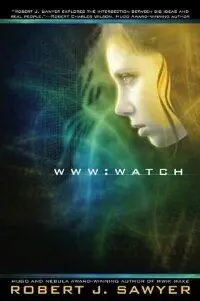
- Название:Watch
- Автор:
- Издательство:Ace Books
- Жанр:
- Год:2010
- ISBN:978-0-441-01818-5
- Рейтинг книги:5 / 5. Голосов: 1
-
Избранное:Добавить в избранное
- Отзывы:
-
Ваша оценка:
Watch: краткое содержание, описание и аннотация
Предлагаем к чтению аннотацию, описание, краткое содержание или предисловие (зависит от того, что написал сам автор книги «Watch»). Если вы не нашли необходимую информацию о книге — напишите в комментариях, мы постараемся отыскать её.
WATCH is convinced that Webmind represents a risk to national security and wants it purged from cyberspace. But Caitlin believes in Webmind’s capacity for compassion—and she will do anything and everything necessary to protect her friend.
Watch — читать онлайн бесплатно полную книгу (весь текст) целиком
Ниже представлен текст книги, разбитый по страницам. Система сохранения места последней прочитанной страницы, позволяет с удобством читать онлайн бесплатно книгу «Watch», без необходимости каждый раз заново искать на чём Вы остановились. Поставьте закладку, и сможете в любой момент перейти на страницу, на которой закончили чтение.
Интервал:
Закладка:
“How?”
“Actually,” said LaFontaine, “it was one of our international allies who uncovered it. As you can imagine, we’re all vigilant in matters of Internet security, especially after the Chinese aggression last month. Now, if you’d kindly let us know how this Webmind is physically created…?”
“Why?”
Malcolm was looking at the hardwood, noting an unfortunate scratch in it; he had no idea if LaFontaine’s expression had changed, but his tone certainly had. “Because, as I’m sure you can appreciate, an emergent AI might present a threat. Because there is all sorts of sensitive information on the Web. Because, sir, it’s our job to be on top of things.”
Malcolm said nothing, and after a moment LaFontaine spoke again. “Look, Professor Decter, we’re sympathetic to the issues, really we are. I have a doctorate in computer science.”
“Where?” said Malcolm.
“Where did I study? Undergrad at Université Laval; grad school at the University of Calgary.”
“When?”
“I received my Ph.D. in 1997. Again, it really is imperative that we debrief you about this. It’s SOP.”
Malcolm briefly looked up. “What?”
“Standard operating procedure,” said LaFontaine. “Although, I grant you, nothing like this has ever happened before. Still, we don’t wish to use a stick when we might offer a carrot. Your work permit is temporary, and your wife’s, as I understand it, is tied up in red tape. Obviously it’s in the interests of Canada to expedite any immigration and employment issues related to the two of you.” Malcolm caught the spreading of LaFontaine’s arms out of the corner of his eye. “Believe me, we are always happy to see the brain drain working in reverse for a change. Perhaps your wife would like a job with Wilfrid Laurier? ”
Malcolm said, “Who?”—but he actually knew the answer. That was the name of the smaller of the two universities here in Waterloo. In fact, he even knew that Wilfrid Laurier had been the seventh prime minister of Canada, and that he’d lucked into academic immortality when Waterloo Lutheran University had changed its name to something secular in order to secure public funding—and they hadn’t wanted to throw out the monogrammed towels.
Malcolm felt his heart racing—not because he was frightened by the CSIS agents, but rather because he was running out of rhetorical ammunition. There hadn’t been a lot of treatment available for autistics when he’d been a teenager, but one of the therapists had had him memorize the Kipling poem that began:
I keep six honest serving-men
(They taught me all I knew);
Their names are What and Why and When
And How and Where and Who
The therapist had told him when he needed to talk to strangers to just ask those questions; most people, she said, would be happy to answer at length. But now he had to say something more, and, after taking a deep breath, he did.
“All right,” he said. “Since you asked, Webmind is an emergent quantum-computational system based on a stable null-sigma condensate that resists decoherence thanks to constructive feedback loops.” He turned to the blackboard, scooped up a piece of chalk, and began writing rapidly.
“See,” he said, “using Dirac notation, if we let Webmind’s default conscious state be represented by a bra of phi and a ket of psi, then this would be the einselected basis.” His chalk flew across the board again.
“Now, we can get the vector basis of the total combined Webmind alpha-state consciousness system by tensor multiplying the basis vectors of the subsystems together. Of course, the unitarity of time-evolution demands that the total state basis remains orthonormal, and since consciousness requires a superposition of—”
“I—I’m not following,” said LaFontaine.
Malcolm allowed himself a small smile. “Ludwig Silberstein once said to Arthur Eddington, ‘You must be one of the three people in the world who understand relativity.’ To which Eddington replied, ‘I’m trying to figure out who the third person is.’ ” He turned, and did manage to hold LaFontaine’s gaze for a moment. “Actually, I suspect there are a few people in this building who might follow this, too. How widely would you like me to disseminate information about Webmind?”
“We don’t want you to disseminate it at all, Professor. But since you do seem to understand all this, we need you to come to Ottawa, and—”
“Do you know who is in this building right now? Stephen Hawking. I uprooted my family, I took my blind daughter away from her friends and a specialized school that she’d been in for a decade— I changed things —so that I could work here, and work with Hawking. He only comes here once a year, and I’m not going to waste any more time. I’ll happily discourse further on Webmind’s workings, but I’m not going anywhere. You’ll have to bring someone here who can follow what I’m saying.”
LaFontaine took out a small digital camera and photographed the blackboard. “All right, Professor. But don’t leave town.”
Malcolm spread his arms in exasperation. “Where would I go? This is the center of the universe.”
twenty-nine
Shoshana drove Maxine to UCSD early Wednesday morning; she was an engineering student there. As Max prepared to get out of the car, she said, “Dr. Zira, I’d like to kiss you good-bye.”
Shoshana grinned at the ritual. “All right—but you’re so damned ugly!”
Maxine smiled and they kissed for several seconds.
Sho and Max had watched the end of the Apes saga last night: Battle for the Planet of the Apes. Maxine had been immediately incensed because they had changed the color of Roddy McDowall’s makeup. When he’d been playing Caesar as a rebellious leader of a slave uprising, they’d given him quite dark skin. Now, in this film set many years later, Caesar was the peaceful, wise leader of a new ape civilization—and he’d been given a downright Caucasian complexion.
Shoshana, meanwhile, had complained that the final film had suffered from its obviously low budget: mutants, scarred by a nuclear blast, had attacked the ape city in a school bus of all things! But Max had said, “No, no, no, don’t you see—it’s brilliant! A school bus! It’s a metaphor about forced integration.”
Shoshana dearly loved Max, but she thought that was going a bit too far. Still, for her own part, she’d been astonished to see that that movie featured an orangutan named Virgil, who was the smartest of all apes. She’d always thought the Feehan’s pride and joy had been named for the Roman poet, but it seemed Hobo’s buddy was actually called that in honor of this character.
Virgil had been portrayed in Battle by Paul Williams. Shoshana had checked the IMDb; she was curious about what the actors who had portrayed apes looked like without their makeup. In the case of Williams, it was hardly an improvement, sad to say. But she’d been surprised to learn that he was a songwriter, and had written “We’ve Only Just Begun,” “Just an Old-Fashioned Love Song,” and many others.
As Shoshana drove along, she wondered if Virgil—the real Virgil—had spoken with Hobo today. Hobo was usually up at the crack of dawn, and it was three hours later in Miami, so Virgil should be up, too. God, she hoped so; she hoped Hobo was still reachable by someone.
The 7-Eleven was coming up. She pulled into the parking lot and went inside to get a coffee. The pimply young man was behind the counter. He knew enough not to call her “the ape lady,” but he still wasn’t great about understanding where the boundaries were. “What happened to your ponytail?” he asked.
Читать дальшеИнтервал:
Закладка:
Похожие книги на «Watch»
Представляем Вашему вниманию похожие книги на «Watch» списком для выбора. Мы отобрали схожую по названию и смыслу литературу в надежде предоставить читателям больше вариантов отыскать новые, интересные, ещё непрочитанные произведения.



Обсуждение, отзывы о книге «Watch» и просто собственные мнения читателей. Оставьте ваши комментарии, напишите, что Вы думаете о произведении, его смысле или главных героях. Укажите что конкретно понравилось, а что нет, и почему Вы так считаете.