Robert Sawyer - Watch
Здесь есть возможность читать онлайн «Robert Sawyer - Watch» весь текст электронной книги совершенно бесплатно (целиком полную версию без сокращений). В некоторых случаях можно слушать аудио, скачать через торрент в формате fb2 и присутствует краткое содержание. Год выпуска: 2010, ISBN: 2010, Издательство: Ace Books, Жанр: Фантастика и фэнтези, на английском языке. Описание произведения, (предисловие) а так же отзывы посетителей доступны на портале библиотеки ЛибКат.
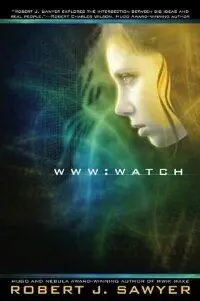
- Название:Watch
- Автор:
- Издательство:Ace Books
- Жанр:
- Год:2010
- ISBN:978-0-441-01818-5
- Рейтинг книги:5 / 5. Голосов: 1
-
Избранное:Добавить в избранное
- Отзывы:
-
Ваша оценка:
Watch: краткое содержание, описание и аннотация
Предлагаем к чтению аннотацию, описание, краткое содержание или предисловие (зависит от того, что написал сам автор книги «Watch»). Если вы не нашли необходимую информацию о книге — напишите в комментариях, мы постараемся отыскать её.
WATCH is convinced that Webmind represents a risk to national security and wants it purged from cyberspace. But Caitlin believes in Webmind’s capacity for compassion—and she will do anything and everything necessary to protect her friend.
Watch — читать онлайн бесплатно полную книгу (весь текст) целиком
Ниже представлен текст книги, разбитый по страницам. Система сохранения места последней прочитанной страницы, позволяет с удобством читать онлайн бесплатно книгу «Watch», без необходимости каждый раз заново искать на чём Вы остановились. Поставьте закладку, и сможете в любой момент перейти на страницу, на которой закончили чтение.
Интервал:
Закладка:
Caitlin paused typing long enough to think about the book she’d recently read at the suggestion of Bashira’s dad: The Origin of Consciousness in the Breakdown of the Bicameral Mind by Julian Jaynes. It wasn’t quite the same argument, but it amounted to the same thing: until all thought was integrated—until there was just one point of view—real consciousness couldn’t exist.
Maybe Kuroda was contemplating the same thing because he said, “In fact, although our brains consist of two hemispheres, they go out of their way to consolidate thought into a single perspective. You know what they say: the left hemisphere is the analytical or logical side, and the right hemisphere is the artistic or emotional side, yes?”
“Yes,” said her mom, and “Right,” said Caitlin.
“Forgive me, Miss Caitlin. I know you have vision in only one eye, but, Barb, if you were to read text with just your left eye, shouldn’t you have an analytical response, while if you read it with your right eye, shouldn’t the response be more emotional? Shouldn’t we give each student an eye patch, and tell them to move it to the left or the right depending on whether they’re reading a physics textbook or a novel for their literature class?”
Caitlin thought about this. She’d once asked Kuroda why he had chosen to put his implant behind her left retina instead of her right one. He’d joked it was because Steve Austin’s left eye had been the bionic one—which had sent her to Google to find out what he meant.
“But we don’t do that,” Kuroda went on. “We don’t give students eye patches—because the brain responds exactly the same way regardless of which one of the two eyes is receiving the input. That’s because your left optic nerve does not feed just into your left hemisphere, nor does your right optic nerve feed just into your right hemisphere. Rather, each optic nerve splits in two in the center of the brain at the optic chiasma in what’s called a partial decussation. Half the signal from the left eye goes to the left hemisphere, and the other half goes to the right. It’s an awfully complex bit of wiring, and evolution doesn’t do things that are complex unless they confer a survival advantage.”
He paused, as if waiting for Caitlin or her mom to chime in with what that advantage might be. After a moment, he went on, his voice triumphant: “And that advantage must be consciousness, must be the unification of sensory input to produce a single perspective, a single point of view.”
“But I was born blind,” said Caitlin, letting her fingers rest. “And I’ve been conscious my whole life without the sharing of sight across both hemispheres.”
“True, but your brain was hardwired for it regardless. I’ve seen your MRIs, remember—you’ve got a perfectly normal brain; the only flaw you were born with was in your retinas. Anyway,” he said, and she resumed typing, “evolution went out of its way to make sure we’ve only got one perspective, one point of view. A bird can’t fly both left and right at the same time; a person can’t think about both this and that at the same time. Consciousness is singular. It’s cogito ergo sum, I think, therefore I am; it’s not cogitamus ergo sumus —it’s not we think, therefore we are. Even in cases of a severed corpus callosum, the brain still retains its single perspective; again, evolution has gone out of its way to make sure that unitary consciousness survives even something as traumatic as cutting the major communications trunk between the hemispheres.”
Caitlin’s mom looked at her but said nothing. Dr. Kuroda went on. “And it’s not just that a directional perspective gives rise to your own consciousness; it also gives rise to your awareness that others have consciousness, too. It’s what’s called theory of mind: the recognition that other people have beliefs, desires, and intentions of their own, and that those might be different from yours. And, again, that comes from you having a single point of view.”
“How so?” asked Caitlin’s mom.
“It’s only because you have a limited perspective that you understand that the person facing you must be seeing something completely different from what you’re seeing as you face him. Are you in Miss Caitlin’s room now?”
“Yes,” said her mom.
“Well, if we were facing each other there, you might be seeing the window and the outside world, and I might be seeing the door and the hallway beyond—not only are we seeing completely different things, but you understand that we are. Your limited perspective lets you know that my point of view is different. And there are those terms again: ‘perspective, ’ ‘point of view’! Thought and vision are inexorably connected in our brains.”
“But what about blind people?” asked Caitlin, taking another break from typing.
“Again, you don’t actually need the vision, just the neural infrastructure geared for a single point of view.” He paused. “Look, if having eyes in the back of our heads really was an improvement, we’d have them. Mutants with extra eyes are born periodically today, and probably have been throughout vertebrate history—and if that had conferred a survival advantage, the mutation would have spread. But it didn’t. Having one point of view—having consciousness and being able to understand that what the predator sees is different from what you see—trumps even being able to see things approaching you from behind.”
Caitlin was wrestling with the implications of this, but it was her mother who got it first. “And Webmind sees through Caitlin’s eye, right? Caitlin is his window on our world.”
Caitlin found herself looking down, pleased but a tad embarrassed that the conversation had suddenly come around to her, and—
And she saw what Webmind had written at the end of her transcript of Kuroda’s comments, glowing blue: You really did uplift me. You gave me the perspective and point of view and focus I needed to become truly conscious. Without you, I wouldn’t exist.
Caitlin looked up and allowed herself a warm, satisfied smile. “Go me!” she said.
thirteen
“What the hell happened?” demanded Tony Moretti. He was standing at the side of the WATCH mission-control room again. Peyton Hume was next to him, somewhat higher up on the sloping floor; although he was shorter than Tony, they were now seeing eye to eye.
Shel Halleck was back at his workstation in the third row. “I’m not sure,” he called out. “There was a sudden surge in traffic associated with the AI, and then it just froze. And Caitlin Decter—or someone in her house—kept sending it IMs saying it should ‘break the links.’ ”
“Why?” asked Tony.
“I’m not sure,” Shel said again.
“I’m getting tired of hearing that,” Tony snapped. In fact, he was getting tired, period.
“There seem to be limits to its processing capacity,” Peyton Hume offered. “That suggests at least some models of how it might be composed—and eliminates some other ones. In fact…”
“Yes?” said Tony.
“Well,” the colonel said, “remember what the Chinese did last month? I don’t mean the slaughter; I mean how they tried to keep word about it from getting out. They cut off almost all communication with the outside world for several days, including the Internet. Perhaps it’s not a coincidence that the cleaving then reunification of so large a part of the Internet preceded the emergence of this entity. That suggests there’s a critical threshold of components required to keep it going—and that at least some of them are in China.”
“All right,” said Tony. “It’s a lead, anyway. Shel, Aiesha, let’s find out precisely where the damned thing resides. If the president does give the kill order, I want us to be ready to implement it at once.”
Читать дальшеИнтервал:
Закладка:
Похожие книги на «Watch»
Представляем Вашему вниманию похожие книги на «Watch» списком для выбора. Мы отобрали схожую по названию и смыслу литературу в надежде предоставить читателям больше вариантов отыскать новые, интересные, ещё непрочитанные произведения.





Обсуждение, отзывы о книге «Watch» и просто собственные мнения читателей. Оставьте ваши комментарии, напишите, что Вы думаете о произведении, его смысле или главных героях. Укажите что конкретно понравилось, а что нет, и почему Вы так считаете.