Robert Sawyer - Watch
Здесь есть возможность читать онлайн «Robert Sawyer - Watch» весь текст электронной книги совершенно бесплатно (целиком полную версию без сокращений). В некоторых случаях можно слушать аудио, скачать через торрент в формате fb2 и присутствует краткое содержание. Год выпуска: 2010, ISBN: 2010, Издательство: Ace Books, Жанр: Фантастика и фэнтези, на английском языке. Описание произведения, (предисловие) а так же отзывы посетителей доступны на портале библиотеки ЛибКат.
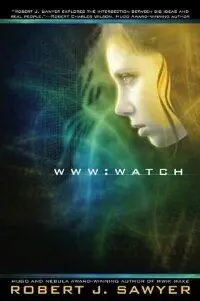
- Название:Watch
- Автор:
- Издательство:Ace Books
- Жанр:
- Год:2010
- ISBN:978-0-441-01818-5
- Рейтинг книги:5 / 5. Голосов: 1
-
Избранное:Добавить в избранное
- Отзывы:
-
Ваша оценка:
Watch: краткое содержание, описание и аннотация
Предлагаем к чтению аннотацию, описание, краткое содержание или предисловие (зависит от того, что написал сам автор книги «Watch»). Если вы не нашли необходимую информацию о книге — напишите в комментариях, мы постараемся отыскать её.
WATCH is convinced that Webmind represents a risk to national security and wants it purged from cyberspace. But Caitlin believes in Webmind’s capacity for compassion—and she will do anything and everything necessary to protect her friend.
Watch — читать онлайн бесплатно полную книгу (весь текст) целиком
Ниже представлен текст книги, разбитый по страницам. Система сохранения места последней прочитанной страницы, позволяет с удобством читать онлайн бесплатно книгу «Watch», без необходимости каждый раз заново искать на чём Вы остановились. Поставьте закладку, и сможете в любой момент перейти на страницу, на которой закончили чтение.
Интервал:
Закладка:
It took Shoshana an hour to shower, get dressed, and drive out to the Marcuse Institute, stopping along the way at the 7-Eleven (where, mercifully, an older female clerk was on duty) to grab a bran muffin and a coffee.
Dr. Marcuse had an apartment in San Diego proper, but he mostly slept at the Institute that bore his name. Enculturating an ape was like raising a child; it was more than a full-time job. Sho checked in with him, got some raisins, then headed out back to say hi to Hobo.
The ape looked up as she approached even though the wind was going the wrong way for him to have caught her scent. She sometimes wondered how good his eyesight was. It seemed fine, but there was no way to get him to read an eye chart. Still, it would be fascinating to know if he simplified her form so much in his paintings because his style was minimalist, or just because all he really saw when he looked at her across the gazebo was fuzzy blotches of color.
Good morning, Shoshana signed as she closed the distance.
He didn’t reply, and, again, thoughts that his vision might not be that good crossed her mind. She waited until she was just six feet away from him and tried again; she often signed to him from such a distance, and he’d never had any trouble following along.
But there was still no reply.
A small bird was hopping across the grass, as oblivious to the two primates as its dinosaurian ancestors had been to the mammals of long ago. Hobo eyed the bird sullenly.
What’s wrong? signed Shoshana.
She was used to Hobo greeting her with a hug; indeed, most days he ran over on all fours to meet her. But today he just sat there. He sometimes did that during the hottest summer afternoons, but it was October 6 now and still early morning.
Hobo sick? Shoshana asked.
He removed his hand from under his jaw as if he was going to use it to sign a reply, but, after a moment, he just let it fall.
She held up a Ziploc bag containing some raisins—it was economical to buy them in a big box, but she couldn’t bring the whole box out, or he’d want to eat them all. Treat? she said.
He usually held out a hand, long black fingers curled up, but this time he simply shifted his position, and, as Sho went to open the bag, his arm shot out, quick as a snake, and grabbed it.
No! signed Shoshana. Bad! Bad!
He looked momentarily contrite and spread his long arms, the bag of raisins still firmly grasped in his left hand, as if inviting her for a hug. She smiled and moved closer, and he reached behind her head with his right hand, and—
And he suddenly yanked hard on her ponytail.
“Shit!” She jumped backward and stood, hands on hips, looking at the ape. “Bad Hobo!” she said, scolding him with words spoken aloud, something she only did when really angry with him. “Bad, bad Hobo!”
Hobo let out a pant-hoot and ran away, using both legs and his right arm to propel himself across the grass; in his left hand, he was still clutching the raisins.
She gingerly patted the back of her head with her palm. When she moved the hand in front of her face, she could see it was freckled with blood.
twelve
Caitlin pushed the button on her eyePod, switching back to simplex mode. The glowing lines of webspace were replaced by what she’d dubbed “worldview”—the reality she shared with the rest of humanity, which, just then, consisted of her blue-walled bedroom with multicolored autumn leaves visible through the window.
Her mother entered, having crossed the hallway from her office.
Blue letters were glowing in her notebook’s IM window: Thank you, Caitlin!
Caitlin typed back, Whew! You’re welcome! You OK now?
I believe so.
Don’t do that again. Don’t try to multitask, or form multiple links.
I won’t. But I would like to know what went wrong.
So would I, Caitlin typed—but her mom gave it more direct voice, demanding: “What the hell happened?”
Kuroda was still on the speakerphone from Tokyo. “As Miss Caitlin said, it was multitasking.”
“So?” replied her mom. “Computers do that all the time.”
“Forgive me, Barb,” Kuroda said, “but, first, Webmind is not a computer, and, second, no, they don’t.”
Dr. Kuroda is explaining, Caitlin sent to Webmind. Here—I’ll type in what he says.
“A typical computer,” continued Kuroda, “seems to be doing many different things at once, but it’s only an illusion due to its incredible speed. Up until recently, few computers had more than one processor, and that single processor only ran one program at a time. In order to apparently multitask, the processor switched rapidly between programs, devoting little slices of time to each program in succession, but it never actually did multiple things simultaneously.”
Caitlin was a fast typist; typing what the teacher said was how she took notes in school, so transcribing Kuroda for Webmind, with only a few omissions, wasn’t hard.
He went on: “More modern computers do have multicore processors or multiple processors which can, to a very limited degree, do more than one job at once… provided that the programs have been written to take advantage of this ability, which often isn’t the case. But computers are dumb as posts; they don’t think, and they aren’t conscious. And consciousness, you see—and I mean precisely that: you see —is incompatible with multitasking.”
Her mom walked over to the desk and sat on the swivel chair. “How come?” she said.
“I’m a vision researcher,” Kuroda said, “so my take on all this is perhaps skewed.” But then his tone changed, as if he were tiptoeing around a delicate subject. “I know you are Americans, and, um, you’re from the South, I believe.”
Caitlin paused typing long enough to say, “Don’t mess with Texas.”
“Um, do you… do you believe in evolution?”
She laughed, and so did her mom. “Of course,” her mom said.
Kuroda sounded relieved. “Good, good, I—forgive me; I’m sure we don’t get an accurate picture of America here in Japan. You know we evolved from fish, right?”
“Right,” said Caitlin, and then she went back to typing.
“Well,” said Kuroda, “let’s consider that ancestral fish: it had two eyes, one on each side of its head. And it therefore had two different fields of view—and they didn’t overlap at all. It simultaneously had two perspectives on its world, yes?”
“Okay,” said her mom.
“Somewhere along the line,” Kuroda continued, “evolution decided that it was better to have those fields of view overlap, because that gave depth perception. Prior to that, our fishy ancestor pretty much had to assume that if two other fish were in its fields of view, the bigger one was closer. But, in fact, the bigger one might actually be bigger but be farther away; the small one might be close by, and be about to take a bite out of you. By the time that fish had evolved into a mammal-like reptile, it had overlapping fields of vision, and that gave it depth perception. And even though overlapping visual fields meant a narrowing of the angle of view, the advantages of perceiving depth outweighed that loss.”
“Hang on a minute,” Caitlin said. “I’m transcribing what you’re saying for Webmind… okay, go on.”
“Along with stereoscopic vision,” Kuroda said, “suddenly the notion of looking at this as opposed to that —of shifting one’s gaze, of concentrating one’s attention—was born. Our very words for describing consciousness come from this: attention, perspective, point of view, focus.”
Читать дальшеИнтервал:
Закладка:
Похожие книги на «Watch»
Представляем Вашему вниманию похожие книги на «Watch» списком для выбора. Мы отобрали схожую по названию и смыслу литературу в надежде предоставить читателям больше вариантов отыскать новые, интересные, ещё непрочитанные произведения.





Обсуждение, отзывы о книге «Watch» и просто собственные мнения читателей. Оставьте ваши комментарии, напишите, что Вы думаете о произведении, его смысле или главных героях. Укажите что конкретно понравилось, а что нет, и почему Вы так считаете.