Jack Chalker - Priam's Lens
Здесь есть возможность читать онлайн «Jack Chalker - Priam's Lens» весь текст электронной книги совершенно бесплатно (целиком полную версию без сокращений). В некоторых случаях можно слушать аудио, скачать через торрент в формате fb2 и присутствует краткое содержание. Год выпуска: 1999, ISBN: 1999, Издательство: Del Rey / Ballantine, Жанр: Фантастика и фэнтези, на английском языке. Описание произведения, (предисловие) а так же отзывы посетителей доступны на портале библиотеки ЛибКат.
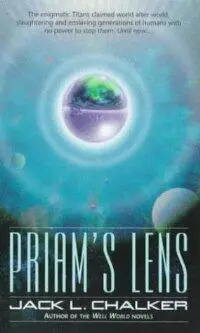
- Название:Priam's Lens
- Автор:
- Издательство:Del Rey / Ballantine
- Жанр:
- Год:1999
- ISBN:0-345-40294-4
- Рейтинг книги:3 / 5. Голосов: 1
-
Избранное:Добавить в избранное
- Отзывы:
-
Ваша оценка:
Priam's Lens: краткое содержание, описание и аннотация
Предлагаем к чтению аннотацию, описание, краткое содержание или предисловие (зависит от того, что написал сам автор книги «Priam's Lens»). Если вы не нашли необходимую информацию о книге — напишите в комментариях, мы постараемся отыскать её.
Priam's Lens — читать онлайн бесплатно полную книгу (весь текст) целиком
Ниже представлен текст книги, разбитый по страницам. Система сохранения места последней прочитанной страницы, позволяет с удобством читать онлайн бесплатно книгу «Priam's Lens», без необходимости каждый раз заново искать на чём Вы остановились. Поставьте закладку, и сможете в любой момент перейти на страницу, на которой закончили чтение.
Интервал:
Закладка:
“You don’t have one of your own?”
“No, most career Navy don’t. If you decide on a family, you wind up on a base and on port duty, period. You don’t go into space again unless you take the family with you, and Navy vessels aren’t built for real families. Spacers just don’t have homes except our ships. A lot of us are orphans—of which there’s a ton now that migration has turned to refugees overrunning all creation—or greatly estranged. Just make sure that when you decide to settle down, you settle down in a place you can grow old and die happy in.”
She stared at him with sad big brown eyes. “And where’s that, Mister Harker? Where’s that?”
“That’s the problem, isn’t it? If we could just make a jump to another arm, we’d have an escape route, but nobody who’s ever tried it ever came back. I dunno. So, let’s get on a happier note. What is your specialty, anyway?”
“Retrogressed cultures,” she responded. “There’s a ton of them out there even now. Early religious colonies that got themselves deliberately lost and wound up building very primitive societies when they were cut off from The Confederacy, social experimenters, political radicals wanting to build their own colonies, that kind of thing. Mostly they cut themselves off on marginal worlds off the beaten tracks centuries ago, and they all thought, of course, that they could build a higher or better culture with no dependence on the old system. In many cases it’s less anthropology than recent archaeology, since they die out a lot. The ones that succeed can quickly become bizarre, even in a few short generations. They are, however, the finest living laboratories on human behavior and cultural evolution that exist, particularly since it’s unethical to deliberately do it to people or groups.”
“Got an example?”
“Hundreds, but I’ll just be general for now. The one rule we have found to be eighty percent true: people as a group will survive under the most incredible conditions, and sometimes even thrive. There is a significant deviation but primarily as a group dynamic—a charismatic leader or some such who leads the desperate and trapped group to mass ritual suicide or the like. For the most part, however, people find a way, often by doing things that would have been inconceivable to them before. We’ve found cannibalism developing in desperate situations far more than we’d thought, for one thing, and even if they find a way to get around needing it as an emergency food source, it tends to remain as ritual. The general consensus is that the first practitioners are unwilling. They must eat some of their number to get out of a particularly nasty situation or they all die. After that, they have to justify it to themselves or they feel guilty, often consumed by guilt and nightmares. So, to deal with it as a survival practice rather than as a one-time thing, it becomes some kind of religious experience.”
“Seems to me that if you began eating your fellow human beings, you’d soon not have any fellow human beings. The last two survivors would be hunting each other,” he noted.
“No, no! It’s counterproductive if you do that, and you’re right, they’d all die. But suppose you were trapped by a seasonal thing—subzero cold and snow, or a long dormancy before crops appear, or a drought. Then it becomes more of an imperative, and after that it becomes something you have to justify to posterity. You keep it alive in limited form as a ritual—as many early human civilizations did back on our ancestral world—so that if the need arises you won’t have to go through heavy moral judgments or angry fights to do it.”
He considered it. “I often wonder what happened to any survivors who weren’t captured or whatever the Titans do to survivors after one of those worlds gets changed. You think they survive, maybe underground?”
“Oh, I think they survive even on the surface. The Titans’ ultimate objective appears to be, well, gardening.”
“Huh?” He’d been dodging and weaving around the bastards for decades but he’d never heard that before.
She nodded. “The worlds they remake are uniformly in a temperate range that runs from sixteen to forty-eight degrees Celsius. That’s basically subtropical to almost hot-house, but it’s entirely within the life range of our race. Much of it is simply reseeded with Titan variations of local flora that can stand up to this range, lots of trees, lots of nutrient grains and grasses, but in the center of each growing area is a vast swath of, well, gigantic and exotic-looking alien flowers. You’ve certainly seen the photos. That’s what they do. They move in and they start planting and raising exotic flowers. Perhaps they compete at Titan flower shows. Who knows? At any rate, on a majority of worlds they use hybrids we’ve introduced there in the past for fruit and grain, even things like vegetables and sugar cane and the like. It’s possible to sustain a fair population on that.”
“I knew about that. But they’d have to keep their numbers low to avoid attracting attention to themselves, and they’d be limited to totally non-powered tools. Kind of an animal-like existence. I’ve seen surveys of worlds after a few decades that can show life-form densities, and we’ve never picked up anything that might be a significant population of humans. They’re down there, but they’re few and scattered.”
“Yes, but they’re still there. I would love to be able to find out what sort of life they were living down there.”
“You could—but you’d be stuck living it for the rest of yours.”
She sighed. “I know. Well, let’s face it, Mis… Gene. The way things are going, that may be the only place we’ll have to settle down and have families after a while. That and on gypsy ships wandering around space and trying to avoid the shiny new masters.”
It was not a thought he liked to dwell on much.
The evening didn’t end up in any kind of romantic tryst, nor had he expected it to, but he did take her out for a bit of play in a sim arcade—where she proved pretty good at the rather basic scenarios the game companies created—and even a bit of dancing. When it was very late, he took her back to the spaceport personally and called for the shuttle.
“Thank you,” she sighed. “I had a wonderful time, and I really, really needed it.” She paused. The smile and glow faded. “I guess this is goodbye, though, huh? Unless we’re stuck here for another eternity, this is it. I’ll go one way, you’ll eventually go another, and even if we meet we might be fifty years apart in age. I might look like Anna Marie and you might look like my old professor!”
He sighed. “Could be. But, hey, you just never know in a shrinking universe, do you?”
Not when I want to go wherever you’re going—not for your charms and company, nice as they are, but because I’ve got to know. He wondered, for the tenth time that night, whether, at the moment, she knew any more about where they were headed than he did.
SEVEN
The Stealers of Souls
Littlefeet was feeling both proud and sad after his confirmation into adulthood. The tattoos that now colorfully adorned his thighs were the marks of equality with all the grown men of the tribe, and he delighted most of all in showing off to those of his age who still hadn’t gone the final steps as well as to those close to him who were in every way his extended family. Still, the mystique of the act, often talked about, regularly bragged about, and that held a kind of aura even when secretly observed, was now gone, as was the sense of the girls—women—as some kind of very different creatures. He had pleasant memories, even good feelings, when he thought of Spotty, and he wanted to see her again. That was certainly possible, but the Sisters did everything they could to break up or interrupt any real friendships between the sexes. Loyalty had to be first and foremost to the tribe as a whole, and every woman was wife and sister, every child one of your own. It was general policy, when possible, to pair off the young men with different young women each time, for no more than a year or so, so that such personal attachments didn’t have a chance to flower.
Читать дальшеИнтервал:
Закладка:
Похожие книги на «Priam's Lens»
Представляем Вашему вниманию похожие книги на «Priam's Lens» списком для выбора. Мы отобрали схожую по названию и смыслу литературу в надежде предоставить читателям больше вариантов отыскать новые, интересные, ещё непрочитанные произведения.










Обсуждение, отзывы о книге «Priam's Lens» и просто собственные мнения читателей. Оставьте ваши комментарии, напишите, что Вы думаете о произведении, его смысле или главных героях. Укажите что конкретно понравилось, а что нет, и почему Вы так считаете.