Philip Palmer - Debatable Space
Здесь есть возможность читать онлайн «Philip Palmer - Debatable Space» весь текст электронной книги совершенно бесплатно (целиком полную версию без сокращений). В некоторых случаях можно слушать аудио, скачать через торрент в формате fb2 и присутствует краткое содержание. Жанр: Фантастика и фэнтези, на английском языке. Описание произведения, (предисловие) а так же отзывы посетителей доступны на портале библиотеки ЛибКат.
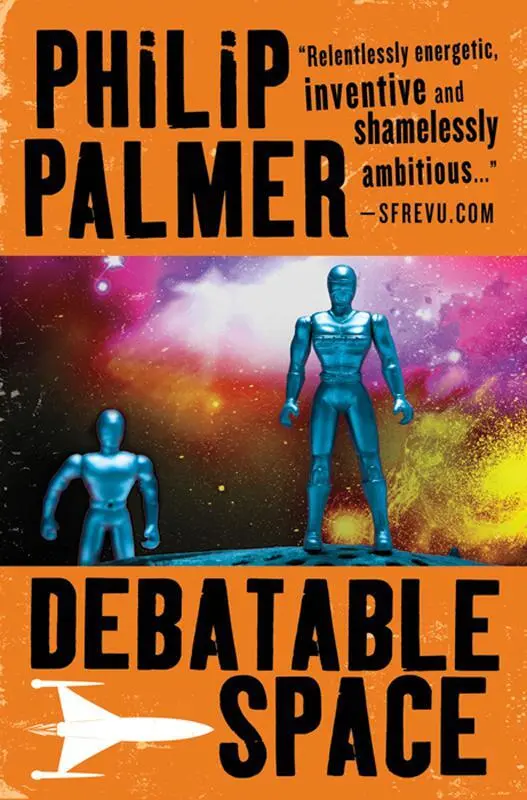
- Название:Debatable Space
- Автор:
- Жанр:
- Год:неизвестен
- ISBN:нет данных
- Рейтинг книги:4 / 5. Голосов: 1
-
Избранное:Добавить в избранное
- Отзывы:
-
Ваша оценка:
Debatable Space: краткое содержание, описание и аннотация
Предлагаем к чтению аннотацию, описание, краткое содержание или предисловие (зависит от того, что написал сам автор книги «Debatable Space»). Если вы не нашли необходимую информацию о книге — напишите в комментариях, мы постараемся отыскать её.
Debatable Space — читать онлайн бесплатно полную книгу (весь текст) целиком
Ниже представлен текст книги, разбитый по страницам. Система сохранения места последней прочитанной страницы, позволяет с удобством читать онлайн бесплатно книгу «Debatable Space», без необходимости каждый раз заново искать на чём Вы остановились. Поставьте закладку, и сможете в любой момент перейти на страницу, на которой закончили чтение.
Интервал:
Закладка:
I am God too; we are, each of us, Gods of our own personal Universe. Nothing about reality is a given; we have to really work to make it happen…
And the radical aspect of my new approach was to apply the principles of emergence theory to this whole area of consciousness study. If we accept that “reality” is a movie screened in the consciousness, it gives the human observer an active not a passive role in his or her private Universe.
And this connects up with the attempts to replicate the nature of human consciousness in computer systems, as “artificial intelligence”. But my equations reached deeper, by embracing the “primary imagination” and its ability to fashion a coherent Universe in which time passes and space has extension and all events have emotional resonance and are tinctured with memory and anticipation.
This was my introductory section, in which I argued that consciousness itself is an example of emergence; and that therefore reality itself (which is created by consciousness) can also be described according to the equations of emergence theory. The rest of the book was devoted to case studies of “mental systems”, taken from memoirs and biographies and autobiographies of famous and not so famous individuals whose ways of seeing were expressed through emergent equations.
Many of these individuals were sociopaths and serial killers – Ted Bundy was my favourite example. Albert Walker, perpetrator of the so-called Rolex watch murder, was another of my intriguing case studies. The choice of criminal case studies was primarily due to expedience, since there is a such a wealth of psychological information available on dysfunctional killers.
The main body of the work consisted therefore of psychological anatomies which didn’t ask the usual questions about such people – but instead, described them thoroughly and scientifically in terms of their ways of processing reality. Psychopaths, at one extreme, process reality in a way that is denuded of emotional content; often, killer psychopaths admit they don’t really feel emotion, but instead “act” emotion. Great novelists, by contrast, process reality by a process of self-glorifying self-fictification. Computer geeks, by further contrast, break down their lives into a series of tasks and challenges; it gives them huge self-confidence, but little emotional competence.
Throughout my book, I interwove equations and poetic insights; I psychologically anatomised great artists, but also monstrous killers; I blurred all the boundaries between art and science and between different areas of science.
And then I heaved a deep sigh, sent the book off to my publishers, and waited for adulation to come my way.
It never did. The book did in fact get published, and it received a healthy amount of press attention. It even got a few mildly favourable reviews. But in the world that mattered to me – the universe of academe – the book was roasted. The whole community of the scientific establishment rose and cast stones at my essential premises, and derided my sometimes half-baked equations. Philosophers mocked the naivety of my treatment of Kant, which failed to acknowledge the perils of Platonic essentialism. Computer geeks identified flaw after flaw in my “critiques” of computer systems.
Two men in particular rose to the forefront of the critical hostility. Both were eminent scientists – Professor John Gallagher of the University of Iowa, and Dr Ralph Cutler of the university of Auckland. They listed all the errors of fact in my admittedly overambitious analysis of emergence from the moment of the Big Bang to the birth of human consciousness. But in mocking, they also refined. They adapted. They, frankly, stole wholesale from the insights and ideas in my book. When, fifteen years later, Gallagher and Cutler jointly won the Nobel Prize for their work on emergence theory and human consciousness, there were few indeed willing to point out that they took their original starting point from my own work of pop science. They won the Nobel Prize by stealing my insights. But You Are God, my life’s work, barely even registers as a footnote in the history of science.
And so, as has happened so many times in my life, I did all the work, but got none of the credit.
And I seethed, of course, at the negative critical response. I knew I should have done as Newton did, and as Darwin did; hugged my insights to myself until I had properly and carefully checked every single detail and observation. But I did nothing of the sort. I was swamped by the material, but also exhilarated at my sense of progress. So I rushed into print, bollixed entire sections of the book with specious extrapolations of valid premises, made countless errors, and lost a large measure of academic credibility.
And yet I was right. Read the book. See for yourself. I was the shoulders on which giants clambered, in ruthless pursuit of the main chance. I was the stepping stone, who got stepped upon. I was the fool.
But curiously, not everyone mocked. The book got a wide general readership, and developed a cult following comparable to Zen and the Art of Motorcycle Maintenance and The Tao of Pooh.
And among the many fans of the book was a man called John Sharpton, who was at that time Commissioner of the UN Police Force. Sharpton recommended the book to a number of his colleagues, who all loved the very detailed case studies of psychopaths, which were full of rich and practical insights into the criminal mentality.
And, as a direct result of this, I was offered a new job, and a new career. Sharpton called me into a meeting and, to my utter astonishment, offered me a job as scientific adviser to a worldwide Crime Task Force devoted to the neutralisation and incarceration of target nominals – the “big fish” of international crime. This was of course based on the main body of my book, the case studies of psychopaths and criminals – not the philosophical underpinnings, which the coppers all found impenetrable. But as far as these senior policemen were concerned, I was a “boffin”, an expert. And so they wanted me to join their crack crime investigation team.
I said yes immediately. I was so excited.
I was a thieftaker!
I bought a leather bomber jacket.
And I looked like an idiot in it. But it seemed to be the right style code for my new job, my new vocation.
My boss in the crime-busting squad was Detective Superintendent Tom Greig, a kindly, tall, powerful, overwhelming giant of a man. I met him in a cafe near Victoria, and watched with goggle-eyed respect as he ate not one but two cooked breakfasts in front of me, without ever pausing for breath or ceasing his rat-a-tat briefing on what my job would require.
Tom saw that I was nervous, indeed panicky, but he reassured me enormously with his gentle, old-fashioned manners. He adopted me as his “sexy boffin” and treated me with a courtesty and respect I had never before known.
Within a month, this gorgeous hunk of a man was also fucking me. I could hardly believe my luck.
A week after that first meeting, he introduced me to the rest of the team, who were based in an office near Tower Bridge in London. There was Tosh, a beer-bellied Glaswegian, with a fondness for practical jokes. There was Mickey “Hurly-Burly” Hurley, who was a wide boy, and a wisecracker par excellence. There was Michiyo, a sleek graduate who was a martial artist and languages specialist. “Blacks” was the computer geek; Rachel was the sergeant, the team leader, the sorting-everyone-out one; Natasha was a Ghanaian princess with more charisma than any one person deserved to possess.
We became a tightly knit team, a collision of unlikely opposites. I was teased for my sensible shoes and air of restraint; they loved to call me the Prof, and shock me with their bawdy humour. Our squad room was a hive swarming with foul invective and casual insults. It could not have been more different to the academic environment to which I was accustomed. I learned to use the word “motherfucka” as an endearment. I discovered that “twat” could be an adjective. I even, to my own amusement if no one else’s, developed the knack of cursing in iambic pentameters.
Читать дальшеИнтервал:
Закладка:
Похожие книги на «Debatable Space»
Представляем Вашему вниманию похожие книги на «Debatable Space» списком для выбора. Мы отобрали схожую по названию и смыслу литературу в надежде предоставить читателям больше вариантов отыскать новые, интересные, ещё непрочитанные произведения.









Обсуждение, отзывы о книге «Debatable Space» и просто собственные мнения читателей. Оставьте ваши комментарии, напишите, что Вы думаете о произведении, его смысле или главных героях. Укажите что конкретно понравилось, а что нет, и почему Вы так считаете.