Philip Palmer - Debatable Space
Здесь есть возможность читать онлайн «Philip Palmer - Debatable Space» весь текст электронной книги совершенно бесплатно (целиком полную версию без сокращений). В некоторых случаях можно слушать аудио, скачать через торрент в формате fb2 и присутствует краткое содержание. Жанр: Фантастика и фэнтези, на английском языке. Описание произведения, (предисловие) а так же отзывы посетителей доступны на портале библиотеки ЛибКат.
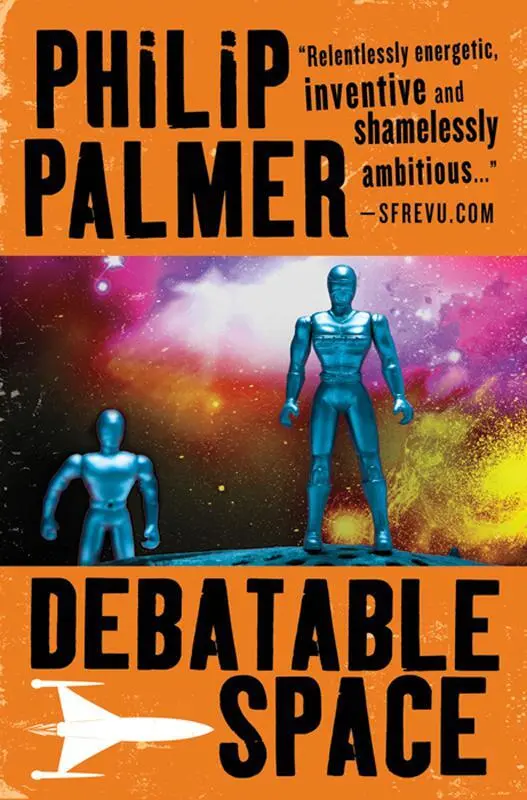
- Название:Debatable Space
- Автор:
- Жанр:
- Год:неизвестен
- ISBN:нет данных
- Рейтинг книги:4 / 5. Голосов: 1
-
Избранное:Добавить в избранное
- Отзывы:
-
Ваша оценка:
Debatable Space: краткое содержание, описание и аннотация
Предлагаем к чтению аннотацию, описание, краткое содержание или предисловие (зависит от того, что написал сам автор книги «Debatable Space»). Если вы не нашли необходимую информацию о книге — напишите в комментариях, мы постараемся отыскать её.
Debatable Space — читать онлайн бесплатно полную книгу (весь текст) целиком
Ниже представлен текст книги, разбитый по страницам. Система сохранения места последней прочитанной страницы, позволяет с удобством читать онлайн бесплатно книгу «Debatable Space», без необходимости каждый раз заново искать на чём Вы остановились. Поставьте закладку, и сможете в любой момент перейти на страницу, на которой закончили чтение.
Интервал:
Закладка:
It sucked away my soul. I think my skin became paler, and frecklier. And I proved to be, despite my academic smarts, a profound nincompoop with regard to the ways of the world, always getting it wrong.
And so I became a college mouse. I held my own academically – I published papers on Newton’s theory of Optics, I wrote reviews for specialist journals. But I had the reputation of being a dry stick, humourless and unimaginative.
My students didn’t like me much. They thought I was a relic from another age. I had the reputation of being a frigid spinster. In fact, I did have sex, a few times, with some of my less repellent colleagues. But I treated it as a chore, an act designed to thwart the stereotype about me which my every word and action served to confirm.
I felt like a character in a science fiction story, trapped in someone else’s body, articulating someone else’s words. To be frank, I bored even myself. And by the time I was thirty-six, my course was set, my die stamped, I knew I would never change.
Then I published my life’s work, and everything changed.
It’s what I’d hoped for, of course. In my dreams, my masterly academic book was going to transform my reputation and my status. In pursuit of this dream I worked long long hours, I read books on science and crime and history, I read novels, I absorbed so much knowledge that I felt my own self was being swamped in information.
Most crucially, I became the supreme intellectual magpie – stealing ideas from here, there, and everywhere. And I was smart enough also to realise that the most important area of modern scientific and philosophical thought was not computing or string theory or postmodernism or chaos theory, but the new science of emergence.
Emergence, put simply, is the study of how systems of simple organisms tend to organise themselves into more complex structures. They do! They just do! Marcus Miller was the great white hope of emergence theory in the late 2030s; he transformed the ideas of twentieth century researchers like John Holland and Art Samuel and arrived at a computer model that flawlessly replicated the workings of emergent systems such as ant colonies.
The miracle of it all is this: put a couple of random atoms together and they will spontaneously turn themselves into something more complicated, a system governed by some set of rules that allows random particles to function as more than the sum of their parts. And a process of evolution – mutation, trial and error, survival of the “most fitted” – will then cause greater and greater levels of complexity to occur. Emergence is, essentially, the study of self-organisation; it is how, in specific terms, order emerges from chaos.
So in other words, no God is needed. Night turns to day spontaneously.
I found this heady, exhilarating stuff. For me, the joy of these ideas colliding together was greater than any amount of partying or alcoholic stimulation or even orgasm. I was high on ideas. I lusted on abstractions…
And, as I read further, I became fascinated by the fact that the principle of emergence applies regardless of the size and scale of the units. Atoms evolve through emergence; and so do animals. Mechanical systems spontaneously self-organise; so do living beings. Bees divide into workers and drones. Fireflies flash in synchrony. An accumulation of cosmic rubble becomes a sun, and then a solar system. And ants are of course the supreme example of a living emergent system. Each individual ant is non-sentient, a low IQ insect of limited abilities. But in colonies ants combine in complex systems and act almost as a single and highly intelligent being.
And as it is with atoms, and as it is with ants, so it is with the entire Universe. Traditional science always regarded the laws of nature themselves as sacrosanct, “given”. But emergence theory suggests that the Universe itself evolved. And not only the Universe, but the laws that govern the Universe. The laws of nature themselves are not a given, a gift from some capricious and, frankly, half-baked Deity. Instead, the laws of nature are self-organising; they adapt and change, or fail to adapt and die out. And as a result, we live in a Universe governed by natural “laws” which had to fight every step of the way to come into existence.
Even though I’m not a scientist by training, I was quick to realise the huge value of all of these developments. Emergence, it seemed to me, is the theory which unifies all theories. It explains how life evolved; how intelligence evolved; it unifies quantum theory with cosmological theory with biological theory with computer theory.
But at the time I was writing, the study of emergence and self-organisation had been hijacked by the computer geeks. The underlying philosophical principles so beautifully anatomised by early theorists such as Lee Smolin had been lost. The geeks kept asking “How?”; they didn’t know how to ask “Why?”
My original and pioneering approach was to apply the principles of emergence theory and relativity theory to human consciousness. I…
(Feel free to skip ahead, by the way, if this section is boring you. I know it’s complicated and hard. So if you have one of those sad grasshopper minds which can’t sustain abstract thought for more than a few seconds, or if you’re a child of MTV with a channel-hopping finger and no stamina, then please, just skip! Move on to the exciting sections later in which I battle with master criminals and put my life in danger on a daily basis. Go on – I won’t be offended – see if I care – skip!)
If you haven’t skipped ahead, then let’s continue with the hard stuff. And**** those other bastards, we’re better off without them.
In my own philosophical theorising, my great inspiration was Immanuel Kant, who wrote about the nature of the nature of knowledge and perception. Like Leibnitz, Kant was a philosopher who went out of vogue but whose ideas are now at the heart of the modern scientific enterprise. And I was also influenced by one of Kant’s most inspired followers, the poet Samuel Taylor Coleridge, who wrote about the “primary imagination” which creates the reality known by our senses, and about the “secondary imagination”, the source of poetry itself, which owes its power to the fact that it is a shadow of the primary imagination.
Coleridge’s formulation was a beautiful poetic restatement of Kant’s carefully argued philosophy which showed that time and space themselves are constructs of the mind perceiving. Which means:
Every day we create our world anew.
Every time we wake, the world springs up around us. We make it so. For a few seconds after waking, there is typically a fog of confusion. But then we remember who we are, and what we plan to do today, and what we did yesterday and in the years before. And a whole network of associations, assumptions and predictions springs into place to unify and control our perceptions. Even time itself only exists because we perceive it as we do; even space is a product of how our minds apprehend the atoms and quarks and superstrings of underlying reality.
This isn’t the same as solipsism. If you and I and the rest of humanity did not exist, there would still be an external universe. Lions would still scent their prey; flies would still be able to find and wallow in shit. But grass would not be so evocatively green, and roses would not smell so delightfully sweet, and nothing in our extraordinary world would have the special beauty and the unique range of meaning that the human perceiving consciousness not only perceives, but creates by its very act of perception.
And so, I argued, our primary imagination gives us the power of a god, to create a world and Universe rich in memories and anticipations and emotions. You Are God, as I pithily phrased it in the subtitle of my book.
Читать дальшеИнтервал:
Закладка:
Похожие книги на «Debatable Space»
Представляем Вашему вниманию похожие книги на «Debatable Space» списком для выбора. Мы отобрали схожую по названию и смыслу литературу в надежде предоставить читателям больше вариантов отыскать новые, интересные, ещё непрочитанные произведения.








Обсуждение, отзывы о книге «Debatable Space» и просто собственные мнения читателей. Оставьте ваши комментарии, напишите, что Вы думаете о произведении, его смысле или главных героях. Укажите что конкретно понравилось, а что нет, и почему Вы так считаете.