JAMES ROLLINS - SANDSTORM
Здесь есть возможность читать онлайн «JAMES ROLLINS - SANDSTORM» весь текст электронной книги совершенно бесплатно (целиком полную версию без сокращений). В некоторых случаях можно слушать аудио, скачать через торрент в формате fb2 и присутствует краткое содержание. Жанр: Фантастика и фэнтези, на английском языке. Описание произведения, (предисловие) а так же отзывы посетителей доступны на портале библиотеки ЛибКат.
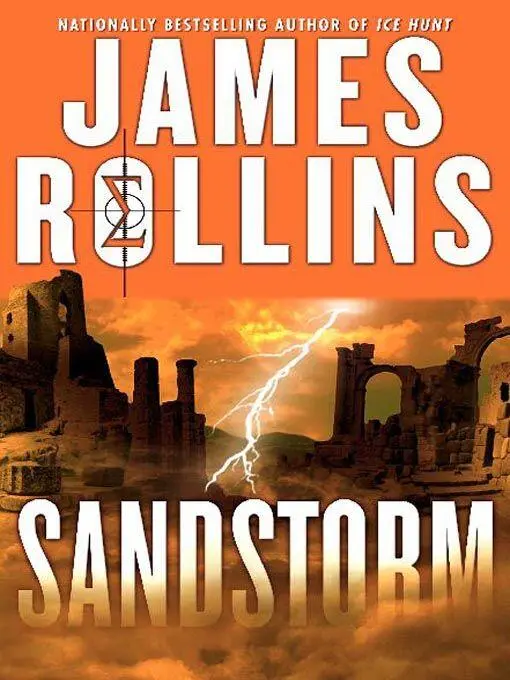
- Название:SANDSTORM
- Автор:
- Жанр:
- Год:неизвестен
- ISBN:нет данных
- Рейтинг книги:3 / 5. Голосов: 1
-
Избранное:Добавить в избранное
- Отзывы:
-
Ваша оценка:
SANDSTORM: краткое содержание, описание и аннотация
Предлагаем к чтению аннотацию, описание, краткое содержание или предисловие (зависит от того, что написал сам автор книги «SANDSTORM»). Если вы не нашли необходимую информацию о книге — напишите в комментариях, мы постараемся отыскать её.
SANDSTORM — читать онлайн бесплатно полную книгу (весь текст) целиком
Ниже представлен текст книги, разбитый по страницам. Система сохранения места последней прочитанной страницы, позволяет с удобством читать онлайн бесплатно книгу «SANDSTORM», без необходимости каждый раз заново искать на чём Вы остановились. Поставьте закладку, и сможете в любой момент перейти на страницу, на которой закончили чтение.
Интервал:
Закладка:
As if demonstrating, the old woman hauled herself up with considerable effort.
“And what of us now?” Safia asked, standing with Kara.
“I will tell you along the way,” she said. “We have far to travel.”
“Where are we going?” Safia asked.
The question seemed to surprise the hodja. “You are one of us, Safia. You brought us the keys.”
“The heart and the spear?”
A nod. She turned away. “After two millennia, we go to unlock the Gates of Ubar.”
Part Four
The Gates of Ubar

16
Crossroads

AS THEskies brightened to the east, Omaha slowed the van at the top of the pass. The road continued down the far side…if the rutted, stone-plagued track could be called a road. His lower back ached from the constant bump and rattle of the last ten miles.
Omaha braked to a halt. Here the road crested the last pass through the mountains. Ahead, the highlands dropped to salt flats and gravel plains. In the rearview mirror, fields of green heather spread, dotted with grazing cattle. The transition was abrupt.
To either side of the van lay a moonscape of red rock, interrupted by patches of straggly, red-barked trees, bent by the winds flowing over the pass. Boswellia sacra. The rare and precious frankincense trees. The source of wealth in ages past.
As Omaha braked, Painter’s head snapped up from a light drowse. “What is it?” he asked blearily. One hand rested on the pistol in his lap.
Omaha pointed ahead. The road descended through a dry riverbed, a wadi. It was a rocky, treacherous course, meant for four-wheel-drive vehicles.
“It’s all downhill from here,” Omaha said.
“I know this place,” Barak said behind them. The fellow never seemed to sleep, whispering directions to Omaha as they wound through the mountains. “This is Wadi Dhikur, the Vale of Remembrance. The cliffs to either side are an ancient graveyard.”
Omaha popped the van into gear. “Let’s hope it doesn’t become ours.”
“Why did we come this way?” Painter asked.
In the third row of seats, Coral and Danny stirred, slumped against each other. They sat straighter, listening. Clay, seated beside Barak, merely snored, head craned back, lost to the world.
Barak answered Painter’s question. “Only the local Shahra tribe know of this route down the mountains to the desert. They still collect frankincense from the trees around here in the traditional manner.”
Omaha had never met anyone from the Shahra clan. They were a reclusive bunch, almost stone age in their technology, frozen in tradition. Their language had been studied at length. It was unlike modern Arabic, almost a reedy singsong, and contained eight additional phonetic syllables. Over time, most languages lose sounds, becoming more refined as they mature. With the additional syllables, the Shahri language was considered to be one of the most ancient in all of Arabia.
But more particularly, the Shahra called themselves the People of ’Ad, named after King Shaddad, the first ruler of Ubar. According to oral traditions, they descended from the original inhabitants of Ubar, those who fled its destruction inA.D 300. In fact, Barak might be leading them down the very path to Ubar that the People of ’Ad had once used to flee its destruction.
A chilling thought, especially shadowed by the entombed graves.
Barak finished, “At the bottom of the wadi, it is only thirty kilometers to reach Shisur. It is not far.”
Omaha began their descent, in the lowest gear, creeping at five miles per hour. To go any faster risked sliding out in the loose shale and rocky scree. Despite the caution, the van skidded all too often, as if traveling on ice. After half an hour, Omaha’s hands were damp on the wheel.
But at least the sun was up, a dusty rose in the sky.
Omaha recognized that hue. A storm was coming. Due to strike the area in a few more hours. Already winds off the sands blew up the wadi, blustering against the less-than-aerodynamic van.
As Omaha rounded a blind bend in the riverbed, two camels and a pair of robed bedouin appeared ahead. He hit the brakes too hard, fishtailed the rear end, and struck broadside into a precariously stacked set of stone slabs alongside the road. Metal buckled. The slabs toppled.
Clay startled awake with a snort.
“There goes our collision deposit,” Danny griped.
The two camels, loaded and strapped with bales and overflowing baskets, gurgled at them, tossing their heads, as they were walked past the stalled van. It looked like they were carrying an entire household on their backs.
“Refugees,” Painter said, nodding to other similarly laden camels, mules, and horses moving up the dry watercourse. “They’re fleeing the storm.”
“Is everyone okay?” Omaha asked as he fought the gearshift knob, punching the clutch. The van lurched, rocked, and finally began to roll again.
“What did we hit back there?” Coral asked, staring at the toppled stones.
Danny pointed to other similar stone piles that peppered the graveyard. “Triliths,” he answered. “Ancient prayer stones.” Each was composed of three slabs leaned against one another to form a small pyramid.
Omaha continued down the road, wary of the stacked stones. This was made more difficult as “traffic” grew thicker the lower down the riverbed they traveled.
Folks were fleeing the desert in droves.
“I thought you said no one knew about this back door out of the mountains,” Painter asked Barak.
The Arab shrugged. “When you’re facing the mother of all sandstorms, you run toward higher ground. Any ground. I wager every riverbed is being climbed like this. The main roads are surely worse.”
They had heard periodic reports over the radio as reception came and went. The sandstorm had grown in size, as large as the Eastern Seaboard, whipping up eighty-mile-per-hour winds, packed by scouring sands. It was shifting sand dunes around like they were whitecaps on a storm-swept sea.
And that was not the worst. The high pressure system off the coast had begun to move inland. The two storm systems would meet over the Omani desert, a rare combination of conditions that would whip up a storm unlike any seen in ages before.
Even as the sun dawned, the northern horizon remained cloaked in a smoky darkness. As they descended the mountain road, the storm ahead grew taller and taller, a tidal wave cresting.
They finally reached the bottom of the wadi. The cliffs fell away to either side, spilling out into the sandy salt flats.
“Welcome to the Rub‘ al-Khali,” Omaha announced. “The Empty Quarter.”
The name could not be more fitting.
Ahead stretched a vast plain of gray gravel, etched and scoured with pictographic lines of blue-white salt flats. And beyond, a red ridge marked the edge of the endless roll of dunes that swept across Arabia. From their vantage, the sands glowed in pinks, browns, purples, and crimsons. A paint pot of hues.
Omaha studied their fuel gauge. With luck, they’d have just enough gas to reach Shisur. He glanced over to the Desert Phantom, their only guide. “Thirty kilometers, right?”
Barak leaned back and shrugged. “Thereabouts.”
Shaking his head, Omaha turned forward and set off across the flat-lands. A few straggling folk still trudged toward the mountains. The refugees showed no interest in the van heading toward the storm. It was a fool’s journey.
Читать дальшеИнтервал:
Закладка:
Похожие книги на «SANDSTORM»
Представляем Вашему вниманию похожие книги на «SANDSTORM» списком для выбора. Мы отобрали схожую по названию и смыслу литературу в надежде предоставить читателям больше вариантов отыскать новые, интересные, ещё непрочитанные произведения.



Обсуждение, отзывы о книге «SANDSTORM» и просто собственные мнения читателей. Оставьте ваши комментарии, напишите, что Вы думаете о произведении, его смысле или главных героях. Укажите что конкретно понравилось, а что нет, и почему Вы так считаете.