Mitchell Smith - Moonrise
Здесь есть возможность читать онлайн «Mitchell Smith - Moonrise» весь текст электронной книги совершенно бесплатно (целиком полную версию без сокращений). В некоторых случаях можно слушать аудио, скачать через торрент в формате fb2 и присутствует краткое содержание. Жанр: Фантастика и фэнтези, на английском языке. Описание произведения, (предисловие) а так же отзывы посетителей доступны на портале библиотеки ЛибКат.
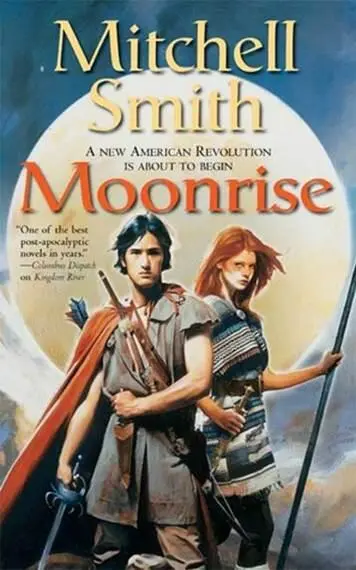
- Название:Moonrise
- Автор:
- Жанр:
- Год:неизвестен
- ISBN:нет данных
- Рейтинг книги:4 / 5. Голосов: 1
-
Избранное:Добавить в избранное
- Отзывы:
-
Ваша оценка:
Moonrise: краткое содержание, описание и аннотация
Предлагаем к чтению аннотацию, описание, краткое содержание или предисловие (зависит от того, что написал сам автор книги «Moonrise»). Если вы не нашли необходимую информацию о книге — напишите в комментариях, мы постараемся отыскать её.
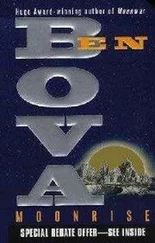
Civilization survives in pockets of warmth, most notably in the vast, Mississippi-based Middle Kingdom of North America and in glacier-covered Boston. Boston, where high technology that borders on magic is used to create the "moonrisen," people with the genes of animals. Boston, which looks at the growing strength of Middle Kingdom, united under the brilliant King and Commander, Sam Monroe, and sees a time when Boston will not rule.
A coup destroys Middle Kingdom's royal family, save for young Prince Bajazet. With Boston's minions in pursuit, before long Baj is Prince no longer, just a man on the run. His saviours are three of the moon's children, who are conspiring with the surviving northern Tribes to overthrow Boston. Baj has no choice-he must side with the rebels or die.
Moonrise — читать онлайн бесплатно полную книгу (весь текст) целиком
Ниже представлен текст книги, разбитый по страницам. Система сохранения места последней прочитанной страницы, позволяет с удобством читать онлайн бесплатно книгу «Moonrise», без необходимости каждый раз заново искать на чём Вы остановились. Поставьте закладку, и сможете в любой момент перейти на страницу, на которой закончили чтение.
Интервал:
Закладка:
Those peoples' lives lived rich in confidence that earth would never turn hot or cold enough to kill them, and destroy the wheat and corn and rice to leave hundreds and hundreds of millions with the choice of freezing or starvation… A confidence proved misplaced by nothing but a slight shift in great Jupiter's orbit.
It seemed to Baj that of all the things this pretend, this nearly, this almost town was not, there was still something it was, though its men maimed and burned. And that something – a recreation of the past, apparently as instrument of creation-anew – drew Baj to it as the crowd drew him and his friends into the bannered square, into the noisy merry music – sounding old as Island's celebratory "Washington Post," and meant, apparently, to be marched to.
Baj felt that something, and saw that Richard, Nancy – and empty Errol – did not. There had been no Persons in Warm-times. That past was not theirs. Before centuries of cold, before the mind-making of Boston Talents, there had been only beasts, and men.
… Baj and the others – Errol kept close – were drawn along with the townspeople: the weary soldiers grimy in their odd uniforms, their wives and children, elderly parents… sweethearts. Drawn with them as if herded – but always with a distance kept, so the travelers stayed separate in the crowd. Errol was strutting to the music's solid beats, thin legs and moccasined feet pumping up and down.
The biggest flag had been raised on a pole by the garden house, and its cloth, striped and starred, brightly colored as dyed honey candies, rippled out on the north wind – a chill breeze, despite the sunshine – as if in time to the music.
Though to what celebration these people were called – the end of their so-short northern summer, or perhaps only a triumph after killing, burning Robins – had not been spoken of, the festival air lent for Baj an additional magic to this town. A town that might be his in wishes for the past – if he were asked, and lived blind to what it wasn't. If he were willing to maim sweat-slaves, blind them, slice their manhoods so they acted only as engines to power the false-locomotives – power those, and likely other things: a wood mill, a stone mill to crush rock to gravel, a manufactury for spring-shooters. Making all those work, though slowly, poorly, straining in imitation of machinery that once had hummed and roared and whirled in heat and heated oil.
Still, perhaps because of so many boyhood hours reading, perhaps by a would-be poet's imagination that had fleshed the copybooks out, this remembrance-place of a lost time seemed not so strange to him at all.
The soldiers and their families gathered, and gathered Baj and the others with them – though slightly separate – to crowd before the garden house and music band… Then the band stopped playing with a blare and crash, seemed to draw fresh breath, and commenced another, slower melody – to which, here and there, then throughout, the men and women began to sing.
It was a song that began "Oh, beautiful," and continued in such sweet description that Warm-times, even by these sad and crippled ways, seemed to rouse and return to bless them.
There were rows of rough wooden tables and benches beside the garden house, where people were already seating themselves, and several long serving tables past those, where women dealt with bowls and platters of food, and a cooking pit smoked with roasting meat.
Nancy said, "Uh-oh." One of the oldest exclamations.
A young man in a dark jacket, dark trousers, white shirt and throat-tie, was wending through the tables toward them. He was not carrying a spring-shooter.
When he stood smiling in front of them, Baj saw the young man was weary, unshaven, his white shirt stained and dirty. His face had the drawn look that Baj remembered from when he was a boy, and saw young officers of the Army-United come down the river from the fighting in Map-Illinois… Their faces had been as this man's was. It seemed that burning Robins had a cost.
"Amazing how well I see you all," the young man said. And to Baj. "You, a little more clearly… But all four of you… manifestations are invited to eat gift food set out for you. We are… perhaps more than usually tender, today, to those drifting out of proper time." He stared at them, shook his head. "- So, what of our food might nourish you, you are welcome to eat while fact and falseness touch for this little time." Still smiling, he gestured them to follow him past others, families sitting to their food… then indicated the empty benches of a table that must just have been weighted with platters of sizzling mutton – sliced thick, of roast onions, broken potato, steamed cabbage and carrots, a stack of rye flatbread, and a clay pitcher of what seemed barley beer.
"Yours," the young man said, "for what use it is to you. – Any questions?"
"None." Richard shook his head. "But thanks for your generosity to insubstantial guests, only passing through."
The young man nodded, but looked past Richard, not at him. There was a dull brown stain down the front of his white shirt. He had very clear gray eyes… an older man's eyes, with an older man's understanding in them. "My father should be thanked for that," he said, "- as we thank him for so much." He smiled again, then wended away through the crowded tables.
Not one other – of the hundreds seating themselves around them, serving out food, joking with their loved ones – not one appeared to see them.
"Does this mean they won't hurt us," Nancy murmured, "- take our eyes?" But neither Baj nor Richard could answer her.
CHAPTER 17
Though the town's armed men might still smell of Robins burning, gentler odors came drifting from the cookstoves and kettles as Baj and the others were left as perfectly to themselves as if they still camped high in the Smoking Mountains – though here, with wooden spoons and their belt knives, they dealt with mugs of barley beer and fired-clay plates heavy with roasted mutton and steaming vegetables. They ate, dipped flatbread in gravy, and poured out foaming beer.
"It seems," Baj said between bites, "that terror does not affect appetite."
"Increases mine." Richard folded a slice of meat in flatbread, and ate it.
"You three," Nancy said, apparently including Errol, who had slid under the table with fistfulls of mutton, "- you three are fools." Though she was chewing as she spoke. She tried a carrot, made a face, and looked around, staring at the women. "Light cloth clothes," she said, "- and worn in this never-truly-warm, so close to the Wall. And showing so much, as to say, 'See my bare legs? Come and fuck me.' "
"It's likely," Baj said, refilling his mug, "this is their Last-of-summer festival." Errol slid from under the table, a wad of mutton-fat in his hand, to join boys coursing through the crowd, but Baj reached down and held him. "Stay with us."
"I think," Richard spoke softly, though there was no other table close, "- I think the Robins shouldn't have settled so near these people."
Baj, mashing his potatoes in mutton gravy, turned to look around them. "Yes, and became too much of a contradiction to these believers."
"Believers enough," Nancy said, "- to perch men and women with sticks up their rear ends as the Shrikes do, then burn them." An eye-tooth grated on a mutton bone.
Hunger over fear for all of them, Baj supposed, at least for the moment. "… And intend those murders to frighten other tribes-people, keep them from settling near I-Seventy, spoiling this dream of Warm-times with reminders of now."
"Madness." Richard set his carrots aside with a large horn-nailed finger. "- And the reason the Guard is kept away. Boston doesn't want its soldier Persons building their own magical town. For fear, I suppose, of what they might pretend." He smiled at a girl-child – the only child who'd come to stare at them, but the smile proved too toothy, and the child fled. "Oh, dear, and the only one who'd look at us…"
Читать дальшеИнтервал:
Закладка:
Похожие книги на «Moonrise»
Представляем Вашему вниманию похожие книги на «Moonrise» списком для выбора. Мы отобрали схожую по названию и смыслу литературу в надежде предоставить читателям больше вариантов отыскать новые, интересные, ещё непрочитанные произведения.






Обсуждение, отзывы о книге «Moonrise» и просто собственные мнения читателей. Оставьте ваши комментарии, напишите, что Вы думаете о произведении, его смысле или главных героях. Укажите что конкретно понравилось, а что нет, и почему Вы так считаете.