Mitchell Smith - Moonrise
Здесь есть возможность читать онлайн «Mitchell Smith - Moonrise» весь текст электронной книги совершенно бесплатно (целиком полную версию без сокращений). В некоторых случаях можно слушать аудио, скачать через торрент в формате fb2 и присутствует краткое содержание. Жанр: Фантастика и фэнтези, на английском языке. Описание произведения, (предисловие) а так же отзывы посетителей доступны на портале библиотеки ЛибКат.
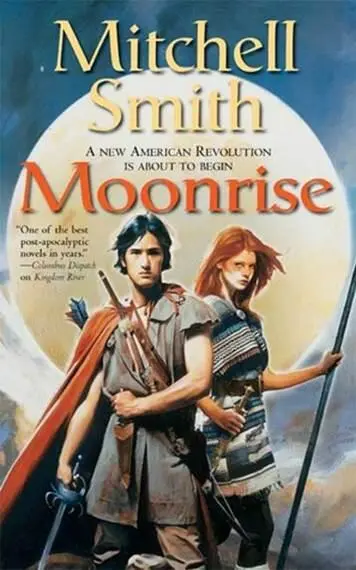
- Название:Moonrise
- Автор:
- Жанр:
- Год:неизвестен
- ISBN:нет данных
- Рейтинг книги:4 / 5. Голосов: 1
-
Избранное:Добавить в избранное
- Отзывы:
-
Ваша оценка:
Moonrise: краткое содержание, описание и аннотация
Предлагаем к чтению аннотацию, описание, краткое содержание или предисловие (зависит от того, что написал сам автор книги «Moonrise»). Если вы не нашли необходимую информацию о книге — напишите в комментариях, мы постараемся отыскать её.
Civilization survives in pockets of warmth, most notably in the vast, Mississippi-based Middle Kingdom of North America and in glacier-covered Boston. Boston, where high technology that borders on magic is used to create the "moonrisen," people with the genes of animals. Boston, which looks at the growing strength of Middle Kingdom, united under the brilliant King and Commander, Sam Monroe, and sees a time when Boston will not rule.
A coup destroys Middle Kingdom's royal family, save for young Prince Bajazet. With Boston's minions in pursuit, before long Baj is Prince no longer, just a man on the run. His saviours are three of the moon's children, who are conspiring with the surviving northern Tribes to overthrow Boston. Baj has no choice-he must side with the rebels or die.
Moonrise — читать онлайн бесплатно полную книгу (весь текст) целиком
Ниже представлен текст книги, разбитый по страницам. Система сохранения места последней прочитанной страницы, позволяет с удобством читать онлайн бесплатно книгу «Moonrise», без необходимости каждый раз заново искать на чём Вы остановились. Поставьте закладку, и сможете в любой момент перейти на страницу, на которой закончили чтение.
Интервал:
Закладка:
Women, some with their hair cut close as their lawns, knelt tending the plants in cloth dresses or very short trousers that showed their bare legs despite a chill morning. Only a few looked up to see the pretend-locomotive roll past, though children dressed in blue-dyed cloth trousers and colored shirts trotted along beside it, waving to the men riding. Baj saw no dogs… no strutting chicken-birds.
No one stared at him and the Persons – not even the children – as if he, Nancy, Richard, and Errol were only ghosts of an improbable future, not present in this time at all.
There were wide gravel walkways or drives alongside each small house, and placed on every one was a much smaller box than the false-locomotive – though also of painted wood.
"What are those?" Baj asked the air as he labored along. Errol, sleeping in his arms, had grown heavier.
One of the men riding, leaned down and called, "A question?"
"No question," Richard called back, "- only admiration."
That man, and others, stared down for a moment… then seemed satisfied.
These smaller boxes, in many painted colors – and one by every little house – were shaped resting on four fat wooden disks, painted black. Each box on each graveled walk had little square windows cut out of it… The nearest, as they passed, showed curving letters along its side, painted tar-black. BUICK.
"Pretend driving-cars," Baj said.
Richard, walking ahead, stopped and waited to take Errol from him. "Careful," he murmured, "what words you use. Better not pretend."
Baj decided to be quiet, since these people – mad or not – were so grimly serious. But even in pretense, the town still lay before him as if risen not from copybook sketches and descriptions, but from the reality behind them… The street and tree-shaded houses breathed an ancient perfect warmth, that, as if a great brass cymbal were struck, rang and vibrated from that time to this time and back again, so the laughing children, the plant-tending women in their odd immodest dress, and the silent men wearing button-jackets and trousers, shirts and throat-ties, all seemed to insist that the Age of Ice was false after all, and ancient truth lay here, beneath Lady Weather's apron.
There was a sudden blare of distant music that made Nancy jump and say, "Jesus!" It was music startlingly loud and thumping. There were trumpets in it, and heavy drums, so it crashed and clanged.
Errol jerked awake, and Richard set him down.
As if the music had signaled it, the booted feet beneath their locomotive shuffled to a halt at last. The men riding, climbed down with their heavy spring-sticks… As one was carried by, Baj saw Winchester burned into polished wood in small square letters.
The bearded old man, lithe and easy for his age, swung to the street and gestured to Richard and the others. "Drift along, Dream-oddities," he said. "- And see the past and future kiss."
The booted stompers began to crawl from beneath their great rust-red box – crawled out from under, and were kicked into a stumbling line by two of the men with spring-shooters… All finally stood holding hands like children, naked but for their heavy boots. Naked and shaved bare. It appeared that their nuts had been cut away. And their eyes. Their eyes had been taken out, and round little wooden eyes with painted blue pupils put in.
Baj said, "My God," a serious thing to say.
The two spring-shooter men were hitting the naked blind ones – striking them lightly, casually as pig-drovers, to move them, hand in hand, back down the graveled road toward the tamaracks and long wooden buildings there.
"We aren't going to get out of this," Nancy said, and sounded close to weeping. "These Sunrisers do terrible things."
"They cannot keep us," Richard said. "We would spoil their truth. They'll either be easy and let us swiftly go, or turn us into those. And before that happens," Richard made no effort to keep his voice low, "- we fight."
"If they try to take our weapons," Baj said, and had to clear his throat, "- we fight."
The old man called to them again. "Drift along, Apparents!" And they filed after him and the other spring-shooter men, Baj now more frightened than weary. He had a sickening vision of Nancy, ruined and eyeless. Nancy, and all of them.
… They were led down that street, and across another. Baj saw more pretty wooden houses down little side streets – noticed each had a chimney-stack, and windows showing cloth drapings inside, but no panes of leaded glass. From these houses, men were coming walking with their friends and families. They carried spring-shooters, and all were dressed in one of four different ways: some in jacket, trousers, throat-tie, and low shiny shoes… others in mottled-brown cloth and black lace-up boots (those wore round brown helmets on their heads). Others were dressed either in blue cloth with blue peaked caps, or gray cloth with gray peaked caps (the ones in gray all barefooted). But in whichever color, these peak-cap men wore beards and mustaches… The blue cloth, Baj supposed, dyed with crushed blueberry; the gray by thinned glue and powdered soot; the brown, by nutshells – ground then soaked. In whatever dress or uniform, the men seemed tired, rumpled, unwashed. A number were bandaged. Several limped.
At the far end of the last graveled street they crossed, Baj saw another imitation locomotive standing still, come into the town, apparently, on another of their gravel roads… He supposed they had others as well, and those had brought their men to marching-distance of the Robins.
"Soldiers," Baj kept his voice low. Low-speaking seemed the safest way. "Those are dressed as Warm-time soldiers."
Nancy lifted her head, sniffed the air. "Smoke," she said. "They smell of smoke. More than one village has been burned."
Richard, gripping Errol's arm, looked back. "Shhh…"
All those men and their families were walking the same way, the women leaving their plant-tending – and apparently not minding showing their legs – while the children ran here and there, from mothers to fathers, like schools of river fish… ran yelling past Baj and the others, so Errol clicked his tongue and tugged to join them.
But none of these people, not even the young, seemed to notice Baj and the others – not even Richard looming among them.
They followed the old man and his neck-clothed Spring-shooters toward the thumping clashing music, surrounded by what might have been veterans of Warm-time wars, many centuries ago.
At what would have been the third cross-street, there was, instead, a very large grassed square with seven or eight wood-built buildings – all painted gray (likely also with hoof-glue and soot) – standing along its eastern edge. Baj could see National Bank painted across the front of the biggest. There were letters on the other buildings, but too small to read.
In the middle of the square, there was a garden house – very much like those the river lords built amid their flower gardens along the Mississippi – a raised, open wooden floor, with latticework walls and a shingle roof.
The musical band was sitting on benches there, playing very loud, brass horns and decorated bleached-hide drums bright in morning sunlight. The music players, in odd tall hats, were dressed in red clothes with shiny buttons down the front.
All, Baj supposed, a slightly awkward and innaccurate recreation of the distant past… On those warm, sunny afternoons of six hundred years before, certainly not all little towns were green, perfect, and pleasant, with musical bands playing in their grassy squares. Though all were certain, at least, of a winter survivable with scientific heating, or, far from their splendid cities, with only a woodstove and warm coat.
Читать дальшеИнтервал:
Закладка:
Похожие книги на «Moonrise»
Представляем Вашему вниманию похожие книги на «Moonrise» списком для выбора. Мы отобрали схожую по названию и смыслу литературу в надежде предоставить читателям больше вариантов отыскать новые, интересные, ещё непрочитанные произведения.









Обсуждение, отзывы о книге «Moonrise» и просто собственные мнения читателей. Оставьте ваши комментарии, напишите, что Вы думаете о произведении, его смысле или главных героях. Укажите что конкретно понравилось, а что нет, и почему Вы так считаете.