Robert Sawyer - Humans
Здесь есть возможность читать онлайн «Robert Sawyer - Humans» весь текст электронной книги совершенно бесплатно (целиком полную версию без сокращений). В некоторых случаях можно слушать аудио, скачать через торрент в формате fb2 и присутствует краткое содержание. Жанр: Фантастика и фэнтези, на английском языке. Описание произведения, (предисловие) а так же отзывы посетителей доступны на портале библиотеки ЛибКат.
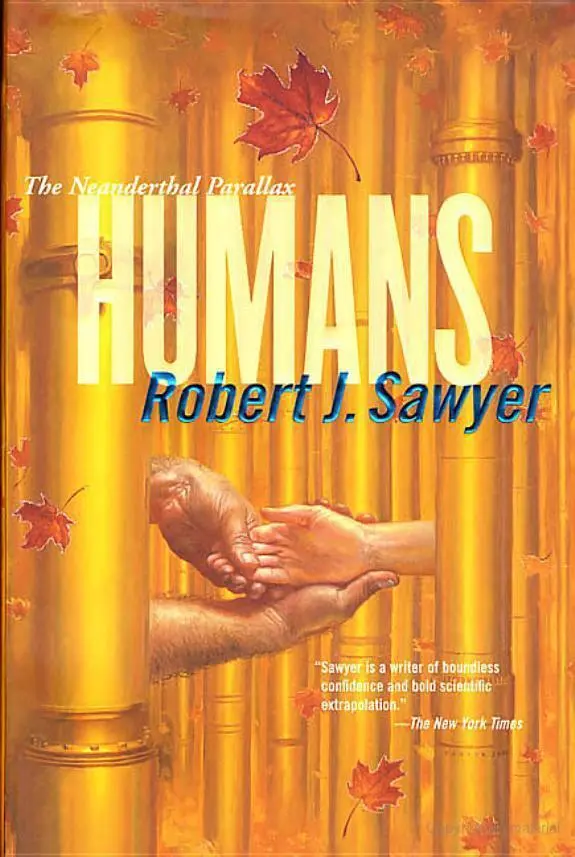
- Название:Humans
- Автор:
- Жанр:
- Год:неизвестен
- ISBN:нет данных
- Рейтинг книги:5 / 5. Голосов: 1
-
Избранное:Добавить в избранное
- Отзывы:
-
Ваша оценка:
Humans: краткое содержание, описание и аннотация
Предлагаем к чтению аннотацию, описание, краткое содержание или предисловие (зависит от того, что написал сам автор книги «Humans»). Если вы не нашли необходимую информацию о книге — напишите в комментариях, мы постараемся отыскать её.
Humans — читать онлайн бесплатно полную книгу (весь текст) целиком
Ниже представлен текст книги, разбитый по страницам. Система сохранения места последней прочитанной страницы, позволяет с удобством читать онлайн бесплатно книгу «Humans», без необходимости каждый раз заново искать на чём Вы остановились. Поставьте закладку, и сможете в любой момент перейти на страницу, на которой закончили чтение.
Интервал:
Закладка:
Mary smiled. “You’ve been talking to Milford Wolpoff.”
“Indeed. As well as Ian Tattersall and just about every other Neanderthal expert you can name. There seems to be no consensus among them about how much Neanderthals differed from us.”
Mary nodded; that much was certainly true. Some, like Wolpoff, held that Neanderthals were just another variety of Homo sapiens — at best a race, if that term had any validity, and certainly members of the same species as modern humans. Others, including Tattersall, felt the opposite: that Neanderthals were a species in their own right, Homo neanderthalensis. To date, all DNA studies seemed to support the latter view-but Wolpoff and company felt the few Neanderthal DNA samples available, including the 379 nucleotides of mitochondrial DNA that Mary herself had extracted from the Neanderthal type specimen at the Rheinisches Landesmuseum, were either aberrant or misinterpreted. It wasn’t too much to say that this was the most hotly contested issue in all of paleoanthropology.
“We still only have complete genetic material from one Neanderthal,” said Mary, “namely Ponter Boddit. It might be impossible to find anything diagnostic in that one sample.”
“I understand that. But we won’t know for sure until you try.”
Mary looked around the lab. “I have duties here, at York. Classes to teach. Grad students.”
“I understand that, too,” said Krieger. “But I’m sure arrangements can be made to cover your responsibilities. I’ve already had a word with the university’s president.”
“You’re talking about a full-time research project?”
“We’ll certainly compensate you for the entire academic year, yes.”
“Where would I work? Here?”
Krieger shook his head. “No, we’d want you to come to our secure facility.”
“In Rochester, right?”
“Rochester, New York, yes.”
“That’s not that far from here, is it?”
“I flew in today,” said Krieger, “and that takes no time at all. I understand it’s about three and a half hours by car.”
Mary considered. She would still be able to come up and see her mother and friends. And she had to admit that nothing interested her more right now than studying Ponter’s DNA; her class load would just be an inconvenience.
“What, ah, terms did you have in mind?”
“I can offer you a one-year consulting contract at $150,000 U.S., starting immediately, with full medical benefits.” He smiled. “I know that’s a key point with you Canadians.”
Mary frowned. She’d more or less prepared herself for returning to York University, to the site of the rape, but…
But no. No, that wasn’t true. She’d hoped she could stand being here, but, if this morning had been any indication, she was still jumpy as hell.
“I have an apartment here,” said Mary. “Acondo.”
“We’ll take care of the mortgage payments, taxes, and maintenance fees for you while you’re away; your home will be waiting for you when this job is done.”
“Really?”
Krieger nodded. “Yes. This is the biggest thing that’s happened to this planet since-well, ever. What we’re looking at here, Professor Vaughan, is the end of the Cenozoic, and the beginning of the next era. There haven’t been two versions of humanity on this planet for thirty-five thousand years or so-but, if that portal reopens, there are going to be two versions again, and we want to make sure it goes right this time.”
“You make it sound very tempting, Dr. Krieger.”
“Jock. Call me Jock.” A pause. “Look, I used to be with the RAND Corporation. I’m a mathematician; back when I graduated from Princeton, seventy percent of all math grads from major universities applied for jobs at RAND. That was where you got the money and resources to do pure research. In fact, the joke was that RAND actually stood for ‘Research And No Development’-it’s a think tank in the purest sense.”
“What does it stand for?”
“Just ‘Research and Development,’ supposedly. But the fact is its funding came from the U.S. Air Force, and it existed for a fundamentally unpleasant reason: to study nuclear conflict. I’m a game theorist; that’s my specialty, and that’s why I was there-doing simulations of nuclear brinksmanship.” He paused. “You ever see Dr. Strangelove?”
Mary nodded. “Years ago.”
“Old George C. Scott, he’s clutching a ‘BLAND’ corporation study there in the War Room. Freeze-frame it next time you’re watching the DVD. The study is labeled World Targets in Megadeaths. That’s about right for what we had to do. But the Cold War is over, Professor Vaughan, and now we’re looking at something incredibly positive.” He paused. “You know, despite its military roots, RAND did lots of far-out thinking. One of our studies was called Habitable Planets for Man, and it was all about the likelihood of finding earthlike planets elsewhere in the galaxy. Stephen Dole put that one together in 1964, just when I started at RAND. But, even then, back in the glory days of the space program, very few of us seriously thought we’d have access to another earthlike world in our lifetime. But if that portal reopens, we will. And we want contact to go as positively as possible. When the first Neanderthal embassy opens up-”
“A Neanderthal embassy!” exclaimed Mary.
“We’re thinking ahead, Professor Vaughan. That’s what Synergy is all about-not just the best of both worlds, but making something that’s more than the sum of its parts. It’s going to be wild. And we want you along for the ride.”
Chapter Five
Ponter and Daklar walked through the square, chatting. Lots of children were about, playing games, chasing each other, having fun.
“I’ve always wanted to ask a man,” said Daklar. “Do you miss your children when Two are separate?”
A little boy-a 148-ran right in front of them, catching a flying triangle. Ponter never regretted having two daughters, but sometimes he did wish he had a son, as well. “Of course,” he said. “I think about them constantly.”
“They’re such wonderful girls, Jasmel and Mega,” said Daklar.
“I thought you and Jasmel crossed spears while I was away,” said Ponter.
Daklar laughed ruefully. “Oh, yes, indeed. She spoke on behalf of Adikor at the dooslarm basadlarm, and I was the one accusing him. But I’m no fool, Ponter. Obviously I was wrong, and she was right.”
“So things are pleasant between the two of you now?”
“It’ll take some time,” said Daklar. “You know how Jasmel is. Stubborn as a stalactite-hanging on despite everything trying to pull her down.”
Ponter laughed. He did indeed know Jasmel-and, it seemed, Daklar knew her, too. “She can be difficult,” Ponter said.
“She’s just turned 225 months old,” said Daklar. “Of course she’s difficult. So was I, at her age.” She paused. “There’s a lot of pressure on young ladies, you know. She’s expected to take two mates before winter. I know Tryon is likely to become her man-mate, but she’s still searching for a woman-mate.”
“She’ll have no trouble,” said Ponter. “She’s quite a find.”
Daklar smiled. “That she is. She’s got all of Klast’s best qualities and…” She paused again, perhaps wondering if she were being too forward. “And all of yours, as well.”
But Ponter was pleased by the remark. “Thank you,” he said.
Daklar looked down. “When Klast died, Jasmel and Mega were very sad. Megameg was too young to really understand, but Jasmel…It’s hard for a girl, not having a mother.” She fell silent, and Ponter wondered if she was gathering for him to volunteer that Jasmel had had an excellent substitute. Ponter was beginning to think that was probably true, but he didn’t know what to say. “I’ve tried to be a good tabant, ” continued Daklar, “but it’s not the same as having their mother look after them.”
Читать дальшеИнтервал:
Закладка:
Похожие книги на «Humans»
Представляем Вашему вниманию похожие книги на «Humans» списком для выбора. Мы отобрали схожую по названию и смыслу литературу в надежде предоставить читателям больше вариантов отыскать новые, интересные, ещё непрочитанные произведения.

Обсуждение, отзывы о книге «Humans» и просто собственные мнения читателей. Оставьте ваши комментарии, напишите, что Вы думаете о произведении, его смысле или главных героях. Укажите что конкретно понравилось, а что нет, и почему Вы так считаете.