Robert Sawyer - Humans
Здесь есть возможность читать онлайн «Robert Sawyer - Humans» весь текст электронной книги совершенно бесплатно (целиком полную версию без сокращений). В некоторых случаях можно слушать аудио, скачать через торрент в формате fb2 и присутствует краткое содержание. Жанр: Фантастика и фэнтези, на английском языке. Описание произведения, (предисловие) а так же отзывы посетителей доступны на портале библиотеки ЛибКат.
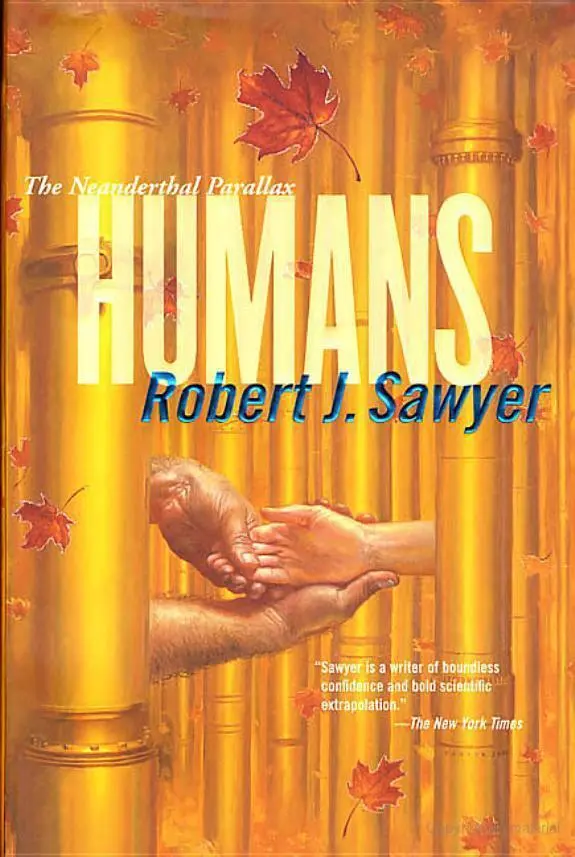
- Название:Humans
- Автор:
- Жанр:
- Год:неизвестен
- ISBN:нет данных
- Рейтинг книги:5 / 5. Голосов: 1
-
Избранное:Добавить в избранное
- Отзывы:
-
Ваша оценка:
Humans: краткое содержание, описание и аннотация
Предлагаем к чтению аннотацию, описание, краткое содержание или предисловие (зависит от того, что написал сам автор книги «Humans»). Если вы не нашли необходимую информацию о книге — напишите в комментариях, мы постараемся отыскать её.
Humans — читать онлайн бесплатно полную книгу (весь текст) целиком
Ниже представлен текст книги, разбитый по страницам. Система сохранения места последней прочитанной страницы, позволяет с удобством читать онлайн бесплатно книгу «Humans», без необходимости каждый раз заново искать на чём Вы остановились. Поставьте закладку, и сможете в любой момент перейти на страницу, на которой закончили чтение.
Интервал:
Закладка:
Mary nodded. She hadn’t believed it herself at the outset.
“Of course,” continued Krieger, “it may be that the portal between our universe and the Neanderthal one might never reopen. But, in case it ever does, we want to be ready.”
“We?”
“The United States government.”
Mary felt her back stiffen slightly. “The portal opened on Canadian soil, and-”
“Actually, ma’am, it opened a mile and a quarter beneath Canadian soil, at the Sudbury Neutrino Observatory, which is a joint project of Canadian, British, and American institutions, including the University of Pennsylvania, the University of Washington, and the Los Alamos, Lawrence Berkeley, and Brookhaven National Laboratories.”
“Oh,” said Mary. She hadn’t known that. “But the Creighton Mine, where SNO is located, belongs to Canada.”
“More precisely, it belongs to a Canadian publicly traded corporation, Inco. But, look, I’m not here to argue sovereignty issues with you. I just want you to understand that the United States has a legitimate interest in this matter.”
Mary’s tone was frosty. “All right.”
Krieger paused; he clearly felt he’d gotten off on the wrong foot. “If the portal between our world and the Neanderthal world ever reopens, we want to be ready. Defending the portal doesn’t seem too difficult. As you may know, the Twenty-second Wing Command of the Canadian Forces, based at North Bay, has been charged with securing the portal against invasion or terrorist attacks.”
“You’re kidding,” said Mary, although she suspected he wasn’t.
“No, I’m not, Professor Vaughan. Both your government and mine are taking all this very seriously.”
“Well, what’s this got to do with me?” asked Mary.
“You were able to identify Ponter Boddit as a Neanderthal based on his DNA, correct?”
“That’s right.”
“Would the test you did be able to identify every Neanderthal? Could it reliably tell if any given person was a Neanderthal or a human?”
“Neanderthals are human,” said Mary. “We’re congeners; we all belong to the genus Homo. Homo habilis, Homo erectus, Homo antecessor — if you believe that’s a legitimate species- Homo heidelbergensis, Homo neanderthalensis, Homo sapiens. We’re all humans.”
“I concede the point,” said Krieger, with a nod. “What should we call ourselves to distinguish us from them?”
“ Homo sapiens sapiens,” said Mary.
“Not very catchy, is it?” replied Krieger. “Didn’t I hear someone call us Cro-Magnons? That’s got a pleasant ring to it.”
“Technically, that term refers to a specific population of anatomically modern humans from the Upper Paleolithic of southern France.”
“Then I ask again: what should we call ourselves to distinguish us from the Neanderthals?”
“Well, Ponter’s people had a term for fossil humans from their world that looked like us. They called them Gliksins. It would be an appropriate parity: we call them by a name that really refers to their fossil ancestors, and they call us by a name that really refers to our fossil ancestors.”
“Gliksins? Is that what you said?” Krieger frowned. “All right, I guess that will do. Can your DNA technique reliably distinguish between any Neanderthal and any Gliksin?”
Mary frowned. “I doubt it. There’s a lot of variation within species, and-”
“But if Neanderthals and we Gliksins are different species, surely there are genes that only they have, or only we have. The genes that give them those browridges, for instance.”
“Oh, lots of us Gliksins have browridges. They’re very common among males from Eastern Europe, for instance. Of course, the doubly arched Neanderthal one is quite distinctive, but…”
“Well, what about those triangular projections into their nasal cavities?” asked Krieger. “I’ve heard that they are truly diagnostic of a Neanderthal.”
“Yes, that’s right,” said Mary. “I suppose if you wanted to look up each person’s nose…”
Krieger did not sound amused. “I was thinking you might be able to find the gene responsible for that.”
“Oh, possibly, although they themselves may already know. Ponter implied that they long ago undertook the equivalent of our Human Genome Project. But, sure, I suppose I could search for a diagnostic marker.”
“Can you do it? How fast can you do it?”
“Take it easy,” said Mary. “We only have DNA from four prehistoric Neanderthals and one contemporary one. I’d really rather have a much larger sample base.”
“But can you do it?”
“Possibly, but why?”
“How long would it take?”
“With my current facilities? And if I did nothing else? A few months, perhaps.”
“What if we gave you all the equipment and all the support staff you could possibly need? What then? Money is no object, Professor Vaughan.”
Mary felt her heart pounding. As a Canadian academic, she had never heard those words before. She’d had friends at university who had gone on to do postgraduate work in the States; they’d often reported back about big five-and six-figure research grants and state-of-the-art equipment. Mary’s own first research grant had been for a paltry $3,200-and Canadian dollars, at that.
“Well, with, ah, with unlimited resources, I suppose I could do it fairly quickly. A matter of weeks, if we’re lucky.”
“Good. Good. Do so.”
“Umm, with all due respect, Dr. Krieger, I’m a Canadian citizen; you can’t tell me what to do.”
Krieger was immediately contrite. “Of course not, Professor Vaughan. My apologies. My enthusiasm for the project got the better of me. What I meant to say was, would you please undertake this project? As I said, we will provide whatever equipment and staff you need, and a sizable consultancy fee.”
Mary’s head was swimming. “But why? Why is this so important?”
“If the gateway between the two worlds ever opens again,” Krieger said, “we may have many Neanderthals coming into our world.”
Mary narrowed her eyes. “And you want to be able to discriminate against them?”
Krieger shook his head. “Nothing like that, I assure you. But we’ll need to know for immigration reasons, for providing appropriate health care, and so on. You don’t want an unconscious person being given the wrong medicine because doctors couldn’t tell if he was Neanderthal or Gliksin.”
“Surely you can simply look to see if he has a Companion implant. Ponter says all his people have them.”
“Without disparaging your friend in the least, Professor Vaughan, we have only his word for that. For all we know, he was in fact a parolee in his universe, and that thingamajig was some sort of tracking device worn only by him and other criminals.”
“Ponter is not a criminal,” said Mary.
“Nonetheless, you can surely appreciate that we prefer to have our own methods for determining which species a person belongs to, rather than having to rely on something we’ve heard anecdotally.”
Mary nodded slowly. It did, sort of, make sense. And, after all, there was benign precedent: the Canadian government already put a lot of work into defining who is and who isn’t a Status Indian, so that social programs and entitlements could properly be administered. Still…“There’s no reason to think the portal might open again, is there? I mean, there haven’t been any signs, have there?” She’d love to see Ponter again, but…
Krieger shook his head. “No. But we believe in being prepared. And I’ll be honest: I grant that your Mr. Boddit looked, shall we say, distinctive. But it’s possible that another Neanderthal might have less pronounced features, and be able to slip into a population of our kind of humans.”
Читать дальшеИнтервал:
Закладка:
Похожие книги на «Humans»
Представляем Вашему вниманию похожие книги на «Humans» списком для выбора. Мы отобрали схожую по названию и смыслу литературу в надежде предоставить читателям больше вариантов отыскать новые, интересные, ещё непрочитанные произведения.


Обсуждение, отзывы о книге «Humans» и просто собственные мнения читателей. Оставьте ваши комментарии, напишите, что Вы думаете о произведении, его смысле или главных героях. Укажите что конкретно понравилось, а что нет, и почему Вы так считаете.