David Brin - Existence
Здесь есть возможность читать онлайн «David Brin - Existence» весь текст электронной книги совершенно бесплатно (целиком полную версию без сокращений). В некоторых случаях можно слушать аудио, скачать через торрент в формате fb2 и присутствует краткое содержание. Жанр: Фантастика и фэнтези, на английском языке. Описание произведения, (предисловие) а так же отзывы посетителей доступны на портале библиотеки ЛибКат.
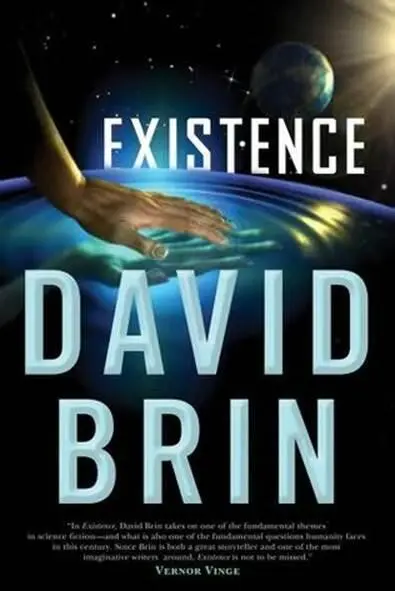
- Название:Existence
- Автор:
- Жанр:
- Год:неизвестен
- ISBN:нет данных
- Рейтинг книги:4 / 5. Голосов: 1
-
Избранное:Добавить в избранное
- Отзывы:
-
Ваша оценка:
Existence: краткое содержание, описание и аннотация
Предлагаем к чтению аннотацию, описание, краткое содержание или предисловие (зависит от того, что написал сам автор книги «Existence»). Если вы не нашли необходимую информацию о книге — напишите в комментариях, мы постараемся отыскать её.
Astronaut Gerald Livingstone grabs a crystal lump of floating space debris. Little does he suspect it's an alien artifact, sent across the vast, interstellar gulf, bearing a message.
"Join us!" – it proclaims. What does the enticing invitation mean? To enroll in a great federation of free races?
Only then, what of rumors that this starry messenger may not be the first? Have other crystals fallen from the sky, across 9,000 years? Some have offered welcome. Others… a warning!
This masterwork of science fiction combines hard-science speculation and fast-paced action with the deeply thoughtful ideas and haunting imagery that David Brin (best-selling author of Earth and The Postman) is known for in more than twenty languages.
Existence — читать онлайн бесплатно полную книгу (весь текст) целиком
Ниже представлен текст книги, разбитый по страницам. Система сохранения места последней прочитанной страницы, позволяет с удобством читать онлайн бесплатно книгу «Existence», без необходимости каждый раз заново искать на чём Вы остановились. Поставьте закладку, и сможете в любой момент перейти на страницу, на которой закончили чтение.
Интервал:
Закладка:
That was what Hamish got from the best yarns, spun by master storytellers. A temporary, willing belief that he could inhabit another world, bound by different rules. Better rules than the dry clockwork rhythms of this one.
The cephalopod emerged from her habitat-cage slowly, cautiously, soon after her handlers opened the gate. Two of her eight tentacles probed the rim as Tarsus brought her bulbous head forward, allowing one big eye-gleaming with feral intelligence-to peer around the rest of the pool. A few rocks and fronds dotted the sandy bottom. Briefly, she tracked some of the fish, darting overhead. But they were too quick and high to try for. She had eaten the slow or unwary, long ago.
With no other danger or opportunity in sight, Tarsus gave a pulse with her siphon, propelling herself toward the only thing of interest. A man-made box with two lids on top.
Whenever they let her out, it meant she had a task to do-one that Tarsus had performed many times before.
Oh, for sure, science wasn’t worthless. Hamish knew there was plenty of good work still to be done in the great laboratories, poking Nature, prying loose more secrets. Research was often a noble endeavor-he still viewed it that way-though one easily led astray.
Only, each night, even back in grad school, Hamish would feel the call of his old-fashioned laptop, and the characters who dwelled within. Dramatic premises kept popping into his head, during each day’s series of tedious meetings and meticulous lab rounds. And most of the stories that poured out through his fingertips revolved around a single, anxious worry.
Yes, the experiment is awesome. The new device seems cool. It may advance progress and make many lives better.
But what if things go horribly, catastrophically wrong?
Suppose, this time, we’ve gone too far?
He would picture slime molds, escaping their petri dish prisons, bursting forth to engulf screaming co-workers, then swarming outside to swallow a city. Some promising new drug might develop awful, delayed side effects, turning your loved ones into terrifying strangers. He envisioned robots escaping all their programmed safeguards, in order to go on killing sprees, then using their former human masters for spare parts. The next tomb unearthed by a naive archaeologist could spew forth poison spores, or hauntings. A new birth control pill instead unleashes Children of the Damned, assisted by aborted fetuses on a rampage! Or do-gooder environmentalists might cripple the nation’s industry and bring on a new stone age. He imagined SETI sky-searches attracting predatory computer viruses that then hypnotize humanity into slavery. Sure, the scenarios were lurid, but that just made them easier, and more fun to write!
Always, of course, there would be a lead character who-with Hamish’s own voice-started each book by wagging his finger, issuing dire warnings against the coming Big Mistake. A protagonist who later (as the dead piled higher) got to say, “I told you so!”
Tarsus used puffs of siphoned water to hover over the box, before bringing all eight of her tentacle arms into play, fondling the polished wooden surface. Bringing one eye close, and then the other, she examined new decorations that adorned each of the two latched covers.
She knew that she would only be allowed to open one of the compartments. As soon as she chose a lid to pry back, the other would lock. Not that it mattered. She always got a prize-a juicy crab-whichever door she selected. And yet, she never picked randomly.
Faces crowded close, human faces, pressing against the other side of a nearby observation pane. Their eyes-the only feature that seemed octopuslike-followed her every movement. Tarsus had a sense that her choice mattered to them. And so, obligingly, she examined the illustrations atop each lid, both visually and with a probing tendril tip.
When his career took off-with books and films and then vivid immersives-jealous complainers gathered round, yapping at Hamish. His stories played loose with scientific fact, they griped. His research consisted of gathering enough vocabulary and jargon to make the outlandish sound plausible.
Even worse (claimed his critics), Hamish Brookeman ignored all the modern safeguards and layers of accountability that earnest men and women had erected, in order to prevent exactly the mistakes that drove his tales. One reviewer even claimed to find a deeper pattern-that every calamity plot Hamish ever wrote arose because his arrogant villain-scientists compulsively insisted upon secrecy. Without that one ingredient, most of the disaster scenarios in his tales would get corrected by wiser heads. So, wasn’t his real complaint about doing bold things in the dark ? The older, more magical way?
Wouldn’t most of his warnings become moot, in a world with more openness, rather than less?
Such talk used to hurt, at first. But in time, Hamish learned to ignore the critics, even those who called him a “traitor to science.” He accomplished it quite simply, by writing them into his next tale-with thinly disguised name changes-to get eviscerated on cue. That was satisfaction enough. Ironically, it allowed him to stay genially mild and pleasant to almost everybody out here, in the merely real world.
Tarsus found no meaning in either of the symbols.
On rare occasions, she had recognized one or both, when the figures were shaped like things she knew. A fish or a simple octopus, or the spindly motif of a man. Far more often, they were just square-cornered emblems-combinations of the pure, flat, static colors that humans seemed to prefer… so different from the subtle hues and shades that rippled across the photo-active skin of any cephalopod, quicker than thought, letting an octopus like Tarsus blend into almost any background.
These emblems just lay there, as always, dull and uninspiring. Only, this time at least the shapes were unusual. They had the stretched outlines of air-breathing creatures, with limbs to carry them about, on land.
But they weren’t human.
And so, for a while, especially during the years with Carolyn, Hamish found some happiness, playing in one cosmos after another of his own devising-wherein he could be God, decreeing harsh punishments for ambitious vanity, meting out justice for the sin of hubris and technological pride.
Anyway, didn’t civilization obviously value him far more as a spinner of scary tales than it ever had before, as a researcher?
And who am I, to argue with civilization?
Yet, as the years passed and his voice grew stronger-becoming a leader in the rising Renunciation Movement-there came strange pangs that tasted like regret.
Which brought him around, full circle, to the very topic he had tried pushing from his ever busy thoughts. The message of the artilens-the aliens dwelling inside the virtual space of the Havana Artifact.
Nobody survives, they assured.
Not as organic beings, dwelling on the fragile, filmy surface of planets, exposed to innumerable dangers from above, below, and on every side. Plus countless hazards of their own making. That type of life is just too fragile, prone to countless missteps and mistakes. Nursery worlds like your Earth are fine for spawning new intelligent races. But then you must move on to higher states of being, before time runs out.
It left Hamish in a quandary. One small part of him felt vindicated by the aliens’ desolate story. The portion that had always viewed civilization-and its pompous, self-important fury-to be futile. A side of him that knew, all along, how inadequate human beings were. A species inherently doomed, whether by God, fate, or ornery nature, from very the start.
Читать дальшеИнтервал:
Закладка:
Похожие книги на «Existence»
Представляем Вашему вниманию похожие книги на «Existence» списком для выбора. Мы отобрали схожую по названию и смыслу литературу в надежде предоставить читателям больше вариантов отыскать новые, интересные, ещё непрочитанные произведения.

Обсуждение, отзывы о книге «Existence» и просто собственные мнения читателей. Оставьте ваши комментарии, напишите, что Вы думаете о произведении, его смысле или главных героях. Укажите что конкретно понравилось, а что нет, и почему Вы так считаете.