David Brin - Existence
Здесь есть возможность читать онлайн «David Brin - Existence» весь текст электронной книги совершенно бесплатно (целиком полную версию без сокращений). В некоторых случаях можно слушать аудио, скачать через торрент в формате fb2 и присутствует краткое содержание. Жанр: Фантастика и фэнтези, на английском языке. Описание произведения, (предисловие) а так же отзывы посетителей доступны на портале библиотеки ЛибКат.
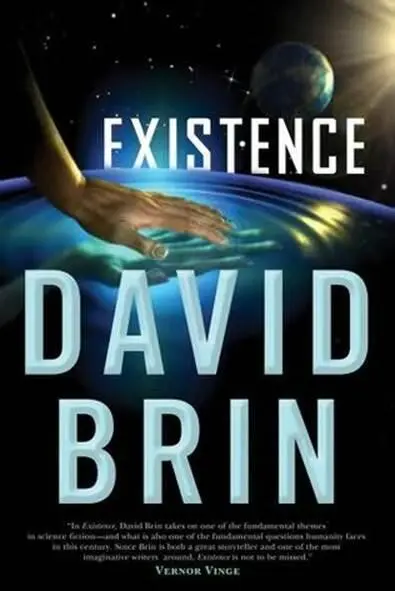
- Название:Existence
- Автор:
- Жанр:
- Год:неизвестен
- ISBN:нет данных
- Рейтинг книги:4 / 5. Голосов: 1
-
Избранное:Добавить в избранное
- Отзывы:
-
Ваша оценка:
Existence: краткое содержание, описание и аннотация
Предлагаем к чтению аннотацию, описание, краткое содержание или предисловие (зависит от того, что написал сам автор книги «Existence»). Если вы не нашли необходимую информацию о книге — напишите в комментариях, мы постараемся отыскать её.
Astronaut Gerald Livingstone grabs a crystal lump of floating space debris. Little does he suspect it's an alien artifact, sent across the vast, interstellar gulf, bearing a message.
"Join us!" – it proclaims. What does the enticing invitation mean? To enroll in a great federation of free races?
Only then, what of rumors that this starry messenger may not be the first? Have other crystals fallen from the sky, across 9,000 years? Some have offered welcome. Others… a warning!
This masterwork of science fiction combines hard-science speculation and fast-paced action with the deeply thoughtful ideas and haunting imagery that David Brin (best-selling author of Earth and The Postman) is known for in more than twenty languages.
Existence — читать онлайн бесплатно полную книгу (весь текст) целиком
Ниже представлен текст книги, разбитый по страницам. Система сохранения места последней прочитанной страницы, позволяет с удобством читать онлайн бесплатно книгу «Existence», без необходимости каждый раз заново искать на чём Вы остановились. Поставьте закладку, и сможете в любой момент перейти на страницу, на которой закончили чтение.
Интервал:
Закладка:
“No. Our only safe recourse would be to get as much out of this worldstone as possible, quickly, in order to catch up.”
Bin realized something, watching Nguyen weave this chain of logic, even as the others nodded in agreement. He is using this argument to support a decision that was already made, far above our heads.
Yang Shenxiu made one last attempt.
“Even if there were no such hidden stones, before, there are now pieces and fragments being discovered, all over the world. Artifact messengers that have drawn attention by sacrificing parts of themselves.”
“But you’ve seen the reports,” Anna responded. “Most of them are too shattered or melted or fused to offer anything coherent.”
“So far. But it has only been a few weeks. And don’t forget those glittering signs that people have detected in space! Undoubtedly from other stones, signaling for attention. Those would be undamaged and surely-”
“-can’t be reached by anyone for at least one or two years,” Anna interrupted again, making Bin frown in disapproval. “That’s how long it will take to gear up the space programs to send unmanned-and then manned-search and retrieval missions, even if preparations proceed at a breakneck pace.”
“Exactly!” Paul pounced. “Now, these things are rare. In a few years, they may be as plentiful as common stones! Those who have an advantage will surely act before that happens.” Then Paul blinked, as if unsure which side of the argument he had just supported.
“None of this changes the essential mission before us.” Dr. Nguyen signaled the end to discussion by adopting a decisive tone. “Xiang Bin, I want to start asking the Courier entity for useful things. No more stories or homesick picture shows about his homeworld. Nor denunciations of the stone in Washington. We need technologies and methodologies, as quickly and practically as possible. Make clear how much depends upon-”
He paused as-ten meters across the lavish chamber-a door opened. At the same instant, curtains of obscurity fell across the table-a dazzle-drapery consisting of countless tiny sparkles that prevented any newcomer from viewing the worldstone.
Too bad it also filled the air with a charged, ozone smell. Bin wrinkled his nose. He didn’t understand how a discretion screen was generated by “laser ionization of air molecules,” but he knew that a simple bolt of black velvet could have accomplished the same thing. Or else locking the door.
A liveried servant hurried in-a young woman with strawberry hair. Bin had spoken to her a few times, a refugee from New Zealand, whose spoken Chinese was broken and coarse, but she lent the place a chaste, decorative charm.
“I asked that we not be disturbed for any-” Nguyen began.
“Sir, I am so sorry, sir.” She bowed low, as if this were Japan, where they still cared about such niceties. “Supervisor Chen sent me to come to you here with discreet message for you. He needs you at command center. Right away.”
Nguyen started to get up, unfailingly polite. “Can you please say what it’s about?”
“Sir, I believe…” The young woman swallowed, then bowed again. “Supervisor Chen is worried that our security has been breached.”
In light of our present, worldwide hysteria over these crazy space Artifact messengers, I’ve decided to animate and hyper-reference one of the most popular person-interviews of ten years ago-back in that blessed era before we learned that we weren’t alone in the universe.
Let me rephrase that. Before we discovered that we actually ARE alone in the universe. Funny, how reality corresponds to both statements, at once, in dismal irony. Either way, it’s time to have another look at this prescient interview. Just will your gaze trackers to follow the keywords “doomsday-fatigue.” Let’s gather a comment-mob and do a full talmudic gloss on this piece.
MARTIN RAMER (FOR THE BBC):We’re here with Jonamine Bat Amittai, compiler of Pandora’s Cornucopia -the epibook that’s been scaring and depressing so many of us ever since Awfulday, conveying all the myriad ways that the universe might have it in for us, bringing an end to human existence. Or perhaps only our dreams.
Either way, it’s been a heady ride through the valley of potential failure and plausible death. Jonamine, how do you explain the popularity of your series?
JONAMINE BAT AMITTAI:Men and women have always been attracted to stories about ultimate doom, from the Books of Daniel and Revelation to Ragnarok, from Mayan cycles to Nostradamus, from Dr. Strangelove to Life After People . Perhaps there is an element of schadenfreude, or deriving abstract pleasure from the troubles of others-even if those others will be your own descendants. Or else, some may feel stimulated to relish what they have, in the precious here-and-now, especially if our lives and comforts appear to be on temporary loan from a capricious universe. For billions of people, nostalgia fascinates with the notion that the past is always better and preferable over the future.
I like to think that much of our fascination with this topic arises from our heritage as practical problem-solvers. The curiosity that drew our ancestors toward danger, in order to begin puzzling ways around it.
MARTIN RAMER:But your list is so lengthy, so extensive, so depressingly thorough. Even supposing that we do manage to discover some pitfalls in time, and act prudently to avoid them-
JONAMINE BAT AMITTAI:And we have already. Some of them.
MARTIN RAMER:But dodging one bullet seems always to put us in front of another.
JONAMINE BAT AMITTAI:Is there a question, Mr. Ramer? Or were you merely stating the obvious?
50.
The art that I practice is the only true form of magic.
It had taken Hamish years to realize this consciously, though he must have suspected it as a child, while devouring fantasy novels and playing whatever interactive game had the best narrative storyline. Later, at university and grad school, even while diligently studying the ornate laws and incantations of science, something had always struck him as wrong about the whole endeavor.
No, wrong wasn’t the word. Sterile. Or dry, or pallid… that is, compared to worlds of fiction and belief.
Then, while playing hooky one day from biomedical research, escaping into the vast realm of a little novel, he found a clue to his dilemma, in a passage written by the author, Tom Robbins.
Science gives man what he needs.
But magic gives him what he wants.
A gross oversimplification? Sure. Yet, Hamish instantly recognized the important distinction he’d been floundering toward.
For all its beauty, honesty, and effectiveness at improving the human condition, science demands a terrible price-that we accept what experiments tell us about the universe, whether we like it or not. It’s about consensus and teamwork and respectful critical argument, working with, and through, natural law. It requires that we utter, frequently, those hateful words-“I might be wrong.”
On the other hand, magic is what happens when we convince ourselves something is, even when it isn’t. Subjective Truth, winning over mere objective fact. The will, triumphing over all else. No wonder, even after the cornucopia of wealth and knowledge engendered by science, magic remains more popular, more embedded in the human heart.
Whether you labeled it faith, or self-delusion, or fantasy, or outright lying-Hamish recognized the species’ greatest talent, a calling that spanned all cultures and times, appearing far more often, in far more tribes, than dispassionate reason! Combine it with enough ardent wanting, and the brew might succor you through the harshest times, even periods of utter despair.
Читать дальшеИнтервал:
Закладка:
Похожие книги на «Existence»
Представляем Вашему вниманию похожие книги на «Existence» списком для выбора. Мы отобрали схожую по названию и смыслу литературу в надежде предоставить читателям больше вариантов отыскать новые, интересные, ещё непрочитанные произведения.

Обсуждение, отзывы о книге «Existence» и просто собственные мнения читателей. Оставьте ваши комментарии, напишите, что Вы думаете о произведении, его смысле или главных героях. Укажите что конкретно понравилось, а что нет, и почему Вы так считаете.