Isaac Asimov - Second Foundation
Здесь есть возможность читать онлайн «Isaac Asimov - Second Foundation» — ознакомительный отрывок электронной книги совершенно бесплатно, а после прочтения отрывка купить полную версию. В некоторых случаях можно слушать аудио, скачать через торрент в формате fb2 и присутствует краткое содержание. Жанр: Фантастика и фэнтези, на английском языке. Описание произведения, (предисловие) а так же отзывы посетителей доступны на портале библиотеки ЛибКат.
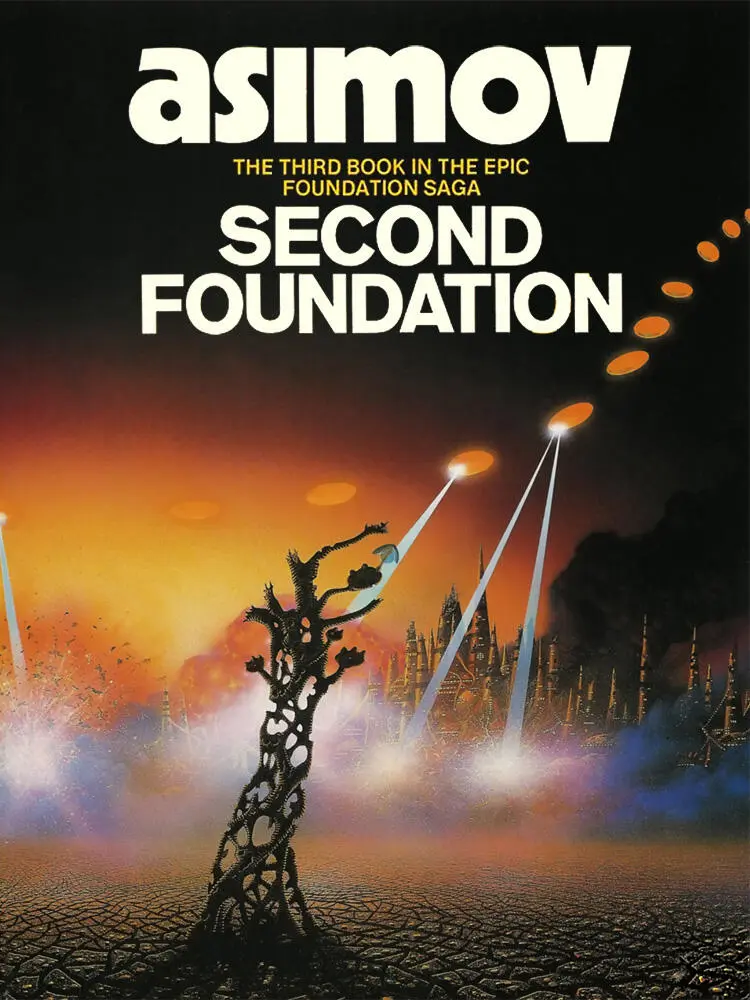
- Название:Second Foundation
- Автор:
- Жанр:
- Год:неизвестен
- ISBN:нет данных
- Рейтинг книги:4 / 5. Голосов: 1
-
Избранное:Добавить в избранное
- Отзывы:
-
Ваша оценка:
Second Foundation: краткое содержание, описание и аннотация
Предлагаем к чтению аннотацию, описание, краткое содержание или предисловие (зависит от того, что написал сам автор книги «Second Foundation»). Если вы не нашли необходимую информацию о книге — напишите в комментариях, мы постараемся отыскать её.
The fate of the Foundation now rests on young Arcadia Darell, only fourteen years old and burdened with a terrible secret. As its scientists gird for a final showdown with the Mule, the survivors of the First Foundation begin their desperate search. They too want the Second Foundation destroyed . . . before it destroys them.
Second Foundation — читать онлайн ознакомительный отрывок
Ниже представлен текст книги, разбитый по страницам. Система сохранения места последней прочитанной страницы, позволяет с удобством читать онлайн бесплатно книгу «Second Foundation», без необходимости каждый раз заново искать на чём Вы остановились. Поставьте закладку, и сможете в любой момент перейти на страницу, на которой закончили чтение.
Интервал:
Закладка:
“Um-m-m,” said Anthor. “Arcadia was born on Trantor, wasn’t she, doc?”
Darell nodded.
“It hangs together, you see. She wanted to go away—quickly and far—and Trantor would suggest itself. Don’t you think so?”
Darell said: “Why not back here?”
“Perhaps she was being pursued and felt that she had to double off in a new angle, eh?”
Dr. Darell lacked the heart to question further. Well, then, let her be safe on Trantor, or as safe as one could be anywhere in this dark and horrible Galaxy. He groped toward the door, felt Anthor’s light touch on his sleeve, and stopped, but did not turn.
“Mind if I go home with you, doc?”
“You’re welcome,” was the automatic response.
By evening, the exteriormost reaches of Dr. Darell’s personality, the ones that made immediate contact with other people, had solidified once more. He had refused to eat his evening meal and had, instead, with feverish insistence, returned to the inchwise advance into the intricate mathematics of encephalographic analysis.
It was not till nearly midnight that he entered the living room again.
Pelleas Anthor was still there, twiddling at the controls of the video. The footsteps behind him caused him to glance over his shoulder.
“Hi. Aren’t you in bed yet? I’ve been spending hours on the video, trying to get something other than bulletins. It seems the F.S. Hober Mallow is delayed in course and hasn’t been heard from.”
“Really? What do they suspect?”
“What do you think? Kalganian skulduggery? There are reports that Kalganian vessels were sighted in the general space sector in which the Hober Mallow was last heard from.”
Darell shrugged, and Anthor rubbed his forehead doubtfully.
“Look, doc,” he said, “why don’t you go to Trantor?”
“Why should I?”
“Because you’re no good to us here. You’re not yourself. You can’t be. And you could accomplish a purpose by going to Trantor, too. The old Imperial Library with the complete records of the Proceedings of the Seldon Commission are there—”
“No! The Library has been picked clean and it hasn’t helped anyone.”
“It helped Ebling Mis once.”
“How do you know? Yes, he said he found the Second Foundation, and my mother killed him five seconds later as the only way to keep him from unwittingly revealing its location to the Mule. But in doing so, she also, you realize, made it impossible ever to tell whether Mis really did know the location. After all, no one else has ever been able to deduce the truth from those records.”
“Ebling Mis, if you’ll remember, was working under the driving impetus of the Mule’s mind.”
“I know that, too, but Mis’ mind was, by that very token, in an abnormal state. Do you and I know anything about the properties of a mind under the emotional control of another; about its abilities and shortcomings? In any case, I will not go to Trantor.”
Anthor frowned, “Well, why the vehemence? I merely suggested it as—well, by Space, I don’t understand you. You look ten years older. You’re obviously having a hellish time of it. You’re not doing anything of value here. If I were you, I’d go and get the girl.”
“Exactly! It’s what I want to do, too. That’s why I won’t do it. Look, Anthor, and try to understand. You’re playing—we’re both playing—with something completely beyond our powers to fight. In cold blood, if you have any, you know that, whatever you may think in your moments of quixoticism.
“For fifty years, we’ve known that the Second Foundation is the real descendant and pupil of Seldonian mathematics. What that means, and you know that, too, is that nothing in the Galaxy happens which does not play a part in their reckoning. To us, all life is a series of accidents, to be met with by improvisations. To them, all life is purposive and should be met by precalculation.
“But they have their weakness. Their work is statistical and only the mass action of humanity is truly inevitable. Now how I play a part, as an individual, in the foreseen course of history, I don’t know. Perhaps I have no definite part, since the Plan leaves individuals to indeterminacy and free will. But I am important and they— they, you understand—may at least have calculated my probable reaction. So I distrust my impulses, my desires, my probable reactions.
“I would rather present them with an improbable reaction. I will stay here, despite the fact that I yearn very desperately to leave. No! Because I yearn very desperately to leave.”
The younger man smiled sourly. “You don’t know your own mind as well as they might. Suppose that—knowing you—they might count on what you think, merely think, is the improbable reaction, simply by knowing in advance what your line of reasoning would be.”
“In that case, there is no escape. For if I follow the reasoning you have just outlined and go to Trantor, they may have foreseen that, too. There is an endless cycle of double-double-double-double-crosses. No matter how far I follow that cycle, I can only either go or stay. The intricate act of luring my daughter halfway across the Galaxy cannot be meant to make me stay where I am, since I would most certainly have stayed if they had done nothing. It can only be to make me move, and so I will stay.
“And besides, Anthor, not everything bears the breath of the Second Foundation; not all events are the results of their puppeting. They may have had nothing to do with Arcadia’s leave-taking, and she may be safe on Trantor when all the rest of us are dead.”
“No,” said Anthor, sharply, “now you are off the track.”
“You have an alternative interpretation?”
“I have—if you’ll listen.”
“Oh, go ahead. I don’t lack patience.”
“Well, then—how well do you know your own daughter?”
“How well can any individual know any other? Obviously, my knowledge is inadequate.”
“So is mine on that basis, perhaps even more so—but at least, I viewed her with fresh eyes. Item one: She is a ferocious little romantic, the only child of an ivory-tower academician, growing up in an unreal world of video and book-film adventure. She lives in a weird self-constructed fantasy of espionage and intrigue. Item two: She’s intelligent about it; intelligent enough to outwit us, at any rate. She planned carefully to overhear our first conference and succeeded. She planned carefully to go to Kalgan with Munn and succeeded. Item three: She has an unholy hero-worship of her grandmother—your mother—who defeated the Mule.
“I’m right so far, I think? All right, then. Now, unlike you, I’ve received a complete report from Lieutenant Dirige and, in addition, my sources of information on Kalgan are rather complete, and all sources check. We know, for instance, that Homir Munn, in conference with the Lord of Kalgan, was refused admission to the Mule’s palace, and that this refusal was suddenly abrogated after Arcadia had spoken to Lady Callia, the First Citizen’s very good friend.”
Darell interrupted. “And how do you know all this?”
“For one thing, Munn was interviewed by Dirige as part of the police campaign to locate Arcadia. Naturally, we have a complete transcript of the questions and answers.
“And take Lady Callia herself. It is rumored that she has lost Stettin’s interest, but the rumor isn’t borne out by facts. She not only remains unreplaced; is not only able to mediate the lord’s refusal to Munn into an acceptance; but can even engineer Arcadia’s escape openly. Why, a dozen of the soldiers about Stettin’s executive mansion testified that they were seen together on the last evening. Yet she remains unpunished. This despite the fact that Arcadia was searched for with every appearance of diligence.”
Читать дальшеИнтервал:
Закладка:
Похожие книги на «Second Foundation»
Представляем Вашему вниманию похожие книги на «Second Foundation» списком для выбора. Мы отобрали схожую по названию и смыслу литературу в надежде предоставить читателям больше вариантов отыскать новые, интересные, ещё непрочитанные произведения.





Обсуждение, отзывы о книге «Second Foundation» и просто собственные мнения читателей. Оставьте ваши комментарии, напишите, что Вы думаете о произведении, его смысле или главных героях. Укажите что конкретно понравилось, а что нет, и почему Вы так считаете.