Isaac Asimov - Foundation's Edge
Здесь есть возможность читать онлайн «Isaac Asimov - Foundation's Edge» весь текст электронной книги совершенно бесплатно (целиком полную версию без сокращений). В некоторых случаях можно слушать аудио, скачать через торрент в формате fb2 и присутствует краткое содержание. Жанр: Фантастика и фэнтези, на английском языке. Описание произведения, (предисловие) а так же отзывы посетителей доступны на портале библиотеки ЛибКат.
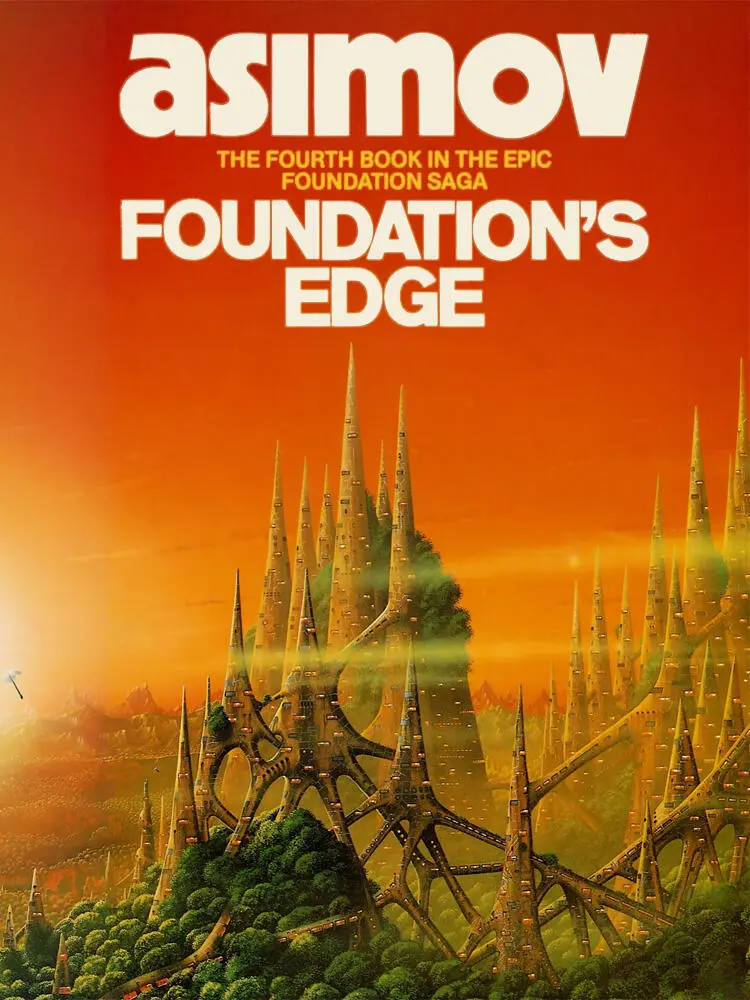
- Название:Foundation's Edge
- Автор:
- Жанр:
- Год:неизвестен
- ISBN:нет данных
- Рейтинг книги:4 / 5. Голосов: 1
-
Избранное:Добавить в избранное
- Отзывы:
-
Ваша оценка:
Foundation's Edge: краткое содержание, описание и аннотация
Предлагаем к чтению аннотацию, описание, краткое содержание или предисловие (зависит от того, что написал сам автор книги «Foundation's Edge»). Если вы не нашли необходимую информацию о книге — напишите в комментариях, мы постараемся отыскать её.
Meanwhile, someone—or something—outside both Foundations seems to be orchestrating events to suit its own ominous purpose. Soon representatives of both the First and Second Foundations will find themselves racing toward a mysterious world called Gaia and a final, shocking destiny at the very end of the universe.
Foundation's Edge — читать онлайн бесплатно полную книгу (весь текст) целиком
Ниже представлен текст книги, разбитый по страницам. Система сохранения места последней прочитанной страницы, позволяет с удобством читать онлайн бесплатно книгу «Foundation's Edge», без необходимости каждый раз заново искать на чём Вы остановились. Поставьте закладку, и сможете в любой момент перейти на страницу, на которой закончили чтение.
Интервал:
Закладка:
It was strange how much there was to her. How could so simple a creature hold such complexity? The smoothness of her mind structure had, beneath it, enormous intelligence, understanding, and courage. What more could he ask—of anyone?
Somehow, he caught an image of Sura Novi—who was not a Speaker, not even a Second Foundationer, not even educated—grimly at his side, playing a vital auxiliary role in the drama that was coming.
Yet he could not see the details clearly. —He could not yet see precisely what it was that awaited them.
2.
“A single Jump,” muttered Trevize, “And there it is.”
“Gaia?” asked Pelorat, looking over Trevize’s shoulder at the screen.
“Gaia’s sun,” said Trevize. “Call it Gaia-S, if you like, to avoid confusion. Galactographers do that sometimes.”
“And where is Gaia itself, then? Or do we call it Gaia-P—for planet?”
“Gaia would be sufficient for the planet. We can’t see Gaia yet, however. Planets aren’t as easy to see as stars are and we’re still a hundred microparsecs away from Gaia-S. Notice that it’s only a star, even though a bright one. We’re not close enough for it to show as a disc. —And don’t stare at it directly, Janov. It’s still bright enough to damage the retina. I’ll throw in a filter, once I’m through with my observations. Then you can stare.”
“How much is a hundred microparsecs in units which a mythologist can understand, Golan?”
“Three billion kilometers; about twenty times the distance of Terminus from our own sun. Does that help?”
“Enormously. —But shouldn’t we get closer?”
“No!” Trevize looked up in surprise. “Not right away. After what we’ve heard about Gaia, why should we rush? It’s one thing to have guts; it’s another to be crazy. Let’s take a look first.”
“At what, Golan? You said we can’t see Gaia yet?”
“Not at a glance, no. But we have telescopic viewers and we have an excellent computer for rapid analysis. We can certainly study Gaia-S, to begin with, and we can perhaps make a few other observations. —Relax, Janov.” He reached out and slapped the other’s shoulder with an avuncular flourish.
After a pause Trevize said, “Gaia-S is a single star or, if it has a companion, that companion is much farther away from it than we are at the present moment and it is, at best, a red dwarf, which means we need not be concerned with it. Gaia-S is a G4 star, which means it is perfectly capable of having a habitable planet, and that’s good. If it were an A or an M, we would have to turn around and leave right now.”
Pelorat said, “I may be only a mythologist, but couldn’t we have determined the spectral class of Gaia-S from Sayshell?”
“We could and we did, Janov, but it never hurts to check at closer quarters. —Gaia-S has a planetary system, which is no surprise. There are two gas giants in view and one of them is nice and large—if the computer’s distance estimate is accurate. There could easily be another on the other side of the star and therefore not easily detectable, since we happen—by chance—to be somewhat close to the planetary plane. I can’t make out anything in the inner regions, which is also no surprise.”
“Is that bad?”
“Not really. It’s expected. The habitable planets would be of rock and metal and would be much smaller than the gas giants and much closer to the star, if they’re to be warm enough—and on both counts they would be much harder to see from out here. It means we’ll have to get in considerably closer in order to probe the area within four microparsecs of Gaia-S.”
“I’m ready.”
“I’m not. We’ll make the Jump tomorrow.”
“Why tomorrow?”
“Why not? Let’s give them a day to come out and get us—and for us to get away, perhaps, if we spot them coming and don’t like what we see.”
3.
It was a slow and cautious process. During the day that passed, Trevize grimly directed the calculation of several different approaches and tried to choose between them. Lacking hard data, he could depend only on intuition, which unfortunately told him nothing. He lacked that “sureness” he sometimes experienced.
Eventually he punched in directions for a Jump that moved them far out of the planetary plane.
“That will give us a better view of the region as a whole,” he said, “since we will see the planets in every part of their orbit as maximum apparent distance from the sun. And they —whoever they may be—might not be quite as watchful over regions outside the plane. —I hope.”
They were now as close to Gaia-S as the nearest and largest of the gas giants was and they were nearly half a billion kilometers from it. Trevize placed it under full magnification on the screen for Pelorat’s benefit. It was an impressive sight, even if the three sparse and narrow rings of debris were left out of account.
“It has the usual train of satellites,” said Trevize, “but at this distance from Gaia-S, we know that none of them are habitable. Nor are any of them settled by human beings who survive, let us say, under a glass dome or under other strictly artificial conditions.”
“How can you tell?”
“There’s no radio noise with characteristics that point them out as of intelligent origin. Of course,” he added, qualifying his statement at once, “it is conceivable that a scientific outpost might go to great pains to shield its radio signals and the gas giant produces radio noise that could mask what I was looking for. Still, our radio reception is delicate and our computer is an extraordinarily good one. I’d say the chance of human occupation of those satellites is extremely small.”
“Does that mean there’s no Gaia?”
“No. But it does mean that if there is a Gaia, it hasn’t bothered to settle those satellites. Perhaps it lacks the capacity to do so—or the interest.”
“Well, is there a Gaia?”
“Patience, Janov. Patience.”
Trevize considered the sky with a seemingly endless supply of patience. He stopped at one point to say, “Frankly, the fact that they haven’t come out to pounce on us is disheartening, in a way. Surely, if they had the capacities they were described as having, they would have reacted to us by now.”
“It’s conceivable, I suppose,” said Pelorat glumly, “that the whole thing is a fantasy.”
“Call it a myth, Janov,” said Trevize with a wry smile, “and it will be right up your alley. Still, there’s a planet moving through the ecosphere, which means it might be habitable. I’ll want to observe it for at least a day.”
“Why?”
“To make sure it’s habitable, for one thing.”
“You just said it was in the ecosphere, Golan.”
“Yes, at the moment it is. But its orbit could be very eccentric, and could eventually carry it within a microparsec of the star, or out to fifteen microparsecs, or both. We’ll have to determine and compare the planet’s distance from Gaia-S with its orbital speed—and it would help to note the direction of its motion.”
4.
Another day.
“The orbit is nearly circular,” Trevize said finally, “which means that habitability becomes a much safer bet. Yet no one’s coming out to get us even now. We’ll have to try a closer look.”
Pelorat said, “Why does it take so long to arrange a Jump? You’re just taking little ones.”
“Listen to the man. Little Jumps are harder to control than big ones. Is it easier to pick up a rock or a fine grain of sand? Besides, Gaia-S is nearby and space is sharply curved. That complicates the calculations even for the computer. Even a mythologist should see that.”
Читать дальшеИнтервал:
Закладка:
Похожие книги на «Foundation's Edge»
Представляем Вашему вниманию похожие книги на «Foundation's Edge» списком для выбора. Мы отобрали схожую по названию и смыслу литературу в надежде предоставить читателям больше вариантов отыскать новые, интересные, ещё непрочитанные произведения.


Обсуждение, отзывы о книге «Foundation's Edge» и просто собственные мнения читателей. Оставьте ваши комментарии, напишите, что Вы думаете о произведении, его смысле или главных героях. Укажите что конкретно понравилось, а что нет, и почему Вы так считаете.