Ted Kosmatka - Prophet of Bones
Здесь есть возможность читать онлайн «Ted Kosmatka - Prophet of Bones» весь текст электронной книги совершенно бесплатно (целиком полную версию без сокращений). В некоторых случаях можно слушать аудио, скачать через торрент в формате fb2 и присутствует краткое содержание. Город: New York, Год выпуска: 2013, ISBN: 2013, Издательство: Henry Holt and Company, Жанр: Фантастика и фэнтези, Триллер, на английском языке. Описание произведения, (предисловие) а так же отзывы посетителей доступны на портале библиотеки ЛибКат.
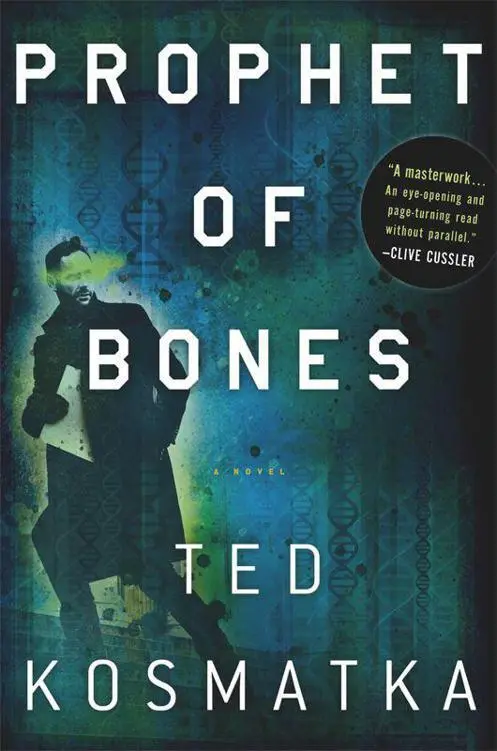
- Название:Prophet of Bones
- Автор:
- Издательство:Henry Holt and Company
- Жанр:
- Год:2013
- Город:New York
- ISBN:9780805096187
- Рейтинг книги:3 / 5. Голосов: 1
-
Избранное:Добавить в избранное
- Отзывы:
-
Ваша оценка:
Prophet of Bones: краткое содержание, описание и аннотация
Предлагаем к чтению аннотацию, описание, краткое содержание или предисловие (зависит от того, что написал сам автор книги «Prophet of Bones»). Если вы не нашли необходимую информацию о книге — напишите в комментариях, мы постараемся отыскать её.
Paul flees with two of his friends, yet within days one has vanished and the other is murdered in an attack that costs Paul an eye, and very nearly his life. Back in America, Paul tries to resume the comfortable life he left behind, but he can’t cast the questions raised by the dig from his mind. Paul begins to piece together a puzzle which seems to threaten the very fabric of society, but world’s governments and Martial Johnston, the eccentric billionaire who financed Paul’s dig, will stop at nothing to silence him.
Prophet of Bones — читать онлайн бесплатно полную книгу (весь текст) целиком
Ниже представлен текст книги, разбитый по страницам. Система сохранения места последней прочитанной страницы, позволяет с удобством читать онлайн бесплатно книгу «Prophet of Bones», без необходимости каждый раз заново искать на чём Вы остановились. Поставьте закладку, и сможете в любой момент перейти на страницу, на которой закончили чтение.
Интервал:
Закладка:
“I don’t work anymore,” he said.
“Did they force you out?”
“They didn’t force me. I resigned.”
“Ms. Bratton says that you’re still on the payroll.”
“It was their idea. A sign of respect for my service, they said.”
“It sounds like they want to keep you happy.”
“Yeah.”
“Are you coming back?”
“No.”
Paul pulled the envelope of photographs out of his backpack. “Charles, what are these pictures of?”
Charles’s face showed surprise. “I thought I wouldn’t see those again.”
“What are they?”
“They came in with a project. I was never able to learn more.”
“When did this happen?”
“Right before you left for Flores.” Charles lowered his eyes. “I heard about what happened there.”
“Do you know the password for the analysis computer on the fourth floor?”
“Yeah.”
“Will you tell me?”
Again Charles nodded, but not to Paul. Another item checked off the list. He stood. “Would you like to see something?” he asked.
“Sure,” Paul said. “If you want to show me.” He followed Charles into the kitchen, where Charles sank into a chair at his kitchen table. Where other houses might have dinner plates or place settings, here the table was covered with drawings. Dramatic, bold illustrations of birds, scratched out in charcoal against a white background. The drawings were piled everywhere. Some of the birds were flying. Others were perched on twigs. Birds of various shapes and sizes, with a whole assortment of different beak shapes.
“You’re an artist,” Paul said.
“No, no.”
“They’re beautiful.”
Charles shook his head. “I just draw what I see. I didn’t make the birds, after all; they are what’s beautiful.” Charles caressed one drawing with his long fingers. “That’s the true artistry. I just copy.”
Paul picked up a stack of drawings. “May I?”
“Sure.”
Paul leafed through the papers. “This must have taken you quite some time.”
“I enjoy drawing them,” Charles said. “It’s relaxing. Why do you want to know the password?”
“Because I want to break into the lab and run a comparison on a sample I took.”
Charles picked up his charcoal pencil and placed the point on one of the drawings. He traced along the outline of the bird’s leg. He did not nod to himself. That response hadn’t been on his internal list.
“What sample?”
Just like that, it was the moment to leap or not. To trust him or not. “A sample I smuggled out of Flores.”
Charles didn’t look up from the drawing. His face didn’t change.
“A sample of something new,” Paul said.
“I heard about your eye,” Charles said. “I heard you were mugged, but that’s not what really happened, is it?”
“No.”
“Then what did?”
So Paul told him everything. He told him about the Tylenol bottle, and the samples, and the flash drive. It felt good to say it. To tell someone about it. To risk it all. Charles’s face barely moved during the telling, though he did wince when Paul mentioned the knife attack. He only nodded, taking it all in. The perfect receptacle of knowledge.
When Paul finished, Charles nodded again, then said, “The password I last used was ‘deep clade.’”
Paul smiled. His trust, at least, had not been misplaced. “The Post-it note on the side of the computer said, ‘Flores.’”
“They must have changed the security pass since I left.”
“Is there a way to find out what it’s been changed to?”
“Were there any other Post-its?”
“I didn’t see any.”
Charles was silent for a moment. “Then no,” he said.
Paul pulled out a chair at the table and sat. He leafed through the drawings again.
“I like drawing finches the best,” Charles offered. “Darwin drew wonderful finches.”
“You follow Darwin?”
“He was wrong about everything, but he drew beautiful birds. So that’s something, at least.”
Paul leafed through to a final picture. A finch on a rock, the beak a delicate, curved scimitar.
Charles said, “You need to be careful of Janus.”
“He’s my lab partner. He’s the one training me.”
“Don’t trust him. You have to be careful.”
“I try to be.”
“You don’t want them noticing you. You don’t want them suspecting you.”
“I think they already do.”
“Then it’s already too late.”
Paul placed the drawing back on the table.
“Why do you want to test the Flores DNA?” Charles asked.
“To learn the truth.”
“Why?”
“Because people died. And because I need to know. That’s what science is supposed to do, isn’t it? Track down the truth, wherever it takes you.”
“What will you do with this knowledge, if you get it?”
“Expose it.”
“What would you expose?”
“The murder, the corporation, the conspiracy. Everything.” He searched Charles’s face for a reaction, but there was nothing. “People have died,” Paul said finally. “The truth is being hidden.”
“What will you do if you find out more than you expected?”
“What do you mean?”
“You told me about your bones and Flores. There are also things I can tell you.”
“I’ll listen to anything you want to say.”
“During my years at the company, I have seen many sequences. It is something few people come to appreciate, the subtle shape of the codes. During my work, I was doing a search of a database, and I mistyped the code I was searching for, a short nucleotide sequence. The search came up zero. This did not make sense. I found the mistake I’d made, a small typo, but still that did not solve the riddle. How could this simple mistyped code not exist in the database? In all the thousands of species on file, how could this sequence not be found in any of them? I searched every database we had, and I realized that this particular sequence of letterbases did not exist anywhere in the genome of any animal tested.”
“Is that unexpected?”
“It was a short sequence, a few dozen base pairs. It should have been somewhere, but it wasn’t. It was an outlaw code.”
“Outlaw code?”
“Yes. It was verboten.”
“I don’t understand.”
“Long sequences are unique because of statistical improbability. But certain short sequences—all short sequences, actually—should pop up again and again in the animal kingdom. Runs of twenty or thirty base pairs should occur by chance many thousands of times in thousands of species. But some are missing.”
“How could they be missing?”
“I don’t know.”
“So you’re saying that sometimes these short sequences… you can’t find them.”
“Yes. Because they’re not there.” Charles leaned back in his chair and glanced out the sliding glass door. His eyes got a faraway look. “And there are other things, too,” he said. “Other irregularities that I found. Sometimes I would build cladograms, and it’s possible to show how different sequences might be linked, simple mutations building on earlier mutations, and it’s possible to build trees, not just for recently derived substructures—like breeds of dogs or human ethnic populations. But for everything. All life. All tracing back to a single beginning.”
“How long ago?”
“Longer than the world has been in existence.”
Paul went back to the living room to get his backpack and set it on the floor in the kitchen.
“I tested the DNA of the Flores sample,” he said.
Charles’s face lifted from his drawing. “You have the raw code?”
“Yes. I brought a partial copy.”
“May I see it?”
Paul unzipped the pack and pulled out the stack of paper. He handed it to Charles.
Читать дальшеИнтервал:
Закладка:
Похожие книги на «Prophet of Bones»
Представляем Вашему вниманию похожие книги на «Prophet of Bones» списком для выбора. Мы отобрали схожую по названию и смыслу литературу в надежде предоставить читателям больше вариантов отыскать новые, интересные, ещё непрочитанные произведения.



Обсуждение, отзывы о книге «Prophet of Bones» и просто собственные мнения читателей. Оставьте ваши комментарии, напишите, что Вы думаете о произведении, его смысле или главных героях. Укажите что конкретно понравилось, а что нет, и почему Вы так считаете.