Ted Kosmatka - Prophet of Bones
Здесь есть возможность читать онлайн «Ted Kosmatka - Prophet of Bones» весь текст электронной книги совершенно бесплатно (целиком полную версию без сокращений). В некоторых случаях можно слушать аудио, скачать через торрент в формате fb2 и присутствует краткое содержание. Город: New York, Год выпуска: 2013, ISBN: 2013, Издательство: Henry Holt and Company, Жанр: Фантастика и фэнтези, Триллер, на английском языке. Описание произведения, (предисловие) а так же отзывы посетителей доступны на портале библиотеки ЛибКат.
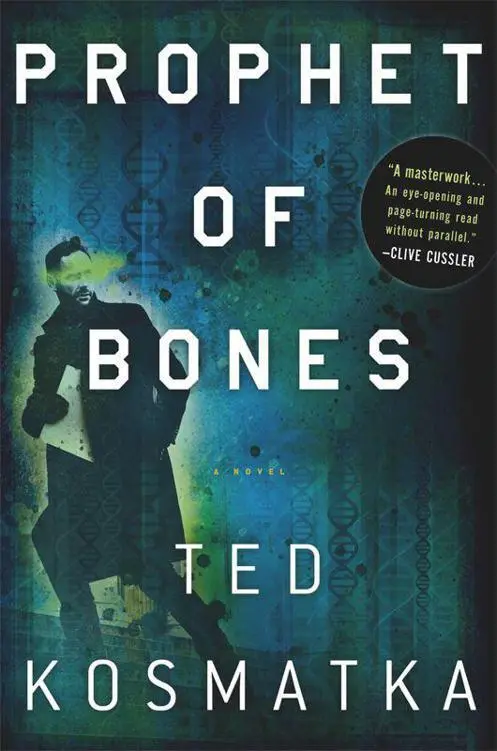
- Название:Prophet of Bones
- Автор:
- Издательство:Henry Holt and Company
- Жанр:
- Год:2013
- Город:New York
- ISBN:9780805096187
- Рейтинг книги:3 / 5. Голосов: 1
-
Избранное:Добавить в избранное
- Отзывы:
-
Ваша оценка:
Prophet of Bones: краткое содержание, описание и аннотация
Предлагаем к чтению аннотацию, описание, краткое содержание или предисловие (зависит от того, что написал сам автор книги «Prophet of Bones»). Если вы не нашли необходимую информацию о книге — напишите в комментариях, мы постараемся отыскать её.
Paul flees with two of his friends, yet within days one has vanished and the other is murdered in an attack that costs Paul an eye, and very nearly his life. Back in America, Paul tries to resume the comfortable life he left behind, but he can’t cast the questions raised by the dig from his mind. Paul begins to piece together a puzzle which seems to threaten the very fabric of society, but world’s governments and Martial Johnston, the eccentric billionaire who financed Paul’s dig, will stop at nothing to silence him.
Prophet of Bones — читать онлайн бесплатно полную книгу (весь текст) целиком
Ниже представлен текст книги, разбитый по страницам. Система сохранения места последней прочитанной страницы, позволяет с удобством читать онлайн бесплатно книгу «Prophet of Bones», без необходимости каждый раз заново искать на чём Вы остановились. Поставьте закладку, и сможете в любой момент перейти на страницу, на которой закончили чтение.
Интервал:
Закладка:
“Scientific periodicals. Bound in book form. Ah, this is it!”
She flipped the book open and set it on the table in the middle of the room. “The foxes,” she said.
Paul looked. Just as she’d said, it appeared to be a research paper on foxes.
“You’ve already read this, I take it?”
“I’ve read a lot of these books.”
“I thought you said it wasn’t worth the risk.”
“I meant to you. The risk to you.”
“Why show me now?”
“Because you’re already at risk.”
Paul looked closely at the document.
“The translation from Russian is banned,” she said, “but not the actual study itself. Consequently, this article gets cited sometimes, but the original research isn’t available. It’s a strange gray area. This is one of the few English translations.”
“I can take this home?”
“No. It can’t leave. Read it here.”
Paul sat down at the table to read. Lilli went to sleep in a chair, resting her head on a desk.
It took him an hour and a half to read through it. He understood why she’d wanted him to see it.
He woke her.
“So they bred tame foxes.”
She sat up and rubbed her eyes.
“They bred for docility,” he said, “and they got white patches on the coats and drooping ears.”
She nodded. “Like a side effect.”
“And in my mice, I bred for maximum expression of white spotting, and I got docility and drooping ears.”
“Like a side effect.”
“Like it’s all connected. Domestication syndrome,” he said. “What else can I read?”
“Whatever you want.”
She let him read through the night.
He woke her a little before dawn.
“We’d better go,” he said. “People will be coming in.”
As they left the library, he asked her, “Do you believe in this stuff?”
“What?”
“All those banned papers.”
“Of course not. Not most of it,” she said. “Most of it is ridiculous. Just old crank writings that were disproved long ago. But I think we should have the right to read it.”
“You don’t think it pollutes the mind?”
“Only if you let it.”
“They ban that stuff for a reason,” Paul said. “A little knowledge can be dangerous.”
She shook her head. “All knowledge is good. It’s what we do with it that matters.”
22
It was a full day’s drive to the museum. Paul left first thing in the morning, getting out of town before rush hour struck. He caught breakfast a few hours up the road, a Sausage McMuffin. Coffee black. The hills of Pennsylvania like some beautiful green oil painting flush with full summer—a series of wide, shallow valleys, too picturesque to be true, that he passed through at sixty miles per hour. He hit the state line a little after noon, lost in a daydream, road-numb and hungry again.
He wondered what she’d say when she saw him.
It had been a long time. A lot could change in six years. Everything, in fact.
He tried to remember their last words and found that he couldn’t recall them—not specifically.
Nothing too horrible, but she’d said it; he could remember that much—something about not wanting to see him again.
He’d considered phoning first, but he didn’t want to risk the call. The part of his brain that whispered against paranoia had been getting quieter and quieter lately. And recent events had caused it to shut up entirely. The paranoid part of his brain said he needed to worry about tapped phones, and the nonparanoid part responded with “Yeah, what he said.”
The truth was, Westing had him more than a little spooked. He wasn’t sure what they were capable of.
From the east, Chicago was something you crept up on, passing through a series of sprawling little suburbs until you finally rounded a curve in the highway and saw skyscrapers in the distance. Paul double-checked his map. Once in the city, he found his exits and descended to the surface streets, winding his way to the museum. At some point, it began to rain. He pulled into the closest lot he could find and paid an exorbitant fee to park his car. He grabbed the manila envelope off the passenger seat and climbed out.
It was a museum of the old guard, back when they knew how to build them. Huge Parthenonian pillars—baroque stonework and intricate detail, all on a scale designed to awe. Like Greek ruins before they were ruins, and with none of this new postmodern simplicity that seemed to govern the design of public works today. It was stone, mostly. And what wasn’t stone looked like stone. A structure in the form of a response, built after the turn of the last century; Chicago saying, Here is a building that will not burn.
Paul splashed through puddles and climbed the broad marble risers to the entranceway. He pushed through—a tiny glass man-door that seemed out of place on a building whose lobby could accommodate a battleship. Footsteps echoed in the expanse. A hundred people milled. Families with kids, tourists with cameras. Up ahead, in the central expanse, elephants shared space with dinosaur bones.
Paul stared for a moment at the enormous skeleton.
He’d always found articulated skeletons to be somewhat unsettling. Standing there, upright, an unnatural creature. It didn’t bother him when the bones were lying flat, resting on felt, assembled in rough approximation to a natural formation. But the single extra step of having them standing upright was one step too far. It implied something that wasn’t there. Bones connected by ghost tendons and ghost ligaments, held in place by ghost flesh. An artificial construction. In this case, it was a dinosaur, Tyrannosaurus rex, or something like it. A species drowned long ago and buried for thousands of years, now brought to light.
He approached the information desk. “I’d like to speak with someone from bones.”
The woman behind the counter looked at him as if he’d spoken Chinese.
He changed tacks: “I’d like to speak with Lillivati Gajjar.”
“She’s an employee here?”
“Yes.”
“What department?”
“Paleographic analysis.”
Again, the look. Like he’d spoken Chinese.
“She works with bones,” he said.
“I’ll see what I can do.”
She got on the phone and dialed a number. There was a pause, and then the woman spoke into the receiver: “A man is here to speak with a Lillivati Gajjar.”
Then came another pause. “Okay, connect me.” After a few moments, she said, “Hello, this is the information desk. There’s a man here to see Ms. Gajjar. Uh-huh.”
The woman turned to him. “What is this about?”
“I’m an old friend.”
The woman repeated Paul’s words into the phone. Another pause. “What did you say your name was?” the woman asked.
“Paul Carlsson.”
Again she repeated his words. There was a longer pause this time.
Long enough for him to wonder what the other side of the conversation sounded like.
“I’m here from Westing,” Paul said. “It’s a laboratory. I’m here to talk about bone samples.”
“He said he’s here from a lab,” the woman said. Another pause. Then: “Yes. Yes. Okay.” She hung up.
“She’s coming down. You can wait for her there.” She gestured to the seats along the wall.
“Thank you.”
Paul walked over to the benches and took a seat. Time seemed to slow. He laid the manila envelope across his legs and watched the reflection of people in the polished floor as they walked by. He listened to the clack of shoes, the slow rhythms of the visitors’ conversations. The light was beautiful, he decided, coming in through the massive skylights in the ceiling.
Five minutes later, he caught sight of Lillivati crossing the wide anteroom. She was as beautiful as ever. Tall and slender. Her hair was short, cut in a pixie style around her oval face. She was wearing a white lab coat with the museum’s name stenciled across the breast.
Читать дальшеИнтервал:
Закладка:
Похожие книги на «Prophet of Bones»
Представляем Вашему вниманию похожие книги на «Prophet of Bones» списком для выбора. Мы отобрали схожую по названию и смыслу литературу в надежде предоставить читателям больше вариантов отыскать новые, интересные, ещё непрочитанные произведения.






Обсуждение, отзывы о книге «Prophet of Bones» и просто собственные мнения читателей. Оставьте ваши комментарии, напишите, что Вы думаете о произведении, его смысле или главных героях. Укажите что конкретно понравилось, а что нет, и почему Вы так считаете.