Orson Card - Pathfinder
Здесь есть возможность читать онлайн «Orson Card - Pathfinder» весь текст электронной книги совершенно бесплатно (целиком полную версию без сокращений). В некоторых случаях можно слушать аудио, скачать через торрент в формате fb2 и присутствует краткое содержание. Год выпуска: 2010, ISBN: 2010, Издательство: Simon Pulse, Жанр: Фантастика и фэнтези, на английском языке. Описание произведения, (предисловие) а так же отзывы посетителей доступны на портале библиотеки ЛибКат.
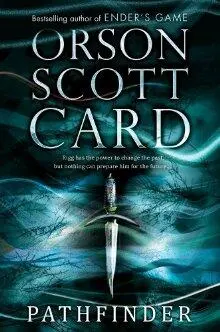
- Название:Pathfinder
- Автор:
- Издательство:Simon Pulse
- Жанр:
- Год:2010
- ISBN:978-1-4169-9176-2
- Рейтинг книги:5 / 5. Голосов: 1
-
Избранное:Добавить в избранное
- Отзывы:
-
Ваша оценка:
Pathfinder: краткое содержание, описание и аннотация
Предлагаем к чтению аннотацию, описание, краткое содержание или предисловие (зависит от того, что написал сам автор книги «Pathfinder»). Если вы не нашли необходимую информацию о книге — напишите в комментариях, мы постараемся отыскать её.
—secrets about Rigg's own past, his identity, and his destiny. And when Rigg discovers that he has the power not only to see the past, but also to change it, his future suddenly becomes anything but certain.
Rigg’s birthright sets him on a path that leaves him caught between two factions, one that wants him crowned and one that wants him dead. He will be forced to question everything he thinks he knows, choose who to trust, and push the limits of his talent…or forfeit control of his destiny.
Pathfinder — читать онлайн бесплатно полную книгу (весь текст) целиком
Ниже представлен текст книги, разбитый по страницам. Система сохранения места последней прочитанной страницы, позволяет с удобством читать онлайн бесплатно книгу «Pathfinder», без необходимости каждый раз заново искать на чём Вы остановились. Поставьте закладку, и сможете в любой момент перейти на страницу, на которой закончили чтение.
Интервал:
Закладка:
“Got it,” said Loaf. Then he drifted back in the queue, made a show of looking for something, and then went back against the flow of the crowd, ostensibly to find it.
“Why did you lie about the knife?” asked Rigg, as he and Umbo continued forward toward the checkpoint.
“I told you I put it in Loaf’s bags so you wouldn’t think I was trying to steal it. You even said yourself that you wouldn’t trust me if you thought I was stealing.”
“Umbo,” said Rigg, “I was wrong when I said I wouldn’t trust you. I trust you with my life.”
Umbo said nothing.
Rigg tried to keep other people between him and Cooper—he wanted to give Loaf plenty of time to get back inside the tower.
“Father always accused me of the worst thing,” said Umbo. “Whatever it was, he always said I was planning to do it. I’m just . . . used to it.”
“We’re friends, Umbo,” said Rigg. “Now try to act stupid and confused.”
“That won’t be acting,” said Umbo.
“I’m going to try to get you out of this,” said Rigg.
Then the people in front moved quickly forward and Rigg was staring Cooper in the face.
“That’s him,” said Cooper. “That’s the boy who’s claiming to be a prince.”
CHAPTER 9
Umbo
“If we are trapped inside the same starship, Ram, on the same voyage, moving backwards through time,” said the expendable, “why did the ship’s computers show that we made the jump successfully?”
“What were the criteria for determining a successful jump?” asked Ram.
“Observations of the positions of distant stars relative to how they should look near the target star system.”
“Can you bring up an image of what the stars looked like at the moment the computers determined that the jump was successful?”
In an instant, a hologram of a starfield appeared in the air over Ram’s console.
“I take it that’s not the appearance of the stars around our present position.”
“Correct,” said the expendable.
“How long did the stars have the appearance recorded here?”
“The scan was repeated three nanoseconds later and the stars were as they had been just before the jump.”
“So we made the jump, and then we unjumped,” said Ram.
“So it seems.”
“And we’re sure that this wasn’t just a glitch? That the computers weren’t just ‘detecting’ what they were predicted to detect?”
“No, because the starfield of the target was not quite identical to the prediction.”
“Show me the difference,” said Ram.
The starfield view on his holodisplay changed to show yellow and green dots instead of white ones.
“The nearest stars show the most difference, and the farthest ones the least,” Ram observed.
“Not always,” said the expendable, pointing to the few exceptions. “This is expected because our observations of the universe are based on old data—light that has had to travel ninety lightyears to reach Earth.”
“Didn’t the astronomers allow for that?”
“Yes,” said the expendable. “But it was partly guesswork.”
“Let’s play a game,” said Ram. “What if the difference between the prediction and what was observed in that less-than-three-nanosecond interval could be explained, not by astronomer error, but by the passage of time. Is there some point in the future or in the past when the stars would be in these positions relative to the target star system?”
One second. Two seconds.
“Eleven thousand years ago, roughly speaking,” said the expendable.
“So when we made our jump through a stuttering, quantized fold in spacetime, the fold didn’t just move us through space, it also moved us backward in time.”
“That is one explanation,” said the expendable.
“And so we got hurtled back into our previous position in spacetime, only progressing backward.”
“So it would seem,” said the expendable.
“That must have taken enormous energy,” said Ram. “To move us eleven thousand years backward in history, and then to recoil back to the present while reversing the flow of time.”
“It might have,” said the expendable, “if we understood how this actually works.”
“Please tell the computers to calculate what laws of physics would explain an exactly equal expenditure of energy for the two operations—passing through the fold into the past, and passing back but reversing direction.”
Umbo tried not to glare at Cooper. Stupid and confused, that’s how he was supposed to act. So he stared at the officers. Loaf had been right—the one with the more rumpled-looking uniform was showing nothing on his face, but there was something about his posture, the tilt of his head, that suggested he expected to be noticed and obeyed.
Umbo had expected that Rigg would talk to Cooper, challenge him, argue with him. But instead Rigg was as silent as Umbo. And when Umbo stole a glance at Rigg, he was looking the general straight in the face—not defiantly, but with the same steadiness as a bird.
“You thought I was fooled by your act, didn’t you, boy!” said Mr. Cooper. “All your strutting and posing, but the moment I saw your signature on the paper I knew you were a fraud and a thief.”
Umbo wanted to answer him, to say, You certainly gave us a lot of money for someone who knew we were frauds and thieves. He wanted to say, Rigg never even knew that was his name until he saw it on the paper. But instead Umbo said nothing, as Rigg was doing.
“Well, I notified the authorities in Aressa Sessamo that a boy was claiming to be the dead prince and had an ancient jewel—”
“Rigg Sessamekesh” was the name of a dead prince? Rigg had never heard of him, if that was so. But then, the People’s Revolutionary Council had made it illegal to talk about royals. Not that people in Fall Ford would have worried much about such a law, from such a far-off government. They simply didn’t care about royals, or the People’s Council either, for that matter. So until this moment Rigg had no idea that the name Father wrote on the paper meant anything except Rigg himself.
“That’s more of our business than needs to be discussed here,” said the officer who wasn’t the general. “You said there was a man.”
“A big man, a roadhouse keeper, they called him Loaf,” said Cooper.
“And this other boy?”
“They keep him like a pet, I have no idea what he’s good for, he’s the most ignorant privick of them all.”
Umbo couldn’t help the way his face reddened.
The officer chuckled. “He doesn’t like that.”
“I said he was ignorant, not deaf,” said Cooper.
“I notice you’re not denying anything,” said the officer to Rigg.
Rigg turned his gaze to the officer for a long, steady moment, and then returned to looking at the general. Umbo wanted to shout with laughter. In that simple look, Rigg had as much as told the officer he was a worm, not worth talking to. And yet his expression had not changed at all.
On impulse, Umbo started to cast his net of speeded-up time around Rigg.
Rigg turned to him and said, “No.”
Umbo stopped.
“No what ?” the officer demanded.
Rigg said nothing.
The officer turned to Umbo. “What did he tell you not to do?”
Umbo shrugged.
The officer seized him by the shoulder, his grip fiercely painful, as if he meant to drill a hole through his shoulder with his thumb. “What did he tell you not to do, boy?”
“He was thinking of running,” said Rigg.
“Oh, you can read his mind?” said the officer.
One of the tower guards approached them gingerly. “If you’ve found them, can we let people continue to leave the tower?”
Читать дальшеИнтервал:
Закладка:
Похожие книги на «Pathfinder»
Представляем Вашему вниманию похожие книги на «Pathfinder» списком для выбора. Мы отобрали схожую по названию и смыслу литературу в надежде предоставить читателям больше вариантов отыскать новые, интересные, ещё непрочитанные произведения.





Обсуждение, отзывы о книге «Pathfinder» и просто собственные мнения читателей. Оставьте ваши комментарии, напишите, что Вы думаете о произведении, его смысле или главных героях. Укажите что конкретно понравилось, а что нет, и почему Вы так считаете.