Gordon Dickson - The Human Edge
Здесь есть возможность читать онлайн «Gordon Dickson - The Human Edge» весь текст электронной книги совершенно бесплатно (целиком полную версию без сокращений). В некоторых случаях можно слушать аудио, скачать через торрент в формате fb2 и присутствует краткое содержание. Город: New York, Год выпуска: 2003, ISBN: 2003, Издательство: Baen Books, Жанр: Фантастика и фэнтези, на английском языке. Описание произведения, (предисловие) а так же отзывы посетителей доступны на портале библиотеки ЛибКат.
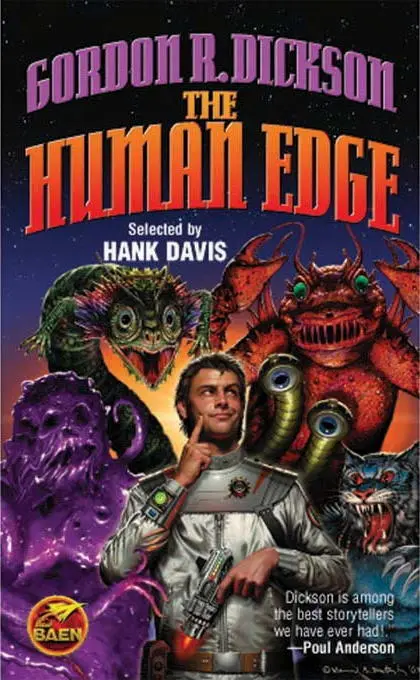
- Название:The Human Edge
- Автор:
- Издательство:Baen Books
- Жанр:
- Год:2003
- Город:New York
- ISBN:0-7434-7174-1
- Рейтинг книги:5 / 5. Голосов: 1
-
Избранное:Добавить в избранное
- Отзывы:
-
Ваша оценка:
The Human Edge: краткое содержание, описание и аннотация
Предлагаем к чтению аннотацию, описание, краткое содержание или предисловие (зависит от того, что написал сам автор книги «The Human Edge»). Если вы не нашли необходимую информацию о книге — напишите в комментариях, мы постараемся отыскать её.
The Human Edge — читать онлайн бесплатно полную книгу (весь текст) целиком
Ниже представлен текст книги, разбитый по страницам. Система сохранения места последней прочитанной страницы, позволяет с удобством читать онлайн бесплатно книгу «The Human Edge», без необходимости каждый раз заново искать на чём Вы остановились. Поставьте закладку, и сможете в любой момент перейти на страницу, на которой закончили чтение.
Интервал:
Закладка:
Jerry swallowed. Even his vocal cords seemed drained of strength and limp.
“You realize,” he croaked, “what would have happened if I hadn’t?”
“You took a chance. You followed a wild hunch—”
“No hunch,” said Jerry. He cleared his throat. “Art found that growth on Wally’s brain had quit growing before Wally killed himself. And I’d been getting along without tranquilizers—handling the nightmares better than I had with them.”
“It could have been the growth in your own brain,” said Milt, “taking over and running you—working better on you than it had on Wally.”
“Working better—talk sense!” said Jerry weakly, too pared down by the past two weeks to care whether school kept or not, in the matter of service courtesy to a superior. “The nightmares had broken Wally down to where we had to wrap him in a straitjacket. They hadn’t even knocked me off my feet. If Wally’s physiological processes had fought the alien invasion to a standstill, then I, you, Art, and Ben—all of us—had to be doing even better. Besides—I’d figured out what the aliens were after.”
“What were they after?” Milt looked strangely at him.
“Curing us—of something we didn’t have when we landed, but they thought we had.”
“And what was that?”
“Insanity,” said Jerry grimly.
Milt’s blond eyebrows went up. He opened his mouth as if to say something disbelieving—then closed it again. When he did speak, it was quite calmly and humbly.
“They thought,” he asked, “Communicator’s people thought that we were insane, and they could cure us?”
Jerry laughed; not cheerfully, but grimly.
“You saw that jungle around us back there?” he asked. “That was a factory complex—an infinitely complex factory complex. You saw their village with those tangles of roots inside the big whitish shells?—that was a highly diversified laboratory.”
Milt’s blue eyes slowly widened, as Jerry watched.
“You don’t mean that—seriously?” said Milt, at last.
“That’s right.” Jerry drained the cup and set it aside. “Their technology is based on organic chemistry, the way ours is on the physical sciences. By our standards, they’re chemical wizards. How’d you like to try changing the mind of an alien organism by managing to grow an extra part on to his brain—the way they tried to do to us humans? To them, it was the simplest way of convincing us.”
Milt stared again. Finally, he shook his head.
“Why?” he said. “Why would they want to change our minds?”
“Because their philosophy, their picture of life and the universe around them grew out of a chemically oriented science,” answered Jerry. “The result is, they see all life as part of a closed, intra-acting chemical circuit with no loose ends; with every living thing, intelligent or not, a part of the whole. Well, you saw it for yourself in your nightmare. That’s the cosmos as they see it—and to them it’s beautiful.”
“But why did they want us to see it the way they did?”
“Out of sheer kindness,” said Jerry and laughed barkingly. “According to their cosmology, there’s no such thing as an alien. Therefore we weren’t alien—just sick in the head. Poisoned by the lumps of metal like the ship and the translator we claimed were so important. And our clothes and everything else we had. The kind thing was to cure and rescue us.”
“Now, wait a minute,” said Milt. “They saw those things of ours work— ”
“What’s the fact they worked got to do with it? What you don’t understand, Milt,” said Jerry, lying back gratefully on the bunk, “is that Communicator’s peoples’ minds were closed. Not just unconvinced, not just refusing to see—but closed! Sealed, and welded shut from prehistoric beginnings right down to the present. The fact our translator worked meant nothing to them. According to their cosmology, it shouldn’t work, so it didn’t. Any stray phenomena tending to prove it did were simply the product of diseased minds.”
Jerry paused to emphasize the statement and his eyes drifted shut. The next thing he knew Milt was shaking him.
“…Wake up!” Milt was shouting at him. “You can dope off after you’ve explained. I’m not going to have any crew back in straitjackets again, just because you were too sleepy to warn me they’d revert!”
“…Won’t revert,” said Jerry thickly. He roused himself. “Those lengths of vine released chemicals into their bloodstreams to destroy what was left of the growths. I wouldn’t leave until I got them from Communicator.” Jerry struggled up on one elbow again. “And after a short walk in a human brain—mine—he and his people couldn’t get us out of sight and forgotten fast enough.”
“Why?” Milt shook him again as Jerry’s eyelids sagged. “Why should getting their minds hooked in with yours shake them up so?”
“…Bust—bust their cosmology open. Quit shaking…I’m awake.”
“ Why did it bust them wide open?”
“Remember—how it was for you with the nightmares?” said Jerry. “The other way around? Think back, about when you slept. There you were, a lone atom of humanity, caught up in a nightmare like one piece of stew meat in a vat stewing all life together—just one single chemical bit with no independent existence, and no existence at all except as part of the whole. Remember?”
He saw Milt shiver slightly.
“It was like being swallowed up by a soft machine,” said the Team captain in a small voice. “I remember.”
“All right,” said Jerry. “That’s how it was for you in Communicator’s cosmos. But remember something about that cosmos? It was warm, and safe. It was all-embracing, all-settling, like a great, big, soft, woolly comforter.”
“It was too much like a woolly comforter,” said Milt, shuddering. “It was unbearable.”
“To you. Right,” said Jerry. “But to Communicator, it was ideal. And if that was ideal, think what it was like when he had to step into a human mind—mine.”
Milt stared at him.
“Why? “Milt asked.
“Because,” said Jerry, “he found himself alone there!”
Milt’s eyes widened.
“Think about it, Milt,” said Jerry. “From the time we’re born, we’re individuals. From the moment we open our eyes on the world, inside we’re alone in the universe. All the emotional and intellectual resources that Communicator draws from his identity with the stewing vat of his cosmos, each one of us has to dig up for and out of himself!”
Jerry stopped to give Milt a chance to say something. But Milt was evidently not in possession of something to say at the moment.
“That’s why Communicator and the others couldn’t take it, when they hooked into my human mind,” Jerry went on. “And that’s why, when they found out what we were like inside, they couldn’t wait to get rid of us. So they gave me the vines and kicked us out. That’s the whole story.” He lay back on the bunk.
Milt cleared his throat.
“All right,” he said.
Jerry’s heavy eyes closed. Then the other man’s voice spoke, still close by his ear.
“But,” said Milt, “I still think you took a chance, going down to butt heads with the natives that way. What if Communicator and the rest had been able to stand exposure to your mind. You’d locked me in and the other men were in restraint. Our whole team would have been part of that stewing vat.”
“Not a chance,” said Jerry.
“You can’t be sure of that.”
“Yes I can.” Jerry heard his own voice sounding harshly beyond the darkness of his closed eyelids. “It wasn’t just that I knew my cosmological view was too tough for them. It was the fact that their minds were closed—in the vat they had no freedom to change and adapt themselves to anything new.”
Читать дальшеИнтервал:
Закладка:
Похожие книги на «The Human Edge»
Представляем Вашему вниманию похожие книги на «The Human Edge» списком для выбора. Мы отобрали схожую по названию и смыслу литературу в надежде предоставить читателям больше вариантов отыскать новые, интересные, ещё непрочитанные произведения.










Обсуждение, отзывы о книге «The Human Edge» и просто собственные мнения читателей. Оставьте ваши комментарии, напишите, что Вы думаете о произведении, его смысле или главных героях. Укажите что конкретно понравилось, а что нет, и почему Вы так считаете.