Gordon Dickson - The Human Edge
Здесь есть возможность читать онлайн «Gordon Dickson - The Human Edge» весь текст электронной книги совершенно бесплатно (целиком полную версию без сокращений). В некоторых случаях можно слушать аудио, скачать через торрент в формате fb2 и присутствует краткое содержание. Город: New York, Год выпуска: 2003, ISBN: 2003, Издательство: Baen Books, Жанр: Фантастика и фэнтези, на английском языке. Описание произведения, (предисловие) а так же отзывы посетителей доступны на портале библиотеки ЛибКат.
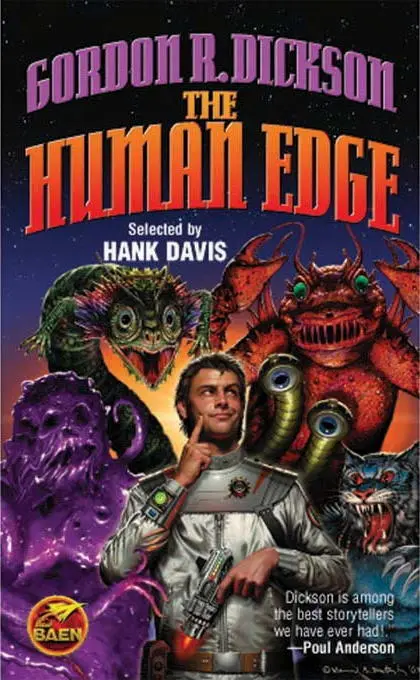
- Название:The Human Edge
- Автор:
- Издательство:Baen Books
- Жанр:
- Год:2003
- Город:New York
- ISBN:0-7434-7174-1
- Рейтинг книги:5 / 5. Голосов: 1
-
Избранное:Добавить в избранное
- Отзывы:
-
Ваша оценка:
The Human Edge: краткое содержание, описание и аннотация
Предлагаем к чтению аннотацию, описание, краткое содержание или предисловие (зависит от того, что написал сам автор книги «The Human Edge»). Если вы не нашли необходимую информацию о книге — напишите в комментариях, мы постараемся отыскать её.
The Human Edge — читать онлайн бесплатно полную книгу (весь текст) целиком
Ниже представлен текст книги, разбитый по страницам. Система сохранения места последней прочитанной страницы, позволяет с удобством читать онлайн бесплатно книгу «The Human Edge», без необходимости каждый раз заново искать на чём Вы остановились. Поставьте закладку, и сможете в любой момент перейти на страницу, на которой закончили чтение.
Интервал:
Закладка:
It was not possible to advance one small segment of a civilization. It had to be upgraded as a whole. That meant cooperation, which was not now in effect. The Tomah had a science, but no trade. They were isolated on a few of the large land-masses by the seas that covered nine-tenths of their globe. Ironically, on a world which had great amounts of settleable land and vast untapped natural resources, they were cramped for living room and starved for raw materials. All this because to venture out on the Lugh-owned seas was sheer suicide. Their civilization was still in the candlelit, domestic-beast-powered stage, although they were further advanced in theory.
The Lugh, on the other hand, with the overwhelming resources of the oceans at their disposal, had by their watery environment been prohibited from developing a chemistry. The sea-girt islands and the uninhabited land masses were open to them; but, being already on the favorable end of the current status quo, they had had no great need or urge to develop further. What science they had come up with had been mainly for the purpose of keeping the Tomah in their place.
The human sociologists had given their opinion that the conflicts between the two races were no longer based on valid needs. They were, in fact, hangovers from competition in more primitive times when both peoples sought to control the seashores and marginal lands. To the Tomah in those days (and still), access to the seas had meant a chance to tap a badly needed source of food; and to the Lugh (no longer), access to the shore had meant possession of necessary breeding grounds. In the past the Tomah had attempted to clear the Lugh from their path by exterminating their helpless land-based young. And the Lugh had tried to starve the Tomah out, by way of retaliation.
The problem was to bury these ancient hatreds and prove cooperation was both practical and profitable. The latest step in this direction was to invite representatives of both races to a conference at the human Base on the uninhabited southern continent of this particular hemisphere. The humans would act as mediator, since both sides were friendly toward them. Which was what caused Chuck to be at the controls now, with his two markedly dissimilar passengers in the bins behind him.
Unfortunately, the sudden appearance of Member Thomas Wagnall meant they were getting impatient back home. In fact, he could not have come at a worse time. Human prestige with the two races was all humanity had to work with; and it was a delicate thing. And now had arisen this suddenly new question in Chuck’s mind as to whether Binichi had regarded his promise to start no trouble with the Tomah as an ironclad guaranty, or a mere casual agreement contingent upon a number of unknown factors.
The question acquired its full importance a couple of hours later, and forty thousand feet above nothing but ocean, when the main burners abruptly cut out.
II
Chuck wiped blood from his nose and shook his head to clear it. Underneath him, the life raft was rocking in soothing fashion upon the wide swell of the empty ocean; but, in spite of the fact that he knew better, he was having trouble accepting the reality of his present position.
Everything had happened a little too fast. His training for emergency situations of this sort had been semi-hypnotic. He remembered now a blur of action in which he had jabbed the distress button to send out an automatic signal on his position and predicament. Just at that moment the standby burners had cut in automatically—which was where he had acquired the bloody nose, when the unexpected thrust slammed him against the controls. Then he had cut some forty-two various switches, got back to the main compartment, unharnessed his passengers, herded them into the escape hatch, blown them all clear, hit the water, inflated the life raft, and got them aboard it just as the escape hatch itself sank gracefully out of sight. The pot, of course, had gone down like so much pig iron when it hit.
And here they were.
Chuck wiped his nose again and looked at the far end of the rectangular life raft. Binichi, the closer of the two, was half-lolling, half-sitting on the curved muscle of his tail. His curved mouth was half-open as if he might be laughing at them. And indeed, thought Chuck, he very well might. Chuck and the envoy, adrift on this watery waste, in this small raft, were castaways in a situation that threatened their very lives. Binichi the Lugh was merely and comfortably back at home.
“Binichi,” said Chuck. “Do you know where we are?”
The curved jaw gaped slightly wider. The Lugh head turned this way and that on the almost nonexistent neck; then, twisting, he leaned over the edge of the raft and plunged his whole head briefly under water like a duck searching for food. He pulled his head out again, now slick with moisture.
“Yes,” said Binichi.
“How far are we from the coast of the south continent?”
“A day’s swim,” said Binichi. “And most of a night.”
He gave his information as a simple statement of fact. But Chuck knew the Lugh was reckoning in his own terms of speed and distance, which were roughly twelve nautical miles an hour as a steady pace. Undoubtedly it could be done in better time if a Lugh had wished to push himself. The human Base had clocked some of this race at up to eighty miles an hour through the water for short bursts of speed.
Chuck calculated. With the small outboard thrust unit provided for the raft, they would be able to make about four miles an hour if no currents went against them. Increase Binichi’s estimate then by a factor of three—three days and nights with a slight possibility of its being less and a very great probability of its taking more. Thought of the thrust unit reminded him. He went to work unfolding it from its waterproof seal and attaching it in running position. Binichi watched him with interest, his head cocked a little on one side like an inquisitive bird’s; but as soon as the unit began to propel the raft through the waves at its maximum cruising speed of four miles an hour, his attention disappeared.
With the raft running smoothly, Chuck had another question.
“Which way?”
Binichi indicated with a short thick-muscled forearm, and Chuck swung the raft in nearly a full turn. A slight shiver ran down his spine as he did so. He had been heading away from land out into nearly three thousand miles of open ocean.
“Now,” said Chuck, locking the tiller, and looking at both of them. “It’ll take us three days and nights to make the coast. And another three or four days to make it overland from there to the Base. The accident happened so quickly I didn’t have time to bring along anything with which I could talk to my friends there.” He paused, then added: “I apologize for causing you this inconvenience.”
“There is no inconvenience,” said Binichi, and bubbled in his throat. The envoy neither moved nor answered.
“This raft,” said Chuck, “has food aboard it for me, but nothing, I think, that either one of you could use. There’s water, of course. Otherwise, I imagine Binichi can make out with the sea all around him, the way it is; and I’m afraid there’s not much to be done for you, Envoy, until we reach land. Then you’ll be in Binichi’s position of being able to forage for yourself.”
The envoy still did not answer. There was no way of knowing what he was thinking. Sitting facing the two of them, Chuck tried to imagine what it must be like for the Tomah, forced into a position inches away from his most deadly traditional enemy. And with the private preserves of that enemy, the deep-gulfed sea, source of all his culture’s legends and terrors, surrounding him. True, the envoy was the pick of his people, a learned and intelligent being—but possibly there could be such a situation here that would try his self-control too far.
Читать дальшеИнтервал:
Закладка:
Похожие книги на «The Human Edge»
Представляем Вашему вниманию похожие книги на «The Human Edge» списком для выбора. Мы отобрали схожую по названию и смыслу литературу в надежде предоставить читателям больше вариантов отыскать новые, интересные, ещё непрочитанные произведения.








Обсуждение, отзывы о книге «The Human Edge» и просто собственные мнения читателей. Оставьте ваши комментарии, напишите, что Вы думаете о произведении, его смысле или главных героях. Укажите что конкретно понравилось, а что нет, и почему Вы так считаете.