Frank Schätzing - Limit
Здесь есть возможность читать онлайн «Frank Schätzing - Limit» весь текст электронной книги совершенно бесплатно (целиком полную версию без сокращений). В некоторых случаях можно слушать аудио, скачать через торрент в формате fb2 и присутствует краткое содержание. Город: London, Год выпуска: 2013, ISBN: 2013, Издательство: Jo Fletcher Books, Жанр: Фантастика и фэнтези, на английском языке. Описание произведения, (предисловие) а так же отзывы посетителей доступны на портале библиотеки ЛибКат.
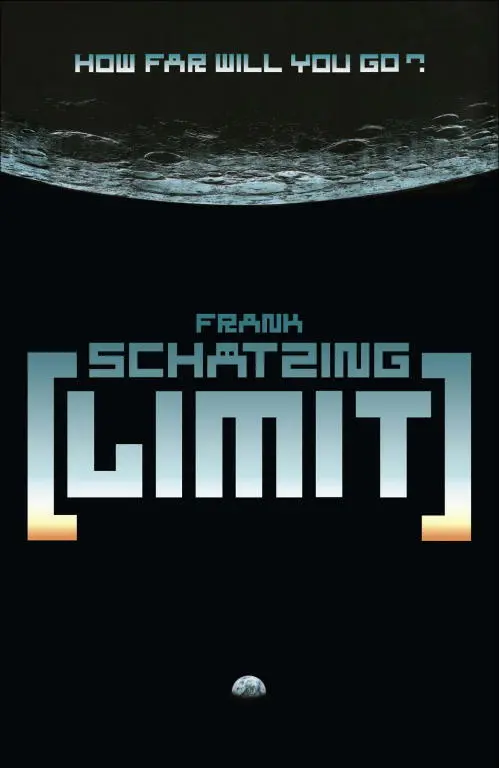
- Название:Limit
- Автор:
- Издательство:Jo Fletcher Books
- Жанр:
- Год:2013
- Город:London
- ISBN:9781849165150
- Рейтинг книги:4 / 5. Голосов: 1
-
Избранное:Добавить в избранное
- Отзывы:
-
Ваша оценка:
Limit: краткое содержание, описание и аннотация
Предлагаем к чтению аннотацию, описание, краткое содержание или предисловие (зависит от того, что написал сам автор книги «Limit»). Если вы не нашли необходимую информацию о книге — напишите в комментариях, мы постараемся отыскать её.
In 2025, entrepreneur Julian Orley opens the first-ever hotel on the moon. But Orley Enterprises deals in more than space tourism—it also operates the world’s only space elevator, which in addition to allowing the very wealthy to play tennis on the lunar surface connects Earth with the moon and enables the transportation of helium-3, the fuel of the future, back to the planet. Julian has invited twenty-one of the world’s richest and most powerful individuals to sample his brand-new lunar accommodation, hoping to secure the finances for a second elevator…
On Earth, meanwhile, cybercop Owen Jericho is sent to Shanghai to find a young female hacker known as Yoyo, who’s been on the run since acquiring access to information that someone seems quite determined to keep quiet. As Jericho closes in on the girl and the conspiracy swirling around her, he finds mounting evidence that connects her to Julian Orley as well as to the entrepreneur’s many competitors and enemies. Soon, the detective realizes that the lunar junket to Orley’s hotel is in real and immediate danger.
Limit — читать онлайн бесплатно полную книгу (весь текст) целиком
Ниже представлен текст книги, разбитый по страницам. Система сохранения места последней прочитанной страницы, позволяет с удобством читать онлайн бесплатно книгу «Limit», без необходимости каждый раз заново искать на чём Вы остановились. Поставьте закладку, и сможете в любой момент перейти на страницу, на которой закончили чтение.
Интервал:
Закладка:
Hanna’s fingers clutched the weapon. He rested his free hand on the sensor field, raised the bulkhead and took a step back.
Locatelli slumped out from the cabin like a sack and stared at the ceiling. His left arm weakly struck the floor, his fingers open as if he were begging for a final pittance. His right hand, still in the lock, was wrapped around the lower edge of his helmet. There was no outward sign of injury, and in any case he had been able to take off his armour before he collapsed.
Hanna frowned, leaned forward and paused.
At that moment he realised that something was wrong. The unusually healthy colour of the man’s face might be just about compatible with his being a corpse – but Warren Locatelli was definitely the first dead person he’d ever seen sweating.
So, Hanna.
Locatelli cried out. With all his might he swung the helmet, hit Hanna’s arm, saw the weapon flying away, leapt up.
Hanna staggered.
That the Canadian would see through his bluff and shoot him a moment later had been Locatelli’s worst-case expectation. So, two seconds after the attack, what surprised him most of all was that he was still alive. Countless times during the sequence of eternities that had passed since the shuttle lifted off, he had tried to imagine the situation and calculate his chances. Now here they were, and there was no longer any time to think, not even to wonder or catch his breath. Trusting, in the Celtic manner, to the effects of a good shout, loud and inarticulate like an attacking horde, he thrashed away at his opponent with his helmet, again and again, without a pause, without giving him the slightest opportunity to retreat, saw his knees bending, aimed at the top of his shaven head, struck again, as hard as he could. The Canadian made a grab for him. Locatelli dealt him a kick to the shoulder. God knew he had fought quite enough in his life, both often and enthusiastically, but never with a professional hitman, as Hanna plainly was when you looked at things with a lucid eye, so for the sake of certainty he brought the helmet down on his head once more, even though the man hadn’t moved a muscle for ages, grabbed for the curious weapon, staggered a few steps back and took aim.
Spurts of blood from the back of Hanna’s head, on the floor.
Locatelli’s hand was shaking.
After a while, quivering with fear, he risked stepping forward again, crouched down and held the barrel to Hanna’s temple. No reaction. The Canadian’s eyes were shut and his breathing was heavy. Locatelli blinked, felt his heartbeat gradually slowing down. Waited. Nothing happened. Went on waiting.
Nothing. Nothing at all.
Gradually he was starting to believe that the man really was unconscious.
Where should he put him? He thought frantically. Perhaps he should chuck him in the lock and simply get rid of him on the flight. But that would have been murder, and even at his most reckless Locatelli was no murderer. And he wanted to know why Peter, Mimi and Marc had had to die, what Hanna’s crappy aims had been. He needed information, and anyway, Momoka, Julian, the others, were stuck on the Aristarchus Plateau! He had to get back and fetch them, that had absolute priority.
And how, smart-arse?
His gaze wandered to the cockpit. He knew how to drive a racing car, how to sail a yacht into the wind. But he hadn’t the faintest idea about Hornets, or about where the Ganymede was headed, how high and how fast it flew. Nothing on board was designed to lift his spirits. Here the Canadian, who would eventually come round, there the unfamiliar world of the cockpit. He hadn’t the first clue. He would have to learn, and fast.
No. First of all he had to put Hanna somewhere.
Nothing occurred to him even after he had gone on thinking for a few minutes longer, so he dragged the motionless body towards the cockpit, dumped it behind the co-pilot’s seat and looked around for something to tie it up with.
There didn’t seem to be anything like that on board either.
Right. At least no one could say things were getting boring.
London, Great Britain
One of the last works of the venerable Sir Norman Foster stood on the Isle of Dogs, a droplet-shaped peninsula in London’s East End. Bent into a U at this point, the Thames flowed around an area of business districts, elegantly restored docks, exclusive apartments and preserved remainders of social housing, whose traditional inhabitants were reduced to the status of extras in this affluent architectural idyll. As early as the 1990s, well-to-do Londoners had discovered the hidden charms of the area for themselves; artists, galleries, medium-sized companies had moved here to bear down on the crumbling working-class estates like so many pest controllers. After over two decades of violent social tensions, the last stretches of estate streets had now been lovingly restored, as if by museum curators, and the families living there had been made protected species, which meant turning them, with financial support, into the kind of happy social case that stressed managers were able to envy without drawing suspicions of cynicism.
In 2025 there was no one left on the Isle of Dogs who was still really poor. Certainly not in the shadow of the Big O.
The construction of the new headquarters of Orley Enterprises had begun even in Jericho’s day, the year before the fear of losing Joanna had sent him to Shanghai. In the south-east of the Isle of Dogs, in the former Island Gardens, resting on a low plinth – if you could call a twelve-storey complex low – was an O two hundred and fifty metres in diameter, circled parabolically by an artificial orange moon which contained several conference rooms and was reached via airy bridges. More than five thousand staff swarmed around the light-flooded atriums, gardens and open-plan offices of the big glass torus, busy as termites. A flight pad had been worked into the roof area so skilfully that the curve of the O was preserved from every perspective. Only as you approached it from the air did you notice that the zenith of the building was not arched but flat, a surface with two dozen helicopters and skymobiles arranged on it.
Tu’s jet had landed in Heathrow at a quarter past four. While it was still on the runway, the company’s security forces had welcomed them and brought them to the firm’s helicopter, which flew them straight to the Isle of Dogs. Further north stretched the skyscrapers of Canary Wharf, vainly straining to be a match for the Big O, which towered over everything else in sight. Private boats, tiny and white, moved about on the waters of the renovated docks. Jericho saw two men stepping onto the landing pad. The helicopter turned in the air, settled on the pad and opened its side door. The men’s steps quickened. One, with black, wiry hair and a mono-brow, held his right hand out to Jericho, then reconsidered and held it out to Yoyo.
‘Andrew Norrington,’ he said. ‘Deputy head of security. Chen Yuyun, I assume.’
‘Just Yoyo.’ She shook his outstretched hand. ‘The honourable Tu Tian, Owen Jericho. Also very honourable.’
The other man coughed, wiped his palms on his trouser-legs and nodded at everyone.
‘Tom Merrick, information services.’
Jericho studied him. He was young, prematurely bald, and clearly afflicted with inhibitions that kept him from looking anyone in the eye for longer than a second.
‘Tom is our specialist in all kinds of communication and information transmission,’ said Norrington. ‘Did you bring the dossier?’
Instead of replying, Jericho held the tiny cube into the light.
‘Very good!’ Norrington nodded. ‘Come.’
The path led them inside the roof onto a grassy track and across a bridge, beyond which there stretched a bank of glass lifts. The eye was drawn down into the open interior of the Big O, criss-crossed by further bridges. People hurried busily back and forth across them. A good hundred and fifty metres below him, Jericho saw lift-like cabins travelling along the loop of the hollow. Then they stepped into one of the high-speed lifts, plunged towards the ground and through it, and stopped on sub-level 4. Norrington marched ahead of them. Without slowing his pace, he made for a reflective wall that opened silently, and they plunged into the world of high security, dominated by computer desks and monitor walls. Men and women spoke into headsets. Video conferences were under way. Tu straightened his glasses on the bridge of his nose, made some contented noises and craned his neck, transfixed by so much technology.
Читать дальшеИнтервал:
Закладка:
Похожие книги на «Limit»
Представляем Вашему вниманию похожие книги на «Limit» списком для выбора. Мы отобрали схожую по названию и смыслу литературу в надежде предоставить читателям больше вариантов отыскать новые, интересные, ещё непрочитанные произведения.






Обсуждение, отзывы о книге «Limit» и просто собственные мнения читателей. Оставьте ваши комментарии, напишите, что Вы думаете о произведении, его смысле или главных героях. Укажите что конкретно понравилось, а что нет, и почему Вы так считаете.