Frank Schätzing - Limit
Здесь есть возможность читать онлайн «Frank Schätzing - Limit» весь текст электронной книги совершенно бесплатно (целиком полную версию без сокращений). В некоторых случаях можно слушать аудио, скачать через торрент в формате fb2 и присутствует краткое содержание. Город: London, Год выпуска: 2013, ISBN: 2013, Издательство: Jo Fletcher Books, Жанр: Фантастика и фэнтези, на английском языке. Описание произведения, (предисловие) а так же отзывы посетителей доступны на портале библиотеки ЛибКат.
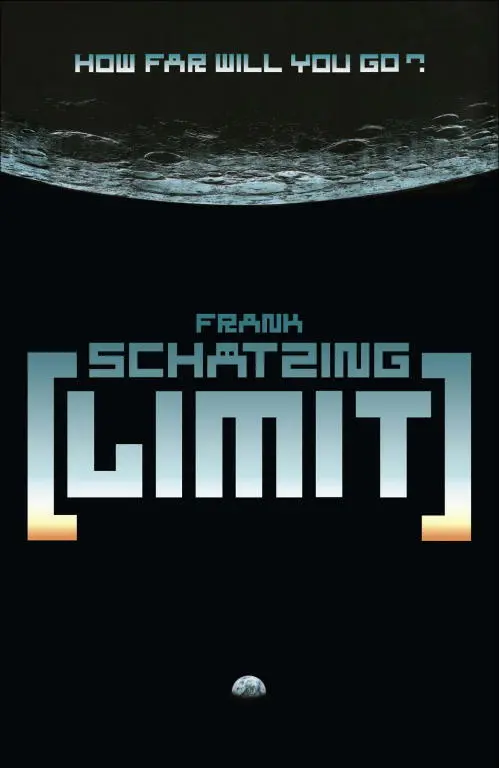
- Название:Limit
- Автор:
- Издательство:Jo Fletcher Books
- Жанр:
- Год:2013
- Город:London
- ISBN:9781849165150
- Рейтинг книги:4 / 5. Голосов: 1
-
Избранное:Добавить в избранное
- Отзывы:
-
Ваша оценка:
Limit: краткое содержание, описание и аннотация
Предлагаем к чтению аннотацию, описание, краткое содержание или предисловие (зависит от того, что написал сам автор книги «Limit»). Если вы не нашли необходимую информацию о книге — напишите в комментариях, мы постараемся отыскать её.
In 2025, entrepreneur Julian Orley opens the first-ever hotel on the moon. But Orley Enterprises deals in more than space tourism—it also operates the world’s only space elevator, which in addition to allowing the very wealthy to play tennis on the lunar surface connects Earth with the moon and enables the transportation of helium-3, the fuel of the future, back to the planet. Julian has invited twenty-one of the world’s richest and most powerful individuals to sample his brand-new lunar accommodation, hoping to secure the finances for a second elevator…
On Earth, meanwhile, cybercop Owen Jericho is sent to Shanghai to find a young female hacker known as Yoyo, who’s been on the run since acquiring access to information that someone seems quite determined to keep quiet. As Jericho closes in on the girl and the conspiracy swirling around her, he finds mounting evidence that connects her to Julian Orley as well as to the entrepreneur’s many competitors and enemies. Soon, the detective realizes that the lunar junket to Orley’s hotel is in real and immediate danger.
Limit — читать онлайн бесплатно полную книгу (весь текст) целиком
Ниже представлен текст книги, разбитый по страницам. Система сохранения места последней прочитанной страницы, позволяет с удобством читать онлайн бесплатно книгу «Limit», без необходимости каждый раз заново искать на чём Вы остановились. Поставьте закладку, и сможете в любой момент перейти на страницу, на которой закончили чтение.
Интервал:
Закладка:
‘Julian! That was the most brilliant day of any holiday I’ve ever had!’
‘Impressive, really.’ Aileen Donoghue laughed in her tinkling soprano. ‘Even if we’ve had to learn golf all over again.’
‘Golf, bullshit!’ Locatelli pressed Julian to his chest and pulled him over to the seated group. ‘Carl and I went charging around in those moon buggies, it was absolutely crazy! You’ve got to build a racetrack up here, a real fucking Le Mans de la Lune!’
‘And he didn’t even win,’ giggled Momoka Omura. ‘He almost flattened his buggy.’
‘More to the point, he nearly flattened me ,’ said Rebecca Hsu, placing a single peanut between her lips. ‘Warren’s company is inspiring, particularly when you think about moon burials.’
‘We had a wonderful day,’ smiled Sushma Nair. ‘Do come and join us.’
‘Right away.’ Julian smiled. ‘Just for a little while. Carl, have you got a minute?’
‘Of course.’ Hanna swung his legs off his sofa.
‘Just don’t go missing on me,’ Locatelli laughed. Recently he and Hanna had been spending a lot of time together. One chatty, the other taciturn, somehow strange, but plainly a friendship was developing there. They went to the bar, where Julian ordered the most complicated cocktail on the menu, an Alpha Centauri.
‘Listen, I feel a bit silly.’ He waited till Funaki was busy, and lowered his voice. ‘But I’ve got to ask you something. When we met in the corridor this morning, you were coming from the station.’
Hanna nodded.
‘And?’ Julian asked.
‘And what?’
‘Did you take a look inside?’
‘Inside the concourse? Once. Through the window.’ Hanna thought. ‘After that I went into one of the gangways. You remember, I was a bit dozy when it came to looking for the exits.’
‘And did you – did you see anything in the concourse?’
‘What are you getting at?’
‘I mean, the train, was it there? Did it set off, did it pull in?’
‘What, the Lunar Express? No.’
‘So it was just parked there.’
‘Exactly.’
‘And you’re a hundred per cent sure about that?’
‘I didn’t see anything else. So why do you feel silly?’
‘Because – oh, this really isn’t the place.’ And he just told Hanna the whole story, simply out of a need to get rid of it.
‘Maybe it was one of those flashes we all see up here,’ said Hanna.
Julian knew what he was referring to. High-energy particles, protons and heavy atomic nuclei, occasionally broke through the armour of spaceships and space stations, reacted with atoms in the eye and caused brief flashes of light that were perceived on the retina, but only if you had your eyes shut. Over time you got used to it, until you barely noticed them. Behind the regolith plating of the bedroom they hardly ever occurred. But in the living room—
Funaki set the cocktail down in front of him. Julian stared at the glass without really seeing it.
‘Yes, perhaps.’
‘You just made a mistake,’ said Hanna. ‘If you want my advice, you should apologise to Lynn and forget the whole thing.’
But Julian couldn’t forget it. Something was wrong, something didn’t fit. He knew without question that he had seen something, just not the train. Something more subtle was bothering him, a crucial detail that proved he wasn’t fantasising. There was a second inner movie that would explain everything if he could just drag it out of his unconscious and look at it, look at it very precisely to understand what he had already seen and just hadn’t understood, whether he liked the explanation or not.
He had to remember.
Remember!
Juneau, Alaska, USA
Loreena Keowa was irritated. On the day of the boat-trip, Palstein had agreed to let the film crew come along, and had delivered a series of powerful quotes, although without giving her that sense of familiarity that she usually developed with her interviewees. By now she knew that Palstein loved the crystalline aesthetic of numbers, with which he rationalised everything and everyone, himself included, although without losing the emotional dimension in his dealings with people. He esteemed the sound-mathematics of a composer like Johann Sebastian Bach, the fractal Minimalism of Steve Reich, and he was also fascinated by the breakdown of all structures and narrative arcs in the music of György Ligeti. He had a Steinway grand, he played well if a bit mechanically, not classics, as Loreena would have expected, but the Beatles, Burt Bacharach, Billy Joel and Elvis Costello. He owned prints by Mondrian, but also an incredibly intense original by Pollock, which looked as if its creator had screamed at the canvas in paint.
Curious to meet Palstein’s wife, Loreena had finally shaken the hand of a gracious creature who commandeered her, dragged her through the Japanese garden she had designed herself for a quarter of an hour and laughed like a bell every now and again for no perceptible reason. Mrs Palstein was an architect, she learned, and had laid out most of the grounds herself. Determined to use the currency of her newly acquired training in small talk, Loreena asked her about Mies van der Rohe, receiving a mysterious smile in return. Suddenly Mrs Palstein was treating her as a co-conspirator. Van der Rohe, oh, yes! Did she want to stay to dinner? While she was considering whether or not to agree, the lady’s phone rang, and she went off in a conversation about migraine, forgetting Loreena so completely that she found her own way back to the house and, because Palstein had issued no similar invitation, left without dinner.
Afterwards, in Juneau, she had admitted to herself that she liked the oil manager, his kindness, his good manners, his melancholy expression, which made her feel strangely exposed, and at the same time made him seem a little weird – and yet she still found him very alien, for reasons she couldn’t quite explain. Instead of devoting herself to her report, she had plunged into research, had flown from Texas to Calgary, Alberta, dropping in unannounced on the police station there. With her Native-American face and her peculiar charm, she managed to get to the office of the police lieutenant, who promised to keep her informed about any progress in investigations. Loreena extended her antennae for undertones, and established that there had been no progress, thanked him, took the next flight back to Juneau and, on the way, told her editorial team she wanted them to collect all available footage about what had happened in Calgary. After she landed, she called an intern to her office and told him what they had to look for.
‘I realise,’ she said, ‘that the police have viewed and analysed all the pictures a hundred times. So let’s look at them another hundred times. Or two hundred if it helps.’
On her desk she spread out a few prints showing the square in front of Imperial Oil headquarters. At the time of the shooting, the complex of buildings opposite had lain empty for months, after the open-cast mining company based there had come to a miserable end.
‘The police conclude for a whole host of reasons that the shot was fired from the middle one of the three buildings, which are, incidentally, all interconnected. Probably from one of the upper storeys. The complex has entrances to the front, the sides and the back, so there are several possible ways of getting in and out again.’
‘You really think we’ll discover something that the cops have missed?’
‘Be optimistic,’ said Loreena. ‘Always look on the bright side.’
‘I’ve taken a look at the material, Loreena. Almost all the cameras were trained on the crowd and the podium. It was only after the shooting that some of them were clever enough to swing around to the complex, but you don’t see anyone coming out.’
Читать дальшеИнтервал:
Закладка:
Похожие книги на «Limit»
Представляем Вашему вниманию похожие книги на «Limit» списком для выбора. Мы отобрали схожую по названию и смыслу литературу в надежде предоставить читателям больше вариантов отыскать новые, интересные, ещё непрочитанные произведения.






Обсуждение, отзывы о книге «Limit» и просто собственные мнения читателей. Оставьте ваши комментарии, напишите, что Вы думаете о произведении, его смысле или главных героях. Укажите что конкретно понравилось, а что нет, и почему Вы так считаете.