Robert Sawyer - Mindscan
Здесь есть возможность читать онлайн «Robert Sawyer - Mindscan» весь текст электронной книги совершенно бесплатно (целиком полную версию без сокращений). В некоторых случаях можно слушать аудио, скачать через торрент в формате fb2 и присутствует краткое содержание. Год выпуска: 2005, ISBN: 2005, Издательство: Tor Books, Жанр: Фантастика и фэнтези, на английском языке. Описание произведения, (предисловие) а так же отзывы посетителей доступны на портале библиотеки ЛибКат.
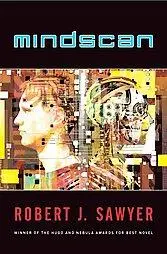
- Название:Mindscan
- Автор:
- Издательство:Tor Books
- Жанр:
- Год:2005
- ISBN:0-765-31107-0
- Рейтинг книги:4 / 5. Голосов: 1
-
Избранное:Добавить в избранное
- Отзывы:
-
Ваша оценка:
Mindscan: краткое содержание, описание и аннотация
Предлагаем к чтению аннотацию, описание, краткое содержание или предисловие (зависит от того, что написал сам автор книги «Mindscan»). Если вы не нашли необходимую информацию о книге — напишите в комментариях, мы постараемся отыскать её.
Mindscan — читать онлайн бесплатно полную книгу (весь текст) целиком
Ниже представлен текст книги, разбитый по страницам. Система сохранения места последней прочитанной страницы, позволяет с удобством читать онлайн бесплатно книгу «Mindscan», без необходимости каждый раз заново искать на чём Вы остановились. Поставьте закладку, и сможете в любой момент перейти на страницу, на которой закончили чтение.
Интервал:
Закладка:
“It’s frequently cited as the case that overturned Roe .” said Neruda.
“Making aborting embryos beyond a certain stage of development illegal again in the United States?”
“Correct.”
“And what is the status of Littler v. Carvey today?”
“It still stands as the law of the land.”
Lopez nodded. “Now, a moment ago, I said that Littler v. Carvey makes abortions illegal after a certain stage of development. Can you explain to the jury how the line between personhood and nonpersonhood was established in Littler ?”
“Certainly. Littler v. Carvey turned precisely on this issue: when does an embryo become a person? After all,” said Neruda, turning briefly to face Judge Herrington, “we can’t very well decide when something ceases to be a person if we don’t know when it began to be one.”
The judge nodded his shoehorn face. “But do get on with it,” he said.
“Of course, of course,” said Neruda. “Drawing the line between personhood and nonpersonhood has represented one of the greatest challenges in bioethics. One position, of course, is that held by hard-line right-to-lifers: a new person, with the rights of personhood, is created at the moment of conception. The opposite extreme says that a new person doesn’t exist until the moment of birth, some nine months later—and, indeed, since the 1970s, there’s been a vocal faction that’s argued that even birth is too early, contending that personhood doesn’t really begin until there’s significant cognitive ability, around two or three years of age; those people find painless infanticide and abortion equally morally acceptable.”
I saw several of the jurors react in horror, but Neruda went on. “Conception and birth are, of course, precise moments in time. Although a human conception was never actually observed until 1969, we had known from animal studies for hundred years prior to that that conception occurs when the spermatozoa and the oocyte fuse.”
“Oocyte?” said Lopez.
“The female gamete. What lay people call the egg.”
Somebody near me snickered at what was presumably Neruda’s inadvertent play on words.
“All right,” said Lopez. “Conception occurs at the moment the sperm and egg fuse.”
“Yes, and that’s one specific second of time. We also, of course, routinely very precisely measure the time of birth. In fact…” Neruda trailed off.
“Yes, Professor?”
“Well, of course, there’s Mr. Sullivan, sitting right over there.”
I always sat up straight these days; there was no additional comfort in slouching my mechanical body.
“What’s significant about Mr. Sullivan?” asked Lopez.
“Well, he’s a Mindscan now, but the original him was, I believe, the first child bom after midnight on 1 January 2001, in Toronto, Canada.”
“Defendant’s ten,” said Lopez, holding up a piece of past. “A newspaper clipping for The Toronto Star from Tuesday 2 January 2001, commemorating this very fact.”
The exhibit was accepted, and Professor Neruda went on: “So, setting aside the extremists I spoke of earlier, we generally accept that a person is a person by the time they are born. But there have been fascinating cases that have tested the flexibility of this particular rubicon for ascribing personhood.”
“For instance?” asked Lopez.
“ Department of Health and Human Services v. Maloney .”
“What happened there?”
“Brenda Maloney was an emotionally unstable woman in the Bronx, New York, in 2016. She had been pregnant for the standard thirty-nine weeks, and was being wheeled into the delivery room, when she saw a steak knife sitting on a tray of food destined for another patient. She grabbed the knife and plunged it into her belly, killing her baby moments before it would have been born.” Again, I saw jurors wince, and again Neruda went on. “Had Ms. Maloney committed murder?
Ultimately, the case was never tried, because Ms Maloney was found unfit to stand trial—but it did certainly galvanize public opinion. Support for the notion that an embryo did not become a person until at least birth waned considerably after that.”
“In other words,” said Lopez, “the hard-line pro-choice position—that until the baby was out of the body, it was not a person—became less tenable because of Maloney , correct?”
“That would certainly be my reading of the legal commentaries from that period, yes.”
“You’d said there were only two absolutely clear points, cleanly and simply demarked by biological circumstances for establishing personhood: conception and birth, correct?”
“Correct.”
“And Maloney —and other cases, I’m sure—made the birth marker not seem tenable in the eyes of most lawmakers and politicians, is that right?”
“Correct,” said Neruda again. “Anything but conception or cutting the umbilical cord seems arbitrary to them. Even birth is arbitrary, when you can induce it with drugs, or perform a C-section.
“In fact, soon enough we’ll doubtless have the ability to bring babies to term in artificial wombs. Take the typical sci-fi version of that: a fetus in a glass bottle full of liquid. The fetus has been growing for almost nine months. I take out a gun and shoot at the glass bottle. If my bullet hits the fetus, and goes through its heart, then I’ve performed an abortion, but if it misses the fetus, and just shatters the jar, spilling the baby out onto the tabletop, I’ve performed a delivery. It’s very hard to draw these lines.”
“Indeed,” said Lopez. “And, in fact, weren’t there legal attempts to define life beginning at a third point, namely implantation?”
“Yes, that’s right,” said Neruda. “But that was just as messy.”
“Why?”
“Well, conception doesn’t take place in the uterus, after all; the fertilized egg—to use the common parlance—normally moves down the fallopian tube into the uterus, then implants in the uterine wall. That event had sometimes been cited as the beginning of personhood, but it was rejected by the Supreme Court in Littler v. Carvey .”
“Why?”
“The march of science, Ms. Lopez. They couldn’t do it then, and we haven’t quite made it happen even yet, but we recognize, as I said before, that in principal it will be possible eventually to bring embryos to term in artificial wombs. The court didn’t want to set up a standard that said that embryos brought to term in vitro were perforce not human. They were looking for a demarcation that was innate to the embryo.”
“Well, then, given that the courts weren’t happy with the birth standard, conception seems the obvious marker to choose, no? You said it was easy to measure.”
“Oh, yes, indeed,” said Neruda, nodding. “Prior to conception, no new organism exists with forty-six chromosomes—plus or minus one, as in Down or Turner syndrome. But as soon as conception occurs, a complete genetic blueprint for an entire person is created—the new person’s sex is determined, and so on.”
“So did the court rule in Littler v. Carvey that personhood was conferred at conception?”
Neruda shook her head. “They couldn’t rule that—not without making millions of Americans into murderers.”
Lopez tilted her head to one side. “How do you mean?”
Neruda took a deep breath, and let it out slowly. “The Oxford English Dictionary tells us that the phrase ‘birth control’ entered the language in 1914. But, of course, it’s really a misnomer. We’re not trying to control birth; we’re looking to do something nine months earlier—prevent pregnancy! In fact, even though conception and birth are at opposite ends of the time span we’re discussing, we use ‘contraception’ and ‘birth control’ as synonyms.
Читать дальшеИнтервал:
Закладка:
Похожие книги на «Mindscan»
Представляем Вашему вниманию похожие книги на «Mindscan» списком для выбора. Мы отобрали схожую по названию и смыслу литературу в надежде предоставить читателям больше вариантов отыскать новые, интересные, ещё непрочитанные произведения.


Обсуждение, отзывы о книге «Mindscan» и просто собственные мнения читателей. Оставьте ваши комментарии, напишите, что Вы думаете о произведении, его смысле или главных героях. Укажите что конкретно понравилось, а что нет, и почему Вы так считаете.