Robert Sawyer - Mindscan
Здесь есть возможность читать онлайн «Robert Sawyer - Mindscan» весь текст электронной книги совершенно бесплатно (целиком полную версию без сокращений). В некоторых случаях можно слушать аудио, скачать через торрент в формате fb2 и присутствует краткое содержание. Год выпуска: 2005, ISBN: 2005, Издательство: Tor Books, Жанр: Фантастика и фэнтези, на английском языке. Описание произведения, (предисловие) а так же отзывы посетителей доступны на портале библиотеки ЛибКат.
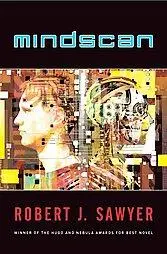
- Название:Mindscan
- Автор:
- Издательство:Tor Books
- Жанр:
- Год:2005
- ISBN:0-765-31107-0
- Рейтинг книги:4 / 5. Голосов: 1
-
Избранное:Добавить в избранное
- Отзывы:
-
Ваша оценка:
Mindscan: краткое содержание, описание и аннотация
Предлагаем к чтению аннотацию, описание, краткое содержание или предисловие (зависит от того, что написал сам автор книги «Mindscan»). Если вы не нашли необходимую информацию о книге — напишите в комментариях, мы постараемся отыскать её.
Mindscan — читать онлайн бесплатно полную книгу (весь текст) целиком
Ниже представлен текст книги, разбитый по страницам. Система сохранения места последней прочитанной страницы, позволяет с удобством читать онлайн бесплатно книгу «Mindscan», без необходимости каждый раз заново искать на чём Вы остановились. Поставьте закладку, и сможете в любой момент перейти на страницу, на которой закончили чтение.
Интервал:
Закладка:
“Is there something I can—”
“I’m doomed. Don’t you get it?”
She frowned. “Do you want me to call a medical doctor?”
I shook my head. “You just scanned my consciousness, making a duplicate of my mind, right?” My voice was sneering. “And since I’m aware of things after you finished the scanning, that means I— this version— isn’t that copy. The copy doesn’t have to worry about becoming a vegetable anymore—it’s free. Finally and at last, it’s free of everything that’s been hanging over my head for the last twenty-seven years. We’ve diverged now, and the cured me has started down its path. But this me is still doomed. I could have woken up in a new, healed body, but—”
Killian’s voice was gentle. “But, Mr. Sullivan, one of you was bound to still be in this body…”
“I know, I know, I know.” I shook my head, and took a few paces forward. There was no window in the scanning room, which was probably just as well; I don’t think I was quite ready to face the world. “And the one of us that is still in this bloody body, with this fucked brain, is still doomed.”
6
I was suddenly somewhere else.
It was an instantaneous transfer, like changing channels on TV. I instantly was somewhere else—in a different room.
At first I was overwhelmed by strange physical sensations. My limbs felt numb, as though I’d slept on them funny. But I hadn’t been sleeping…
And then I was conscious of the things that I wasn’t feeling: there was no pain in my left ankle. For the first time in two years, since I’d torn some ligaments falling down a staircase, I felt no pain at all.
But I remembered the pain, and—
I did remember!
I was still myself.
I remembered my childhood in Port Credit.
I remembered being beaten up every day on the way to school by Colin Hagey.
I remembered the first time I’d read Karen Bessarian’s DinoWorld .
I remembered delivering The Toronto Star —back when papers were physically delivered.
I remembered the great blackout of 2015, and the darkest sky I’d ever seen.
And I remembered my dad collapsing in front of my eyes.
I remembered it all.
“Mr. Sullivan? Mr. Sullivan, it’s me, Dr. Porter. You may have some trouble speaking at first. Do you want to try?”
“Ell-o.” The word sounded strange, so I repeated it several times: “Ell-o. Ell-o. Ell-o.” My voice didn’t seem quite right. But, then again, I was hearing it much as Porter was, through my own external microphones—ears, ears, ears!—rather than resonating through the nasal cavities and bones of a biological head.
“Very good!” said Porter; he was a disembodied voice—somewhere out of my field of view, but I wasn’t yet properly registering his location. “No respiratory asperity,” he continued, “but you’ll learn how to do that. Now, you may have a lot of unusual sensations, but you shouldn’t be in any pain. Are you?”
“No.” I was lying on my back, presumably on the gurney I’d seen earlier, staring up at the plain white ceiling. There was a general paucity of sensation, a sort of numbness—although there was some gentle pressure on my body from, I supposed, the terry-cloth robe that I was presumably now wearing.
“Good. If at any point pain begins, let me know. It can take a little while for your mind to learn how to interpret the signals it’s receiving; we can fix any discomfort that might arise, all right?”
“Yes.”
“Good. Now, before we start trying to move, let’s make sure you can fully communicate. Can you count backwards from ten for me, please?”
“Ten. Nine. Eight. Seven. Six. Five. Four. Tree. Two. One. Zero.”
“Very good. Let’s try that ‘three’ once more.”
“Tree. Tree. Tuh-ree .”
“Keep trying.”
“Tree. Dree.”
“It’s an aspiration issue again, but you’ll get it.”
“Dree. Tree. Thuh-ree. Three! ”
I heard Porter’s hands clapping together. “Perfect!”
“Three! Three! Three!”
“By George, I think he’s got it!”
“Three! Thought, thing, teeth, theater, bath, math. Three!”
“Excellent. Are you still feeling okay?”
“Still—oh.”
“What?” asked Porter.
“My vision went off for a moment, but it’s back.”
“Really? That shouldn’t—”
“Oh, and there it goes—”
“Mr. Sullivan? Mr. Sullivan?”
“I—it feels … oh…”
“Mr. Sullivan? Mr. Sulli—!”
Nothingness, for how long, I had no idea. Just total nothingness. When I came to, I spoke.
“Doc! Doc! Are you there?”
“Jake!” Porter’s voice. He let air out noisily in a “that’s a relief!” sort of way.
“Is something wrong, Doc? What was that?”
“Nothing. Nothing at all. Urn, ah, how do you feel now?”
“It’s strange,” I said. “I feel different —in a ’undred ways I can’t describe.”
Porter was quiet for a moment; perhaps he was distracted by something. But then he said, “Hundred.”
“What?”
“You said ’undred, not hundred. Try to get the H sound.”
“ ’Undred. ’Undred. Huhn-dred. Hundred.”
“Good,” said Porter. “It’s normal for there to be some differences in sensations, but as long as you’re basically feeling okay…?”
“Yes,” I said again. “I feel just fine.”
And I knew, in that instant, that I was fine . I was relaxed. For the first time in ages, I felt calm, safe. I wasn’t going to suddenly have a massive cerebral hemorrhage. Rather, I was going to live a full normal life. I’d get my biblical three-score-and-ten; I’d get the Statistics Canada eighty-eight years for males born in 2001; I’d get all of that and more. I was going to live . Everything else was secondary. I was going to live a good, long time, without paralysis, without being a vegetable. Whatever settling-in difficulties I encountered would be worth it. I knew that at once.
“Very good,” said Porter. “Now, let’s try something simple. See if you can turn your head toward me.”
I did so—and nothing happened. “It’s not working, doc.”
“Don’t worry. It’ll come. Try again.”
I did, and this time my head did loll left, and—
And—and—and—
Oh, my God! Oh, my God! Oh, my God!
“That chair over there,” I said. “What color is it?”
Porter turned, surprised. “Um, green.”
“Green! So that’s what green looks like! It’s— cool , isn’t it? Soothing. And your shirt, doc? What color is your shirt?”
“Yellow.”
“Yellow! Wow!”
“Mr. Sullivan, are you—are you color-blind?”
“Not anymore!”
“Good God. Why didn’t you tell us?”
Why hadn’t I told them? “Because you hadn’t asked” was one true answer, but I knew there were others. Mostly I was afraid if I had told them, they’d have insisted on duplicating that aspect of who I’d been.
“What kind of color blindness do— did —you have?”
“Doo-something.”
“You’re deutanopic?” said Porter. “You’ve got M-cone deficiency?”
“That’s it, yes.” Almost nobody has true color blindness; that is, almost no one sees only in black and white. We deuteranopes see the world in shades of blue, orange, and gray, so that many colors that contrast sharply for people with normal vision look the same to us. Specifically, we see red and greenish-yellow as beige; magenta and green as gray; both orange and yellow as what I’d been told was a brick color; both blue-green and purple as mauve; and both indigo and cyan as cornflower blue.
Читать дальшеИнтервал:
Закладка:
Похожие книги на «Mindscan»
Представляем Вашему вниманию похожие книги на «Mindscan» списком для выбора. Мы отобрали схожую по названию и смыслу литературу в надежде предоставить читателям больше вариантов отыскать новые, интересные, ещё непрочитанные произведения.








Обсуждение, отзывы о книге «Mindscan» и просто собственные мнения читателей. Оставьте ваши комментарии, напишите, что Вы думаете о произведении, его смысле или главных героях. Укажите что конкретно понравилось, а что нет, и почему Вы так считаете.