Ben Bova - Voyagers
Здесь есть возможность читать онлайн «Ben Bova - Voyagers» весь текст электронной книги совершенно бесплатно (целиком полную версию без сокращений). В некоторых случаях можно слушать аудио, скачать через торрент в формате fb2 и присутствует краткое содержание. Год выпуска: 2010, ISBN: 2010, Издательство: Tor, Жанр: Фантастика и фэнтези, на английском языке. Описание произведения, (предисловие) а так же отзывы посетителей доступны на портале библиотеки ЛибКат.
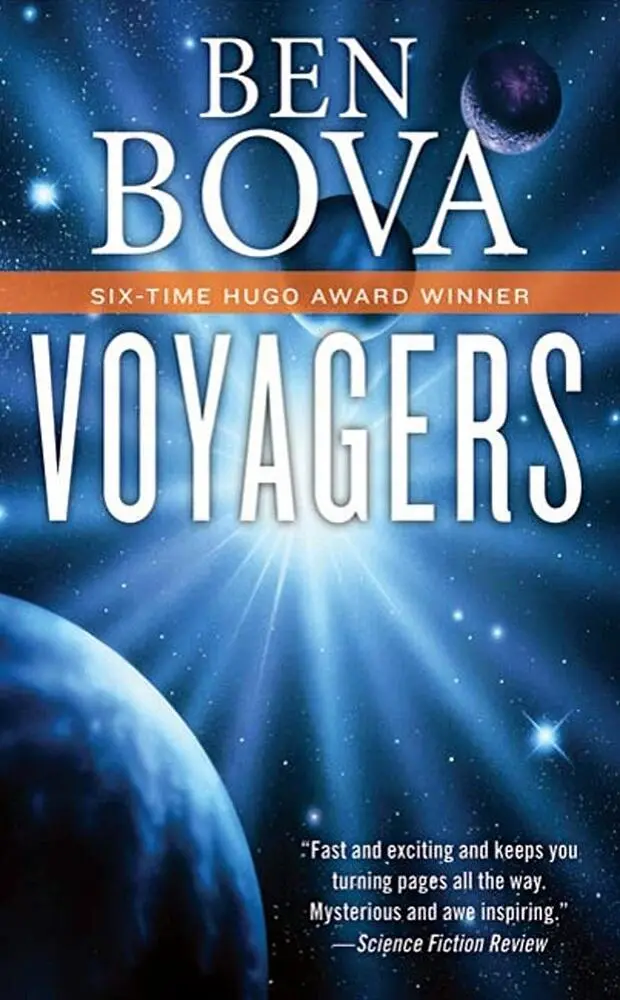
- Название:Voyagers
- Автор:
- Издательство:Tor
- Жанр:
- Год:2010
- ISBN:978-0-765-36365-7
- Рейтинг книги:5 / 5. Голосов: 1
-
Избранное:Добавить в избранное
- Отзывы:
-
Ваша оценка:
Voyagers: краткое содержание, описание и аннотация
Предлагаем к чтению аннотацию, описание, краткое содержание или предисловие (зависит от того, что написал сам автор книги «Voyagers»). Если вы не нашли необходимую информацию о книге — напишите в комментариях, мы постараемся отыскать её.
the signal that his research station is receiving from space is not random. Whatever it is, it’s real.
And it’s headed straight for Earth.
He’ll do anything to be the first man to go out to confront this enigma. Even lose the only woman he’s ever really loved.
And maybe start a world war.
Voyagers — читать онлайн бесплатно полную книгу (весь текст) целиком
Ниже представлен текст книги, разбитый по страницам. Система сохранения места последней прочитанной страницы, позволяет с удобством читать онлайн бесплатно книгу «Voyagers», без необходимости каждый раз заново искать на чём Вы остановились. Поставьте закладку, и сможете в любой момент перейти на страницу, на которой закончили чтение.
Интервал:
Закладка:
In Moscow, Georgi Borodinski phoned the commander of the Red Army missile forces and personally told him to deactivate the pair of hydrogen-bomb-tipped missiles that had been ready to intercept the alien spacecraft.
A few blocks away from the Kremlin, the Minister of Internal Security picked a small pistol from his desk drawer and, with a sardonic smile twitching at his lips, he placed its muzzle against his temple and pulled the trigger.
At the control center in Tyuratam, Jo’s face lit up as she watched the readout glowing on her computer screen.
Turning to Markov, who still stood by her side, she said, “It’ll work! We can get them back! They’ve got to break their current orbit within the next half hour. If they do that they can coast until the new tanker reaches them.”
Markov whooped and lifted Jo out of the chair and kissed her. One of the uniformed guards behind them twitched at the sudden noise and leveled his gun at them.
“I love you like a sister!” Markov proclaimed loudly, as the guard’s partner silently pushed the muzzle of the machine pistol down toward the floor, with a reproving frown.
Oblivious to what was going on behind him, Markov added in a whisper for Jo’s ear, “I never did believe in that silly taboo against incest, you know.”
Stoner was hoarse, his throat raw, but still he talked, minutely describing each artifact arranged along the alien’s sides as he snapped stereo photos. Questions were flooding up from Tyuratam and Kwajalein.
“No, no sign of other life forms,” Stoner answered, his throat rasping. “No plants or seeds or other animals. Maybe they’re in other compartments of the spacecraft.
“I’ve tried to get into the rest of the ship, but it’s no go. Just a smooth blank wall that won’t open up. It’s going to take a lot of study to figure out how they work their entrances and exits.
“The biggest discovery among the artifacts, I think, is this star chart. At least, I think it’s a star chart. I don’t recognize any of the constellations, but there’s writing on it…looks like writing, a lot of circles and curlicues.”
Federenko’s heavy voice broke in. “Shtoner, we have new trajectory data. Tanker is being sent to meet us. We must retrofire in eleven minutes.”
“Eleven minutes?” Stoner’s heart stopped in his chest. His voice nearly cracked.
“Ten minutes, forty-eight seconds, to be exact.”
Stoner’s gaze flashed to the alien resting on his bier. He’s spent thousands of years to get here and I have to leave in ten fucking minutes?
“No,” he protested. “We need more time. We can’t…”
“No more time,” Federenko said flatly. “Come back to Soyuz now. There is no other way.”
“Nikolai, I can’t! Not yet!”
“Now, Shtoner.”
He looked through the transparent hull of the sarcophagus, toward the distant stars. Then at the shrunken Earth, so far away, and finally at the stubby Soyuz.
“Nikolai, please…”
“We must go, Shtoner. Or die here.”
Stoner’s lips were dry and cracked. He felt the chill of death breathe on him, and he turned to stare once again at the alien. All the distance you’ve come, to offer us your body, your knowledge, everything that you are and you represent. So much to learn from you…
“Shtoner.”
“No,” he said quietly. “I’m not coming back with you, Nikolai.”
“Shtoner…”
“I’m going to stay here, with him. Maybe in another few million years some other civilization will find the two of us.”
And he turned off his suit radio.
Kwajalein
The noontime sun beat down on the silent, deserted street. Inside the air-conditioned offices, bungalows, house trailers, every man and woman on the island sat transfixed before their television sets. The same scene showed on every screen: the alien spacecraft floating in the void. The same voice came from the alien craft: Stoner’s.
“No, I’m not coming back with you, Nikolai.”
In the bustling communications center, everything stopped. Men and women froze at their jobs and stared at their screens.
Only Reynaud reacted.
“No! No, he can’t do that! He mustn’t, it’s not necessary!” The cosmologist rushed across the room, red-faced and puffing, toward Tuttle.
“Let me talk to him!” Reynaud screamed. “Give me a link to him! In the name of Christ, let me talk to him!”
Everyone tore their attention from the communications screens to the florid, screeching madman. Tuttle put his hands out in front of him, as if to protect himself from the wild-eyed Reynaud.
“You want to talk to Stoner?”
“Yes! Quickly! Before it’s too late! I can save him! I know I can!”
Chapter 45
Stoner felt strangely calm. All the big decisions were behind him now. There was no more need to struggle. No need to worry. All his life had pointed to this ending, he realized. He would finish life alone, untouched by anyone, away from them all, lost in the starry wilderness with his member of an alien race.
Another loner, he thought, gazing down at the alien’s strange, immobile face. Were you like that in life? Is that why you chose this way to spend eternity?
In New York the FCC monitor was screaming, “Get him off the air!” while the ABC News vice-president grabbed at his flailing arms to keep him away from the master control panel. In Moscow the Soviet censor, livid with anger and fear, slammed his heavy fist into the button that cut the Soyuz transmission off the worldwide broadcast. TV screens all around the globe still showed the picture of the alien spacecraft as seen by the Soyuz cameras, but suddenly there was no voice transmission coming from space.
Stoner had relaxed into an almost fetal-like curl, hanging weightlessly a foot or so above the floor of the chamber. Through the transparent walls of the ship he could see the distant crescent of Earth and the Soyuz, still parked about a hundred meters away. It seemed to be staring at him accusingly.
Stoner flicked on his suit radio.
“…you must return,” Federenko was saying, with frantic determination. “That is an order. Only seven minutes remain…”
“Nikolai, I’ve just realized something,” Stoner said. The cosmonaut fell silent. “This spacecraft—this tomb—must have been built to seek out G-type stars, I’ll bet. Our friend here came from a star that’s similar to the Sun.”
“No time for philosophy, Shtoner.”
“And once it reached a G-class star, it searched for planets with strong magnetic fields. That’s got to be right! That’s why it headed for Jupiter first: the strongest magnetosphere in the solar system. And then toward Earth, the strongest magnetic field among the inner planets.”
“Six minutes and thirty seconds,” Federenko growled.
“The strong magnetic fields are targets for two reasons,” Stoner went on, ignoring him. “First, the spacecraft taps electromagnetic energy to recharge its batteries…or whatever it uses for energy storage. But far more important, it’s likely that only planets with strong magnetospheres can support life. Life needs a strong magnetic field to act as an umbrella that shields the planet’s surface from cosmic radiations!”
“Shtoner, stop this foolishness. Come back.”
“Did you get all that, Nikolai? Was it sent to Earth? It’s important.”
“Yes, yes. Now come back.”
At CBS News, Cronkite was putting on a bravura performance, talking over the static image of the alien spacecraft, filling in with facts, conjectures, history, opinion, while his top aides phoned frantically to Washington to see if there was any way to pick up the live radio transmission from the Soyuz again.
Читать дальшеИнтервал:
Закладка:
Похожие книги на «Voyagers»
Представляем Вашему вниманию похожие книги на «Voyagers» списком для выбора. Мы отобрали схожую по названию и смыслу литературу в надежде предоставить читателям больше вариантов отыскать новые, интересные, ещё непрочитанные произведения.




Обсуждение, отзывы о книге «Voyagers» и просто собственные мнения читателей. Оставьте ваши комментарии, напишите, что Вы думаете о произведении, его смысле или главных героях. Укажите что конкретно понравилось, а что нет, и почему Вы так считаете.