Ben Bova - Voyagers
Здесь есть возможность читать онлайн «Ben Bova - Voyagers» весь текст электронной книги совершенно бесплатно (целиком полную версию без сокращений). В некоторых случаях можно слушать аудио, скачать через торрент в формате fb2 и присутствует краткое содержание. Год выпуска: 2010, ISBN: 2010, Издательство: Tor, Жанр: Фантастика и фэнтези, на английском языке. Описание произведения, (предисловие) а так же отзывы посетителей доступны на портале библиотеки ЛибКат.
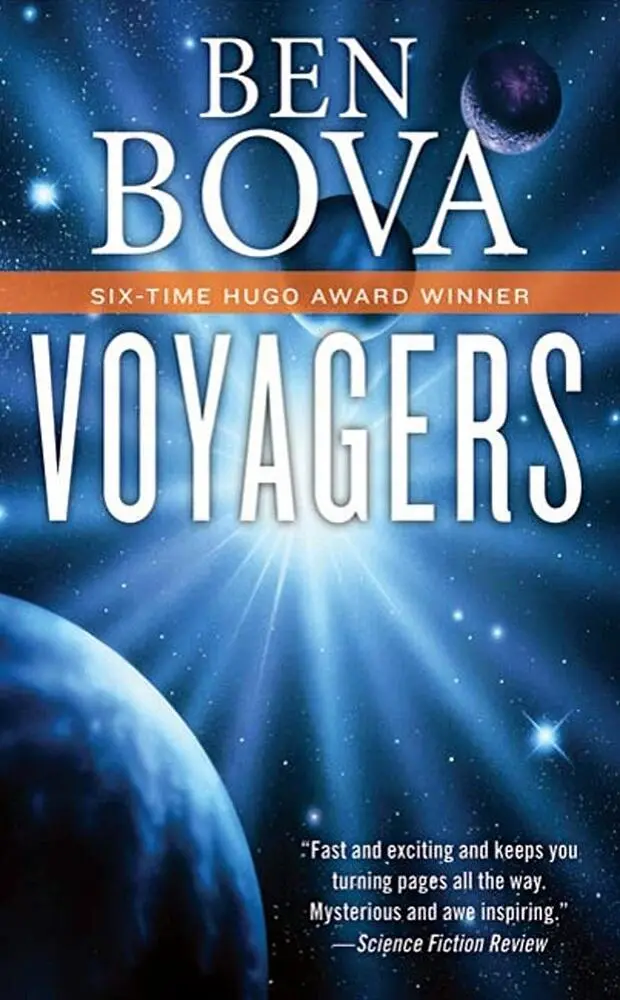
- Название:Voyagers
- Автор:
- Издательство:Tor
- Жанр:
- Год:2010
- ISBN:978-0-765-36365-7
- Рейтинг книги:5 / 5. Голосов: 1
-
Избранное:Добавить в избранное
- Отзывы:
-
Ваша оценка:
Voyagers: краткое содержание, описание и аннотация
Предлагаем к чтению аннотацию, описание, краткое содержание или предисловие (зависит от того, что написал сам автор книги «Voyagers»). Если вы не нашли необходимую информацию о книге — напишите в комментариях, мы постараемся отыскать её.
the signal that his research station is receiving from space is not random. Whatever it is, it’s real.
And it’s headed straight for Earth.
He’ll do anything to be the first man to go out to confront this enigma. Even lose the only woman he’s ever really loved.
And maybe start a world war.
Voyagers — читать онлайн бесплатно полную книгу (весь текст) целиком
Ниже представлен текст книги, разбитый по страницам. Система сохранения места последней прочитанной страницы, позволяет с удобством читать онлайн бесплатно книгу «Voyagers», без необходимости каждый раз заново искать на чём Вы остановились. Поставьте закладку, и сможете в любой момент перейти на страницу, на которой закончили чтение.
Интервал:
Закладка:
He stepped to the edge of the floor and put his hand out, timidly. The gloved fingers touched the invisible hull; it felt spongy, giving.
“Hull’s still there, though. Hasn’t vanished completely, the way the hatch did. And it’s very cold in here, as if energy can go out through the hull, but none can get in. This thing must’ve been designed by Maxwell’s demon.”
Turning back to the alien, Stoner took a long look in the dim starlight. Then he remembered the lamp hooked to his belt and turned it on.
He leaned over the alien’s body. It was very long, but thin, emaciated, desiccated.
“He’s more than two meters tall, I’d say. No clothing. Very slim, plenty of ribs showing. Body’s covered with some kind of orange-brown fuzz. Not hair, really. Looks more like a nap on velvet. Almost.”
“The figure is human?” Federenko asked.
“Sort of. Two arms, one head. Body’s much longer than ours…legs start where our knees would be. And there are four of ’em, four legs. Little knobby ones with round hoof-like pads at the ends.”
“Wait…” Federenko said. “Tyuratam reports, your words being broadcast all across Soviet Union, Europe, America, Asia, many other places.”
“I’m on live, Nikolai? In Russia?”
Federenko hesitated, then replied, “In U.S.S.R., broadcast is delayed fifteen minutes so censors can make certain nothing harmful is let out.”
“And in the States?”
“Live, I think.”
“I’d better watch my language.”
Federenko said nothing.
Stoner turned back to the alien. “Arms are longer than ours. The hands have only two fingers each and the ends of the fingers look like suction cups—suckers, like on an octopus.”
“The head? The face?”
“Seems to have two eyes, but they’re closed. I don’t see a nose of any sort, but there’s a mouth—lips, at least. Wide and thin.” Stoner couldn’t bring himself to touch the creature, although he badly wanted to see what was behind those lips, those closed eyelids. “Same kind of nappy fur covers the whole face, even the eyelids. The head is rounded, large-domed, very smooth. I don’t see what he breathed with.”
“Is it breathing?”
“No,” Stoner said. “He’s dead. I can feel it. There’s no atmosphere in here. This chamber’s been in vacuum for millennia. Cold, too. Frost is forming on my visor.”
“Turn up suit heater.”
“Right. I’m doing that.” The miniaturized fan in the helmet’s collar hummed a bit louder.
As the tendrils of frost cleared from the edges of his visor, Stoner saw that there was writing on the bier alongside the alien’s body. And artifacts: a metal cup, a translucent sphere the size of a child’s ball, a rod of something that looked like wood. He tried to pick up the rod but it stuck fast to the surface of the bier. As he described it all into his microphone he tried to dislodge the other objects. None of them would move.
“This is a sarcophagus, Nikolai. A tomb. I know it is. This guy died a million years ago and had his body sent into space—like an Egyptain pharaoh. He had himself sent out in a sarcophagus.”
“But why?”
“As an ambassador !” The answer hit Stoner’s conscious mind as he pronounced the words. “Of course! As an ambassador! What better way to make contact with unknown intelligent races scattered across thousands of light-years?”
“Ambassador?”
“Yes!” Stoner knew he was right. “He’s saying to us, ‘Here, I want you to see me, to know that I exist, my civilization exists. You aren’t alone in the universe. Take my body. Study it; study the artifacts I’ve brought along with me. Study my ship. Learn from me.’ What better way to share knowledge? To show that his intent is totally peaceful, benign?”
Federenko was silent, thinking.
Stoner went back to his description. “He’s got a jaw that looks like it hinges the same way our own jaws do. No ears, but there’s a couple of circular patches on the sides of his head…they look almost like outcroppings of bone. Not horns, they’re flat. Sense organs of some kind.”
“What sexual organs?” Federenko asked, then added, “Biologists want to know.”
Stoner grinned. “They would. Nothing visible in the usual place, but there’s some kind of protuberance halfway down his torso. And his fuzz is slightly different color around there, more yellowish.” Christ, it looks like he died with a hard-on, Stoner thought.
“Wait,” Federenko said. “We are getting a transmission from ground control.”
Stoner walked around the raised platform, bobbing in the zero gravity as his boots clung slightly to the spongy flooring. There were more artifacts on the alien’s other side. A straight edge, a square covered with dots that were connected by thin lines. An astronomical map? he wondered. This ark is a damned treasure house; he’s brought his whole civilization with him.
Federenko’s voice interrupted his musings. “Switch to frequency two, Shtoner.”
Stoner clicked the suit radio switch on his wrist and the Russian’s voice said, “Shtoner, this frequency is for private talk. Not for broadcast.”
“Okay.”
“Ground command is working out new course for us, to get us back. New tanker is being launched.”
“I knew they’d figure something out,” Stoner said.
“We will fire retro-rockets to break present course. Very soon.”
A tingle of alarm went through Stoner. “How soon?”
“Computers working on it. But you must be ready to return to Soyuz when I give command.”
“Sure,” Stoner replied.
“Photograph everything now,” Federenko said. “Time is short.”
“Yeah, okay. I’m switching back to frequency one now. I want everybody to hear what I’ve got to say.”
Federenko grunted. “Tyuratam estimates more than one billion people hear your voice.”
Good, Stoner thought. Now they’ll know.
Unhooking the bulky 35 mm stereo camera from its case at his belt, Stoner said for broadcast:
“I think it’s clear now that this alien has come in peace. He’s offering us his body and his treasured possessions, giving them to us, for us to study. He’s telling us that we have nothing to fear—that there are other intelligent races scattered among the stars. We’re not alone. The universe is filled with life, and it’s civilized, intelligent life.”
He was starting to babble and he knew it, but his hands clicked away with the camera while he chattered on:
“We have nothing to fear! This isn’t the end of our world, it’s just the beginning! Do you realize what that means? Intelligent civilizations don’t wipe themselves out with wars or pollution or overpopulation—not always, not inevitably. We have a future ahead of us as wide and bright as the stars themselves, if we strive for it, if we work together, all of us—the whole human race as a species, as a family, as one family unit in the great interstellar community of intelligent civilizations…”
In Rome, St. Peter’s Square was thronged with tens of thousands who stood in awed silence, watching the giant TV screens that had been set up there by the government. Finally the Pope appeared, not at the usual balcony, but at the head of the cathedral’s steps, flanked by red-robed cardinals and the colorful Swiss guards.
The mammoth crowd surged toward the Pontiff, its roar deafening. He smiled and nodded and gave his blessing to them all.
In Washington the President watched the rendezvous with the alien spacecraft in the privacy of his family room, with his wife and children clustered close around him. Downstairs in the West Wing the staff watched, too, and for at least a few hours all thoughts of the upcoming national conventions were suspended.
Читать дальшеИнтервал:
Закладка:
Похожие книги на «Voyagers»
Представляем Вашему вниманию похожие книги на «Voyagers» списком для выбора. Мы отобрали схожую по названию и смыслу литературу в надежде предоставить читателям больше вариантов отыскать новые, интересные, ещё непрочитанные произведения.

Обсуждение, отзывы о книге «Voyagers» и просто собственные мнения читателей. Оставьте ваши комментарии, напишите, что Вы думаете о произведении, его смысле или главных героях. Укажите что конкретно понравилось, а что нет, и почему Вы так считаете.