Гилберт Честертон - Eugenics and Other Evils
Здесь есть возможность читать онлайн «Гилберт Честертон - Eugenics and Other Evils» весь текст электронной книги совершенно бесплатно (целиком полную версию без сокращений). В некоторых случаях можно слушать аудио, скачать через торрент в формате fb2 и присутствует краткое содержание. Год выпуска: 2014, Издательство: epubBooks Classics, Жанр: Публицистика, на английском языке. Описание произведения, (предисловие) а так же отзывы посетителей доступны на портале библиотеки ЛибКат.
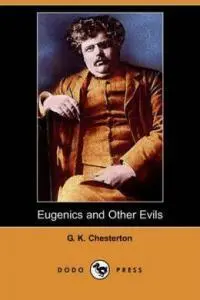
- Название:Eugenics and Other Evils
- Автор:
- Издательство:epubBooks Classics
- Жанр:
- Год:2014
- ISBN:нет данных
- Рейтинг книги:4 / 5. Голосов: 1
-
Избранное:Добавить в избранное
- Отзывы:
-
Ваша оценка:
Eugenics and Other Evils: краткое содержание, описание и аннотация
Предлагаем к чтению аннотацию, описание, краткое содержание или предисловие (зависит от того, что написал сам автор книги «Eugenics and Other Evils»). Если вы не нашли необходимую информацию о книге — напишите в комментариях, мы постараемся отыскать её.
Eugenics and Other Evils — читать онлайн бесплатно полную книгу (весь текст) целиком
Ниже представлен текст книги, разбитый по страницам. Система сохранения места последней прочитанной страницы, позволяет с удобством читать онлайн бесплатно книгу «Eugenics and Other Evils», без необходимости каждый раз заново искать на чём Вы остановились. Поставьте закладку, и сможете в любой момент перейти на страницу, на которой закончили чтение.
Интервал:
Закладка:
Chapter III
True History of a Eugenist
He does not live in a dark lonely tower by the sea, from which are heard the screams of vivisected men and women. On the contrary, he lives in Mayfair. He does not wear great goblin spectacles that magnify his eyes to moons or diminish his neighbours to beetles. When he is more dignified he wears a single eyeglass; when more intelligent, a wink. He is not indeed wholly without interest in heredity and Eugenical biology; but his studies and experiments in this science have specialised almost exclusively in equus celer , the rapid or running horse. He is not a doctor; though he employs doctors to work up a case for Eugenics, just as he employs doctors to correct the errors of his dinner. He is not a lawyer, though unfortunately often a magistrate. He is not an author or a journalist; though he not infrequently owns a newspaper. He is not a soldier, though he may have a commission in the yeomanry; nor is he generally a gentleman, though often a nobleman. His wealth now commonly comes from a large staff of employed persons who scurry about in big buildings while he is playing golf. But he very often laid the foundations of his fortune in a very curious and poetical way, the nature of which I have never fully understood. It consisted in his walking about the street without a hat and going up to another man and saying, "Suppose I have two hundred whales out of the North Sea." To which the other man replied, "And let us imagine that I am in possession of two thousand elephants' tusks." They then exchange, and the first man goes up to a third man and says, "Supposing me to have lately come into the possession of two thousand elephants' tusks, would you, etc.?" If you play this game well, you become very rich; if you play it badly you have to kill yourself or try your luck at the Bar. The man I am speaking about must have played it well, or at any rate successfully.
He was born about 1860; and has been a member of Parliament since about 1890. For the first half of his life he was a Liberal; for the second half he has been a Conservative; but his actual policy in Parliament has remained largely unchanged and consistent. His policy in Parliament is as follows: he takes a seat in a room downstairs at Westminster, and takes from his breast pocket an excellent cigar–case, from which in turn he takes an excellent cigar. This he lights, and converses with other owners of such cigars on equus celer or such matters as may afford him entertainment. Two or three times in the afternoon a bell rings; whereupon he deposits the cigar in an ashtray with great particularity, taking care not to break the ash, and proceeds to an upstairs room, flanked with two passages. He then walks into whichever of the two passages shall be indicated to him by a young man of the upper classes, holding a slip of paper. Having gone into this passage he comes out of it again, is counted by the young man and proceeds downstairs again; where he takes up the cigar once more, being careful not to break the ash. This process, which is known as Representative Government, has never called for any great variety in the manner of his life. Nevertheless, while his Parliamentary policy is unchanged, his change from one side of the House to the other did correspond with a certain change in his general policy in commerce and social life. The change of the party label is by this time quite a trifling matter; but there was in his case a change of philosophy or at least a change of project; though it was not so much becoming a Tory, as becoming rather the wrong kind of Socialist. He is a man with a history. It is a sad history, for he is certainly a less good man than he was when he started. That is why he is the man who is really behind Eugenics. It is because he has degenerated that he has come to talking of Degeneration.
In his Radical days (to quote from one who corresponded in some ways to this type) he was a much better man, because he was a much less enlightened one. The hard impudence of his first Manchester Individualism was softened by two relatively humane qualities; the first was a much greater manliness in his pride; the second was a much greater sincerity in his optimism. For the first point, the modern capitalist is merely industrial; but this man was also industrious. He was proud of hard work; nay, he was even proud of low work—if he could speak of it in the past and not the present. In fact, he invented a new kind of Victorian snobbishness, an inverted snobbishness. While the snobs of Thackeray turned Muggins into De Mogyns, while the snobs of Dickens wrote letters describing themselves as officers' daughters "accustomed to every luxury—except spelling," the Individualist spent his life in hiding his prosperous parents. He was more like an American plutocrat when he began; but he has since lost the American simplicity. The Frenchman works until he can play. The American works until he can't play; and then thanks the devil, his master, that he is donkey enough to die in harness. But the Englishman, as he has since become, works until he can pretend that he never worked at all. He becomes as far as possible another person—a country gentleman who has never heard of his shop; one whose left hand holding a gun knows not what his right hand doeth in a ledger. He uses a peerage as an alias, and a large estate as a sort of alibi. A stern Scotch minister remarked concerning the game of golf, with a terrible solemnity of manner, "the man who plays golf—he neglects his business, he forsakes his wife, he forgets his God." He did not seem to realise that it is the chief aim of many a modern capitalist's life to forget all three.
This abandonment of a boyish vanity in work, this substitution of a senile vanity in indolence, this is the first respect in which the rich Englishman has fallen. He was more of a man when he was at least a master–workman and not merely a master. And the second important respect in which he was better at the beginning is this: that he did then, in some hazy way, half believe that he was enriching other people as well as himself. The optimism of the early Victorian Individualists was not wholly hypocritical. Some of the clearest–headed and blackest–hearted of them, such as Malthus, saw where things were going, and boldly based their Manchester city on pessimism instead of optimism. But this was not the general case; most of the decent rich of the Bright and Cobden sort did have a kind of confused faith that the economic conflict would work well in the long run for everybody. They thought the troubles of the poor were incurable by State action (they thought that of all troubles), but they did not cold–bloodedly contemplate the prospect of those troubles growing worse and worse. By one of those tricks or illusions of the brain to which the luxurious are subject in all ages, they sometimes seemed to feel as if the populace had triumphed symbolically in their own persons. They blasphemously thought about their thrones of gold what can only be said about a cross—that they, being lifted up, would draw all men after them. They were so full of the romance that anybody could be Lord Mayor, that they seemed to have slipped into thinking that everybody could. It seemed as if a hundred Dick Whittingtons, accompanied by a hundred cats, could all be accommodated at the Mansion House. It was all nonsense; but it was not (until later) all humbug.
Step by step, however, with a horrid and increasing clearness, this man discovered what he was doing. It is generally one of the worst discoveries a man can make. At the beginning, the British plutocrat was probably quite as honest in suggesting that every tramp carried a magic cat like Dick Whittington, as the Bonapartist patriot was in saying that every French soldier carried a marshal's baton in his knapsack. But it is exactly here that the difference and the danger appears. There is no comparison between a well–managed thing like Napoleon's army and an unmanageable thing like modern competition. Logically, doubtless, it was impossible that every soldier should carry a marshal's baton ; they could not all be marshals any more than they could all be mayors. But if the French soldier did not always have a baton in his knapsack, he always had a knapsack. But when that Self–Helper who bore the adorable name of Smiles told the English tramp that he carried a coronet in his bundle, the English tramp had an unanswerable answer. He pointed out that he had no bundle. The powers that ruled him had not fitted him with a knapsack, any more than they had fitted him with a future—or even a present. The destitute Englishman, so far from hoping to become anything, had never been allowed even to be anything. The French soldier's ambition may have been in practice not only a short, but even a deliberately shortened ladder, in which the top rungs were knocked out. But for the English it was the bottom rungs that were knocked out, so that they could not even begin to climb. And sooner or later, in exact proportion to his intelligence, the English plutocrat began to understand not only that the poor were impotent, but that their impotence had been his only power. The truth was not merely that his riches had left them poor; it was that nothing but their poverty could have been strong enough to make him rich. It is this paradox, as we shall see, that creates the curious difference between him and every other kind of robber.
Читать дальшеИнтервал:
Закладка:
Похожие книги на «Eugenics and Other Evils»
Представляем Вашему вниманию похожие книги на «Eugenics and Other Evils» списком для выбора. Мы отобрали схожую по названию и смыслу литературу в надежде предоставить читателям больше вариантов отыскать новые, интересные, ещё непрочитанные произведения.



Обсуждение, отзывы о книге «Eugenics and Other Evils» и просто собственные мнения читателей. Оставьте ваши комментарии, напишите, что Вы думаете о произведении, его смысле или главных героях. Укажите что конкретно понравилось, а что нет, и почему Вы так считаете.