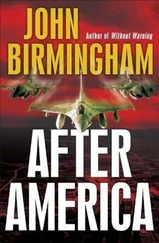
Mark Steyn - After America
Здесь есть возможность читать онлайн «Mark Steyn - After America» весь текст электронной книги совершенно бесплатно (целиком полную версию без сокращений). В некоторых случаях можно слушать аудио, скачать через торрент в формате fb2 и присутствует краткое содержание. Город: Washington, DC, Год выпуска: 2011, ISBN: 2011, Издательство: Regnery Publishing, Жанр: Публицистика, Политика, на английском языке. Описание произведения, (предисловие) а так же отзывы посетителей доступны на портале библиотеки ЛибКат.

- Название:After America
- Автор:
- Издательство:Regnery Publishing
- Жанр:
- Год:2011
- Город:Washington, DC
- ISBN:978-1-59698-100-3
- Рейтинг книги:4 / 5. Голосов: 1
-
Избранное:Добавить в избранное
- Отзывы:
-
Ваша оценка:
After America: краткое содержание, описание и аннотация
Предлагаем к чтению аннотацию, описание, краткое содержание или предисловие (зависит от того, что написал сам автор книги «After America»). Если вы не нашли необходимую информацию о книге — напишите в комментариях, мы постараемся отыскать её.
bestseller,
, Mark Steyn predicted collapse for the rest of the Western World. Now, he adds, America has caught up with Europe on the great rush to self-destruction.
It’s not just our looming financial collapse; it’s not just a culture that seems on a fast track to perdition, full of hapless, indulgent, childish people who think government has the answer for every problem; it’s not just America’s potential eclipse as a world power because of the drunken sailor policymaking in Washington—no, it’s all this and more that spells one word for America: Armageddon.
What will a world without American leadership look like? It won’t be pretty—not for you and not for your children. America’s decline won’t be gradual, like an aging Europe sipping espresso at a café until extinction (and the odd Greek or Islamist riot). No, America’s decline will be a wrenching affair marked by violence and possibly secession.
With his trademark wit, Steyn delivers the depressing news with raw and unblinking honesty—but also with the touch of vaudeville stand-up and soft shoe that makes him the most entertaining, yet profound, columnist on the planet. And as an immigrant with nowhere else to go, he offers his own prescription for winning America back from the feckless and arrogant liberal establishment that has done its level best to suffocate the world’s last best hope in a miasma of debt, decay, and debility. You will not read a more important—or more alarming, or even funnier—book all year than
. Praise for “Mark Steyn is a modern day Jeremiah with a quiverful of devastating one-liners, nailing what the liberals have done to our country. He presents an alarming—and frighteningly convincing—prophecy of where we’re headed. The choice is stark—we either listen to Steyn and act on his recommendations or face economic and cultural armageddon.”
—Mark Levin “Mark Steyn has done it again. In his new book,
, he clearly defines the dangerous signals which show America is embracing the same doomed path as the failed European economies, and how vital it is to implement and avoid policies right now to prevent us from the same fate.”
—Sean Hannity “Only Mark Steyn can write about the decline of America and leave you laughing.”
—Ann Coulter
After America — читать онлайн бесплатно полную книгу (весь текст) целиком
Ниже представлен текст книги, разбитый по страницам. Система сохранения места последней прочитанной страницы, позволяет с удобством читать онлайн бесплатно книгу «After America», без необходимости каждый раз заново искать на чём Вы остановились. Поставьте закладку, и сможете в любой момент перейти на страницу, на которой закончили чтение.
Интервал:
Закладка:
But who knows? By 2018, there might be some 70/30 UN/federal bridge plan, under which the UN pays 70 percent, and the feds pay 30, and thus the town would only be liable for 20 percent of the state’s 40 percent of the feds’ 30 percent. And the estimate for the bridge will be a mere $2.7 billion.
While the Select Board was pondering this, another bridge was condemned. The state’s estimate was $415,000, and, given that the previous bridge had been on the to-do list for six years, they weren’t ready to pencil this second one in on the schedule just yet. So instead the town put in a new bridge from a local contractor. Cost: $30,000. Don’t worry; it’s all up to code—and a lot safer than the worn-out temporary bridge still waiting for the 80/20/60/40/70/30 deal to kick in. As my friend said at the meeting:
“Screw the state” is not a Tocquevillian formulation, but he would have certainly agreed with the latter sentiment. When something goes wrong, a European demands to know what the government’s going to do about it.
An American does it himself. Or he used to—in the Jacksonian America a farsighted Frenchman understood so well. Big Government is better understood as remote government. If we can’t “do it ourselves” when it comes to painting schoolrooms or building bridges, we should certainly confine it to the least remote level of government.

DE-GOVERNMENTALIZE
Much of America is now in need of an equivalent to Mrs. Thatcher’s privatization program in 1980s Britain, or post-Soviet Eastern Europe’s economic liberalization in the early Nineties. It’s hard to close down government bodies, but it should be possible to sell them off. And a side benefit to outsourcing the Bureau of Government Agencies and the Agency of Government Bureaus is that you’d also be privatizing public-sector unions, which are the biggest and most direct assault on freedom, civic integrity, and fiscal solvency.
DE-REGULATE
A couple of years back, I was talking to a stonemason and a roofer who were asked to do a job for a certain large institution in New Hampshire. They were obliged to attend “ladder school,” even though both men have been working at the top of high ladders for over forty years. The gentleman from OSHA (the Occupational Safety and Health Administration) cautioned them against mocking his transparent waste of their time: under the new administration, he explained, his bureaucracy would be adopting a more enforcement-oriented approach to private business. So they rolled their eyes merely metaphorically and accepted the notion that they should give up a working day because the federal government has taken to itself the right to credentialize ladder-climbing from the Great North Woods to Honolulu.
At a certain point, why bother? As fast as you climb the ladder, you’ll be taxed and regulated down the chute back to the bottom rung. You’ll be frantically peddling the treadmill seven days a week so that the statist succubus squatting on your belly as you sleep can sluice the fruits of your labors to untold millions of bureaucrats from the Bureau of Compliance microregulating you till your pips squeak while they enjoy a lifestyle you never will. “The business of America is business,” said Calvin Coolidge. Now the business of America is regulation. It is necessary for once free people to take back responsibility for their own affairs. Ultimately, judge-made law and bureaucrat-made regulations and dancing with the czars strike at the compact between citizen and state. By sidestepping the consent of the governed, as regulators do, or expressing open contempt for it, as judges do, the governing class delegitimizes itself. When government is demanding the right to determine every aspect of your life, those on the receiving end should at least demand back that our betters have the guts to do so by passing laws in legislatures of the people’s representatives. Micro-regulation is micro-tyranny, a slithering, serpentine network of insinuating Ceaucescu and Kim Jong-Il minime’s. It’s time for mass rejection of their diktats. A political order that subjects you to the caprices of faceless bureaucrats or crusading “judges” merits no respect. To counter the Bureau of Compliance, we need an Alliance of Non-Compliance to help once free people roll back the regulatory state.
DE-MONOPOLIZE
We also need a new trust-busting movement to bust the dominant trust of our time—the Big Government monopoly that monopolizes more and more of life. It is depressing that the government monopoly is now so taken for granted that much of our public discourse simply assumes the virtues of collectivism. For example, it’s often argued that, as a proportion of GDP, America spends more on health care than countries with government medical systems. 9As a point of fact, pre-ObamaCare “America” doesn’t spend anything on health care: hundreds of millions of people make hundreds of millions of individual decisions about what they’re going to spend on health care. Whereas up north a handful of bureaucrats determine what Canada will spend on health care—and that’s that: health care is a government budget item. If Joe Hoser in Moose Jaw wants to increase Canada’s health-care spending by $500 drawn from his savings account, he can’t. The law prevents it. Unless, as many Canadians do, he drives south and spends it in a U.S. hospital for treatment he can’t get in a timely manner in his own country.
While we’re on the subject, why is our higher per capita health spending by definition a bad thing? We spend more per capita on public education than any advanced nation except Luxembourg, and at least the Luxembourgers have something to show for it. 10But no one says we need to bring our education spending down closer to the OECD average. Au contraire , the same people who say we spend too much on health care are in favor of spending even more on education.
You can make the “controlling costs” argument about anything. After all, it’s no surprise that millions of free people freely choosing how they spend their own money will spend it in different ways than government bureaucrats would be willing to license on their behalf. America spends more per capita on food than Zimbabwe. America spends more on vacations than North Korea. America spends more on lap-dancing than Saudi Arabia (well, officially). America spends more per capita on health than Canada, but Canada spends more per capita on doughnuts than America. Yet the Canadian Parliament doesn’t say, well, that shows that we need to control costs so we’ve drawn up a 2,000-page doughnut-reform bill, which would allow children to charge their doughnuts to their parents until they’re twenty-six years old. Ottawa would introduce a National Doughnut Licensing Agency. You’d still see your general dispenser for simple procedures like a lightly sugared cruller, but he’d refer you to a specialist if you needed, say, a maple-frosted custard—and it would only be a six-month wait, at the end of which you’d receive a stale cinnamon roll.
During the 2004 election, John Kerry and John Edwards went around telling people there are no jobs out there, even though at the time America had much lower unemployment than Canada, France, Germany, or almost any other developed country. But, catching Senator Edwards on the stump in an old mill town in New Hampshire, I saw what he was getting at. There are no jobs like the jobs your pa had, where you could go to the mill and do the same thing day in, day out for forty-five years, and it made it so much easier for swanky senators come election time because there were large numbers of you losers all in the same place when they flew in for the campaign stop, and the crowd was impressive, whereas now they have to prowl around town ferreting out small two- or three-man start-ups, which takes a lot longer and to be honest never looks so good on the evening news. Watching Senator Edwards pining for the mills, I wondered if he wasn’t having a strange premonition of his own obsolescence. The rise of big business was also the rise of Big Government. This isn’t 1934. In an age of small start-ups and home businesses and desktop publishing, we don’t need a one-size-fits-all statist monopoly.
Читать дальшеИнтервал:
Закладка:
Похожие книги на «After America»
Представляем Вашему вниманию похожие книги на «After America» списком для выбора. Мы отобрали схожую по названию и смыслу литературу в надежде предоставить читателям больше вариантов отыскать новые, интересные, ещё непрочитанные произведения.






Обсуждение, отзывы о книге «After America» и просто собственные мнения читателей. Оставьте ваши комментарии, напишите, что Вы думаете о произведении, его смысле или главных героях. Укажите что конкретно понравилось, а что нет, и почему Вы так считаете.