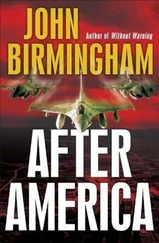
Mark Steyn - After America
Здесь есть возможность читать онлайн «Mark Steyn - After America» весь текст электронной книги совершенно бесплатно (целиком полную версию без сокращений). В некоторых случаях можно слушать аудио, скачать через торрент в формате fb2 и присутствует краткое содержание. Город: Washington, DC, Год выпуска: 2011, ISBN: 2011, Издательство: Regnery Publishing, Жанр: Публицистика, Политика, на английском языке. Описание произведения, (предисловие) а так же отзывы посетителей доступны на портале библиотеки ЛибКат.

- Название:After America
- Автор:
- Издательство:Regnery Publishing
- Жанр:
- Год:2011
- Город:Washington, DC
- ISBN:978-1-59698-100-3
- Рейтинг книги:4 / 5. Голосов: 1
-
Избранное:Добавить в избранное
- Отзывы:
-
Ваша оценка:
After America: краткое содержание, описание и аннотация
Предлагаем к чтению аннотацию, описание, краткое содержание или предисловие (зависит от того, что написал сам автор книги «After America»). Если вы не нашли необходимую информацию о книге — напишите в комментариях, мы постараемся отыскать её.
bestseller,
, Mark Steyn predicted collapse for the rest of the Western World. Now, he adds, America has caught up with Europe on the great rush to self-destruction.
It’s not just our looming financial collapse; it’s not just a culture that seems on a fast track to perdition, full of hapless, indulgent, childish people who think government has the answer for every problem; it’s not just America’s potential eclipse as a world power because of the drunken sailor policymaking in Washington—no, it’s all this and more that spells one word for America: Armageddon.
What will a world without American leadership look like? It won’t be pretty—not for you and not for your children. America’s decline won’t be gradual, like an aging Europe sipping espresso at a café until extinction (and the odd Greek or Islamist riot). No, America’s decline will be a wrenching affair marked by violence and possibly secession.
With his trademark wit, Steyn delivers the depressing news with raw and unblinking honesty—but also with the touch of vaudeville stand-up and soft shoe that makes him the most entertaining, yet profound, columnist on the planet. And as an immigrant with nowhere else to go, he offers his own prescription for winning America back from the feckless and arrogant liberal establishment that has done its level best to suffocate the world’s last best hope in a miasma of debt, decay, and debility. You will not read a more important—or more alarming, or even funnier—book all year than
. Praise for “Mark Steyn is a modern day Jeremiah with a quiverful of devastating one-liners, nailing what the liberals have done to our country. He presents an alarming—and frighteningly convincing—prophecy of where we’re headed. The choice is stark—we either listen to Steyn and act on his recommendations or face economic and cultural armageddon.”
—Mark Levin “Mark Steyn has done it again. In his new book,
, he clearly defines the dangerous signals which show America is embracing the same doomed path as the failed European economies, and how vital it is to implement and avoid policies right now to prevent us from the same fate.”
—Sean Hannity “Only Mark Steyn can write about the decline of America and leave you laughing.”
—Ann Coulter
After America — читать онлайн бесплатно полную книгу (весь текст) целиком
Ниже представлен текст книги, разбитый по страницам. Система сохранения места последней прочитанной страницы, позволяет с удобством читать онлайн бесплатно книгу «After America», без необходимости каждый раз заново искать на чём Вы остановились. Поставьте закладку, и сможете в любой момент перейти на страницу, на которой закончили чтение.
Интервал:
Закладка:
It’s never a good idea to put reality up for grabs. I remember my last visit to Monte Carlo, to see an old friend who had retired there for tax reasons. Enjoying a café au lait under an awning on a pedestrianized street, we watched the world go by and discussed the demographic death spiral that “alarmist” early-century tracts had played up. And, after chewing over the numbers for Italy, Spain, and so on, my friend had said jokingly, “Well, what about Monaco? Could Monte Carlo spearhead the rebirth of Europe?”
Alas, no. Monaco had the lowest birth rate on the planet: seven births per thousand people. 78That was because it was a chichi little enclave of wealthy tax exiles, and who wants snot-nosed kids getting underfoot and spoiling things? The town was impressive—clean, prosperous, civilized, and no children. What could be more amiable?
That’s what more and more of Europe felt like, at least outside the surging Muslim enclaves. Much of the western world had made a bet that it could survive as a giant Monte Carlo—rich, plump, happy, and insulated from all the unpleasantness of life. As I said to my friend that day: What’s holding Monte Carlo in place?
It’s a short sail from impoverished North Africa. What was there to prevent, say, a bunch of Algerians just walking in and taking it?
The first victims of American retreat were the many parts of the world that had benefited from an unusually benign hegemon. But eventually the consequences of retreat came home, too.
How quickly the world turns: Western Europe is semi-Islamic.
A resurgent Russia is also Islamizing fast but under a stern petro-czar confident he can control them. He has reestablished Eastern Europe and Central Asia as the bear’s sphere of influence.
Iran is the dominant power in the Middle East, actively supported by a post-Kemalist Turkey and with the reluctant acquiescence of the Sunni dictatorships. Its missiles can reach western Europe, and its technology is being dispersed to friendly nations and non-state actors alike.
Pakistan has fallen to the local branch of the Taliban, and India is preoccupied by a nuclear stand-off. North Korea is clinging on as a nuclear Wal-Mart for anyone who wants a No Dong missile at unbeatable prices.
China is growing old, and is in a hurry. Resource-short as always, it has bought up much of Africa. The least worst parts of the Dark Continent are a de facto Beijing protectorate, while those territories that are too much trouble for China to annex are exporting their people and their problems north.
Latin America is for sale to whoever’s buying—the Chinese, the Russians, the new Caliphate. Islam has made modest inroads into the continent—not huge but just enough to add a whole new wrinkle to America’s unenforced southern border. A failing superpower doesn’t have the guards to keep track of the line, even if it wanted to. One time there was talk of getting state-of-the-art sensors like the Chinese have, to keep their Uighurs in place. But no one in the crumbling union of however many states remain in Old Glory has the budget any more. The Border Patrol do their best, but it’s getting harder to tell José from Mohammed what with the opportunist “reversions” going on among the drug cartels.
Going over the computer footage one morning, the guards see a truck managed to get across during the night. Not a big deal, probably just a couple dozen peasants heading north to join their families.
Funny thing, though. The truck didn’t stop in the Arizona desert and let out its human cargo. The border guys found out a couple days later it had headed north, picked up Interstate 40 eastbound, all the way through New Mexico, Oklahoma, Arkansas, Tennessee until it hit Greensboro and swung north on I-85.
Towards Washington.
They figured it out when they saw it on the news.

In this chapter, Steyn paints a bleak picture of the world “after America”:
Western Europe is semi-Islamic, Russia has the monopoly on energy and security, China is the new economic superpower, Iran is a nuclear power, Latin America is for sale to the highest bidder, Japan’s population is part robotic, and cannibalism is standard practice in Africa.
Could this happen? Is this happening? Or is it just fantastical?
Click here to tweet us (@Regnery, #AfterAmerica)
Click here to post your answer on our Facebook wall ( Facebook.com/RegneryBooks.)
EPILOGUE
THE HOPE OF AUDACITY
I do not believe that the solution to our problem is simply to elect the right people. The important thing is to establish a political climate of opinion which will make it politically profitable for the wrong people to do the right thing. Unless it is politically profitable for the wrong people to do the right thing, the right people will not do the right thing either, or if they try, they will shortly be out of office.
—Milton Friedman, Milton Friedman in Australia (1975)In February 2009, a few weeks after his inauguration, President Obama went to Congress to deliver America’s first State of the European Union address. It included the following:
I think about Ty’Sheoma Bethea, the young girl from that school I visited in Dillon, South Carolina—a place where the ceilings leak, the paint peels off the walls, and they have to stop teaching six times a day because the train barrels by their classroom. She had been told that her school is hopeless, but the other day after class she went to the public library and typed up a letter to the people sitting in this chamber. She even asked her principal for the money to buy a stamp. The letter asks us for help, and says, “We are just students trying to become lawyers, doctors, congressmen like yourself and one day president, so we can make a change to not just the state of South Carolina but also the world. We are not quitters.” That’s what she said. “We are not quitters.” 1
There was much applause, and this passage was cited approvingly even by some conservatives as an example of how President Obama was yoking his “ambitious vision” (also known as record-breaking spending) to traditional appeals to American virtues. In fact, the Commander-in-Chief was deftly yoking the language of American exceptionalism to the cause of European statism. Apparently, nothing testifies to the American virtues of self-reliance and entrepreneurial energy like joining the monstrous army of robotic extras droning in unison, “The government needs to do more for me….”
The animating principles of the American idea were entirely absent from Obama’s vision—unless by American exceptionalism you mean an exceptional effort to harness an exceptionally big government in the cause of exceptionally massive spending.
Consider first the least contentious part:
We are just students trying to become lawyers, doctors, congressmen…
The doctors are now on track to becoming yet another group of government employees; the lawyers sue the doctors for medical malpractice and, when they’ve made enough dough, like ambulance-chaser par excellence John Edwards, they get elected to Congress. The American Dream, twenty-first-century version? Is there no one in Miss Bethea’s school who’d like to be an entrepreneur, an inventor, a salesman, a generator of wealth? Someone ’s got to make the dough the government’s already spent. Maybe Dillon High School’s most famous alumnus, Federal Reserve chairman Ben Bernanke, could explain it to them.
As for the train “barreling by their classroom,” the closest the railroad track comes to the school is about 240 yards, or over an eighth of a mile. 2
Читать дальшеИнтервал:
Закладка:
Похожие книги на «After America»
Представляем Вашему вниманию похожие книги на «After America» списком для выбора. Мы отобрали схожую по названию и смыслу литературу в надежде предоставить читателям больше вариантов отыскать новые, интересные, ещё непрочитанные произведения.







Обсуждение, отзывы о книге «After America» и просто собственные мнения читателей. Оставьте ваши комментарии, напишите, что Вы думаете о произведении, его смысле или главных героях. Укажите что конкретно понравилось, а что нет, и почему Вы так считаете.