Edward Lucas - Deception
Здесь есть возможность читать онлайн «Edward Lucas - Deception» весь текст электронной книги совершенно бесплатно (целиком полную версию без сокращений). В некоторых случаях можно слушать аудио, скачать через торрент в формате fb2 и присутствует краткое содержание. Город: New York, Год выпуска: 2012, ISBN: 2012, Издательство: Walker & Company, Жанр: Публицистика, на английском языке. Описание произведения, (предисловие) а так же отзывы посетителей доступны на портале библиотеки ЛибКат.
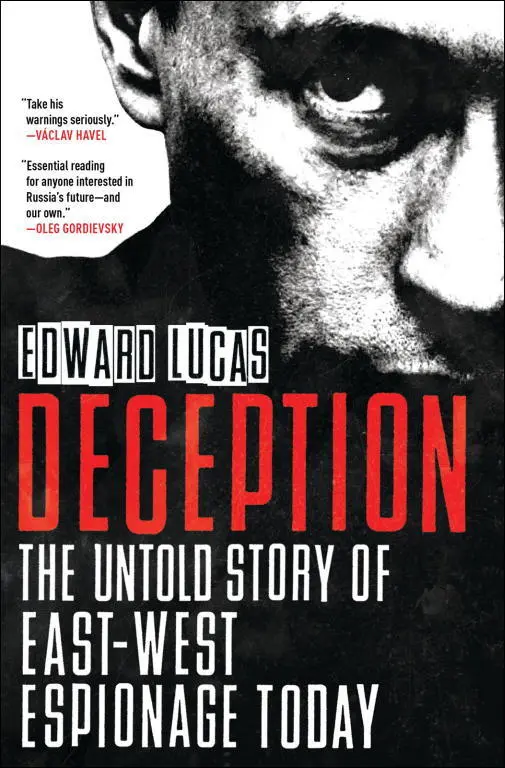
- Название:Deception
- Автор:
- Издательство:Walker & Company
- Жанр:
- Год:2012
- Город:New York
- ISBN:9780802713056
- Рейтинг книги:4 / 5. Голосов: 1
-
Избранное:Добавить в избранное
- Отзывы:
-
Ваша оценка:
Deception: краткое содержание, описание и аннотация
Предлагаем к чтению аннотацию, описание, краткое содержание или предисловие (зависит от того, что написал сам автор книги «Deception»). Если вы не нашли необходимую информацию о книге — напишите в комментариях, мы постараемся отыскать её.
In
Edward Lucas uncovers the real story of Chapman and her colleagues in Britain and America, unveiling their clandestine missions and the spy-hunt that led to their downfall. It reveals unknown triumphs and disasters of Western intelligence in the Cold War, providing the background to the new world of industrial and political espionage. To tell the story of post-Soviet espionage, Lucas draws on exclusive interviews with Russia’s top NATO spy, Herman Simm, and unveils the horrific treatment of a Moscow lawyer who dared to challenge the ruling criminal syndicate there.
Once the threat from Moscow was international communism, now it comes from the
, Russia’s ruthless “men of power.” “The outcome,” Lucas argues, “will determine whether the West brings Russia toward its standards of liberty, legality, and cooperation, or whether Russia will shape the West’s future as we accommodate (or even adopt) the authoritarian crony capitalism that is the Moscow regime’s hallmark.”
Deception — читать онлайн бесплатно полную книгу (весь текст) целиком
Ниже представлен текст книги, разбитый по страницам. Система сохранения места последней прочитанной страницы, позволяет с удобством читать онлайн бесплатно книгу «Deception», без необходимости каждый раз заново искать на чём Вы остановились. Поставьте закладку, и сможете в любой момент перейти на страницу, на которой закончили чтение.
Интервал:
Закладка:
22
vI am concealing the full details of this case out of consideration for his family.
23
w Glavnoye Razvedyvatelnoye Upravleniye (Main Intelligence Directorate).
24
xI focus in this chapter on solely HUMINT (the recruitment and running of human sources) not SIGINT (electronic intercepts) or geospatial reconnaissance (via satellite). I am also leaving out, among other intelligence professionals, the analysts and reporting officers who make sense of the spies’ work.
25
yThis former Napoleonic fort, once used by Britain’s wartime Special Operations Executive, is not as secret as perhaps it should be. Its postcode is PO12 2AT; other details including a telephone number are available on the internet.
26
zA related problem is that a single money-grubbing source may sell the same, slightly tweaked, information to several agencies: to America’s CIA and Germany’s BND for example. A dubious piece of information checks out from several seemingly different sources, and counts as solid. Yet behind it is just one agent, single-mindedly maximising his income. It is this that lay behind the colossal blunder that Western intelligence made over Iraq’s supposed weapons of mass destruction.
27
aa650 acres.
28
abMr Edbrook is presumably quoting from another CIA document not yet declassified.
29
acI think this creates horrific problems for real NGOs and should be off-limits.
30
adMs Chapman and another junior illegal ferried laptop computers between Russia and America, rather more often than planned because of repeated technical glitches. When they worked, the laptops were used to send clandestine radio transmissions to intelligence officers based at Russian diplomatic missions.
31
aeKnown as the ‘Forest’ or the ‘Sanatorium’, the SVR headquarters is a Finnish-built skyscraper complex in the district of Yasenevo, just south of the Moscow ring-road.
32
afSquare brackets signify material redacted by the FBI before the complaint was made public.
33
agI contacted Heathfield via LinkedIn, offering him a chance to review this chapter and give his comments. He replied by giving an email address, but never downloaded the file I sent him.
34
ahI made repeated attempts to gain Ms Chapman’s side of the story for this book. I received two messages in return from her Facebook account. One read: ‘How can you possibly write a book without 1 decent article in press that is based on some what [sic] true facts? No interview, no nothing…’ The other noted: ‘I was the one who suffered and you will be the one to gain? :)’ I responded: ‘I hope my book will sell well but even if I win a Pulitzer prize (which I won’t) you will always be more famous than me!’ I received no answer to this, or to an extensive list of questions.
35
aiIn fact an intelligence officer based at the Russian mission to the United Nations in New York, under the diplomatic cover of ‘second secretary’. It appears that most if not all the illegals were run from the Russian mission in New York, not from the embassy in Washington, DC.
36
ajHe gained political asylum in Britain in 2003, taking up a promise made when he brokered the release of two British hostages in Chechnya in 1998.
37
akShe is sometimes described as a ‘belly’ dancer and sometimes as a ‘ballet’ dancer. This may be a confusion caused by pronunciation.
38
alLuckily my web-savvy son Johnny suggested that I make a screenshot of the Google cache version of the site.
39
amHer website (annachapman.ru) gives details of her exploits. Curiously, it was registered in April 2010, before the spy scandal broke.
40
anCompared to Russia, the Baltic states are tiny. But so are most countries. Their combined land area is around the size of California; the total population of the three countries is just under 7m, rather less than Greater London (7.8m). Lithuania, with 3.2m, is the largest, Latvia has 2.2m people and Estonia has 1.3m.
41
aoThe Kreevians died out in the nineteenth century in Latvia. Probably the last mother-tongue speaker of Livonian died in 2009. The Prussian language became extinct in the eighteenth century, though German colonisers adopted the placename. Around ten thousand Vepsians survive, mostly in Russia. The Vends ceased to be a distinct ethnic group in the sixteenth century.
42
apBritain had longstanding commercial and cultural ties with the region. An Anglican church in Riga opened in 1859, built on English soil specially imported by the wealthy merchants who traded furs and timber. A Scot, George Armitstead (known as Džordžs Armitsteds in Latvian), was even the city’s mayor in 1901–1912.
43
aqPreviously St Petersburg, soon to be Leningrad.
44
arXenophon Kalamatiano was caught trying to scale the wall of the Norwegian embassy, which represented American interests. His interrogator examined his hefty walking stick and found it stuffed with roubles and receipts from his agents. He survived a spell in the Lubyanka and was exchanged for American food aid in August 1921.
45
asThe Bolsheviks refused to allow the dying man a drink of water, or the embassy chaplain to attend to him. My suggestion to the British consulate in St Petersburg, when it opened in 1992, to name a prize or scholarship after this gallant officer met with a sorry lack of enthusiasm.
46
atBoth Russian battleships still had their Tsarist-era names with religious allusions: ‘Peter and Paul’ and ‘Andrew the First-called [apostle]’. A French naval force was also in the Baltic but unable to take part in hostilities against the Bolsheviks for fear that the sailors would mutiny.
47
auVery roughly, around £250,000 or $400,000 in modern money.
48
avIt was part of an underground army comprising the remnants of the armed forces of the short-lived Ukrainian republic, anti-Bolshevik Russians based in Poland and others.
49
awIt is tempting to speculate that this real-life example may have inspired Graham Greene, himself an SIS officer, with the mysterious giant suction device – in fact a domestic vacuum cleaner writ large – depicted in Our Man in Havana .
50
axAugusts Bergmanis.
51
ayRihards Zande and Ēriks Tomsons.
52
azHis Lithuanian and Latvian counterparts were Stasys Žymantas, an Oxford-educated émigré lawyer, and Rūdolfs Silarājs, an airman.
53
baAfter leaving SIS Philby worked briefly for my employer, the Economist , as our Beirut-based Middle East correspondent. Barbara Smith, then one of our Middle East editors, remembers his reporting as excellent but that she had to chivvy him over his lack of productivity. Shortly afterwards we found out the reasons, when he turned up in the Soviet Union.
54
bbA CIA officer called David Murphy responded in a similar vein. ‘Even if they don’t send back good intelligence, we’re causing the Russians a lot of headaches.’
Читать дальшеИнтервал:
Закладка:
Похожие книги на «Deception»
Представляем Вашему вниманию похожие книги на «Deception» списком для выбора. Мы отобрали схожую по названию и смыслу литературу в надежде предоставить читателям больше вариантов отыскать новые, интересные, ещё непрочитанные произведения.








Обсуждение, отзывы о книге «Deception» и просто собственные мнения читателей. Оставьте ваши комментарии, напишите, что Вы думаете о произведении, его смысле или главных героях. Укажите что конкретно понравилось, а что нет, и почему Вы так считаете.