Edward Lucas - Deception
Здесь есть возможность читать онлайн «Edward Lucas - Deception» весь текст электронной книги совершенно бесплатно (целиком полную версию без сокращений). В некоторых случаях можно слушать аудио, скачать через торрент в формате fb2 и присутствует краткое содержание. Город: New York, Год выпуска: 2012, ISBN: 2012, Издательство: Walker & Company, Жанр: Публицистика, на английском языке. Описание произведения, (предисловие) а так же отзывы посетителей доступны на портале библиотеки ЛибКат.
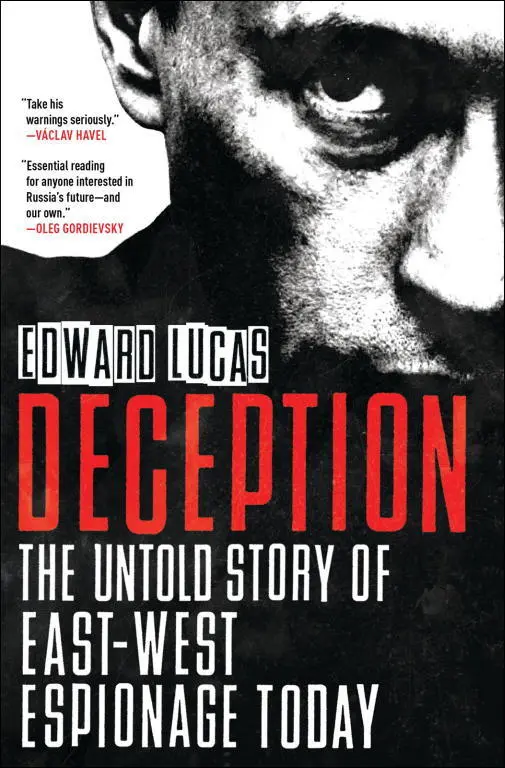
- Название:Deception
- Автор:
- Издательство:Walker & Company
- Жанр:
- Год:2012
- Город:New York
- ISBN:9780802713056
- Рейтинг книги:4 / 5. Голосов: 1
-
Избранное:Добавить в избранное
- Отзывы:
-
Ваша оценка:
Deception: краткое содержание, описание и аннотация
Предлагаем к чтению аннотацию, описание, краткое содержание или предисловие (зависит от того, что написал сам автор книги «Deception»). Если вы не нашли необходимую информацию о книге — напишите в комментариях, мы постараемся отыскать её.
In
Edward Lucas uncovers the real story of Chapman and her colleagues in Britain and America, unveiling their clandestine missions and the spy-hunt that led to their downfall. It reveals unknown triumphs and disasters of Western intelligence in the Cold War, providing the background to the new world of industrial and political espionage. To tell the story of post-Soviet espionage, Lucas draws on exclusive interviews with Russia’s top NATO spy, Herman Simm, and unveils the horrific treatment of a Moscow lawyer who dared to challenge the ruling criminal syndicate there.
Once the threat from Moscow was international communism, now it comes from the
, Russia’s ruthless “men of power.” “The outcome,” Lucas argues, “will determine whether the West brings Russia toward its standards of liberty, legality, and cooperation, or whether Russia will shape the West’s future as we accommodate (or even adopt) the authoritarian crony capitalism that is the Moscow regime’s hallmark.”
Deception — читать онлайн бесплатно полную книгу (весь текст) целиком
Ниже представлен текст книги, разбитый по страницам. Система сохранения места последней прочитанной страницы, позволяет с удобством читать онлайн бесплатно книгу «Deception», без необходимости каждый раз заново искать на чём Вы остановились. Поставьте закладку, и сможете в любой момент перейти на страницу, на которой закончили чтение.
Интервал:
Закладка:
His descent to treason began, according to him and to Estonian officials, during a summer holiday in the Tunisian resort of Sousse in July 1995. A familiar figure approached him in the street. It was Valeri Zentsov, a former official in the Soviet Estonian KGB. Casually dressed in a T-shirt and shorts, he introduced himself, pressing Simm to join him for a vodka. This meeting was no coincidence: when an intelligence officer pitches to a potential agent, every aspect is worked out in advance. What are the target’s weaknesses? What happens if he threatens to report the encounter to his authorities? What mixture of bribery, threats and flattery will work best? That the Russians had identified Simm, and knew his movements well enough to approach him when he was on holiday, in between jobs, and following the end of his relationship with a much younger girlfriend, suggests a thorough knowledge of the comings and goings of Estonian society. Simm himself believes that a Russian mole elsewhere in the defence or security establishment had ‘spotted’ him as a likely prospect. That may well be true. Yet it is also possible that the story is in whole or in part a fake. No external corroboration for it exists. The real truth may be that Simm needed not to be recruited, but just reactivated.
Zentsov greeted him (at least according to Simm’s version of events) with pleasantries. Simm recalls:
I knew it was not a chance meeting. I thought we might be observed. But I was afraid my career would be over if I said no. Also I thought about the future – who would help me? My salary was low.
Simm claims that the approach came at a time when he had survived bruising encounters with organised crime gangs in Tallinn. He recalls:
I wore a bullet-proof vest… Life was cheap… a killer cost just $300… Russian intelligence has more than 500 poisons, for ladies and for men. If they could find me in Tunisia they could find me anywhere. Who could I trust?
Zentsov assured Simm that Russia had no hostile intentions to Estonia, dismissing the (then only occasional) outbursts from Moscow as a mere ‘political game’. But he said his superiors were worried that NATO would use the small country as a base for an attack on Russia. That concern, Simm says, was a hallmark of Russian demands for intelligence over the next thirteen years. ‘Even at the last meeting, they were worried about NATO bases in Estonia.’
The natural thing for a patriotic Estonian to do – even a nervous and unemployed one – would be to listen politely and then report this encounter immediately to the authorities. Simm did not, apparently because Zentsov threatened to expose his collaboration with the KGB in the 1980s. Yet the threat was matched by an appeal to Simm’s self-importance, and his dislike of Estonia’s young, pro-Western, English-speaking security elite. He says elliptically of his decision to commit treason:
It was a very hard question right until the end. But there had to be a little balance. I know the Russian mentality. They needed information because if they believed they were being attacked, they would attack Estonia.
Traitors typically salve their consciences with the idea that they are playing a great role in geopolitics. Simm seems to have been no exception. The Russian also played skilfully on Simm’s troubled psyche, presenting himself as a similarly apolitical colleague. ‘He was a patriot and I was a patriot,’ Simm says, without irony. Zentsov stressed a common disdain for politicians, bemoaning the sleaze and abuse of power of the Yeltsin era, while also undermining Simm’s view of Estonian statehood. Did he know, asked Zentsov, that Estonia’s pre-war military leader, General Johan Laidoner, had worked for Soviet intelligence? And that the country’s then president Konstantin Päts had been on the Kremlin payroll too? Most Estonians would regard these ideas not just as fanciful but outrageously insulting. President Päts died in a Soviet mental hospital in 1956, where he was incarcerated because of his persistent belief that ‘he is a president of Estonia’. Laidoner died in a Soviet prison in 1953. Comparably absurd allegations would be to say that Winston Churchill was a Soviet agent, that FDR took money from the Nazi Party, and that General Douglas MacArthur had been in the pay of Chinese intelligence during the Korean War. But they chimed with Simm’s weakness for conspiratorial explanations.
With a classic mix of money, blackmail and flattery, the pitch worked. Simm agreed to cooperate with Russian intelligence, not as traitor but (he insists) as an officer, with a clandestine rank, salary and pension. That played on a grudge: that the Defence Ministry had never given him the military rank – equivalent to his position as a police general – that he believed he had been promised on joining. Simm claims he also insisted that he would never work against Estonia’s interests (as defined by him). The offer and promise alike were delusions, but Simm’s value for the SVR was all too clear: a trusted, well-connected source, in the heart of the country’s burgeoning defence establishment. Running the new agent was easy. With his KGB background obscured by his status as a ‘military pensioner’, Zentsov had no difficulty in visiting Estonia, though most of the contact with Simm took place in third countries. [69] bp It is worth noting that Estonia experienced extreme international pressure in the 1990s to be softer on military and security personnel from the former occupation regime who did not wish to return to Russia. Had the authorities been allowed to adopt tougher rules, it would have been far harder for Zentsov (and perhaps others like him) to ply their trade.
Everyone involved in Simm’s rise through the Defence Ministry bureaucracy is eager to blame someone else. But the new recruit’s experience at the outset was of profound disappointment. Used to the established bureaucracy of the police force, he found only empty desks, bare walls, intrigues and chaos. He was also unconvinced about the whole idea of defending Estonia by military means. British advisers, he recalled, told him that resistance to a Russian attack would last ‘just four hours’ – the time it would take for tanks to get from the border town of Narva to Tallinn.
Simm’s initial haul of Estonia’s defence information was correspondingly scanty. Estonia in 1995 had practically no armed forces, slender military relationships with other countries, and seemingly scant chance of joining NATO. The biggest target for the Russians was Western intelligence cooperation, about which Simm could make only informed guesses. What he could offer were insights into the Estonian elite: who was up, who was down, who was facing a financial or marital problem; who was being trained in what specialism by which friendly country, how deeply, where and when. In one security exercise, supposedly to help the ministry get ready for NATO membership, he grilled staff with sixty questions covering private hobbies, plus possible weaknesses ranging from sex and alcohol to cars. Although he did not have access to the full ‘confessionals’ of Kapo’s counter-intelligence interviews, in which senior officials have to explain the details of any sexual or other entanglements that could make them vulnerable to blackmail, he would have had a good idea about their conclusions. His knowledge of crisis management plans was also damaging. The Estonian elite is small, with perhaps two hundred people in the key decision-making roles. Many have served in senior positions in several different ministries or agencies – defence, interior, security, the police, the diplomatic service and intelligence. Many of them are trained to stand in for colleagues in an emergency. These carefully made plans were laid bare to Russia. Should it want to decapitate Estonia in future, it knows where to strike.
Читать дальшеИнтервал:
Закладка:
Похожие книги на «Deception»
Представляем Вашему вниманию похожие книги на «Deception» списком для выбора. Мы отобрали схожую по названию и смыслу литературу в надежде предоставить читателям больше вариантов отыскать новые, интересные, ещё непрочитанные произведения.








Обсуждение, отзывы о книге «Deception» и просто собственные мнения читателей. Оставьте ваши комментарии, напишите, что Вы думаете о произведении, его смысле или главных героях. Укажите что конкретно понравилось, а что нет, и почему Вы так считаете.