Edward Lucas - Deception
Здесь есть возможность читать онлайн «Edward Lucas - Deception» весь текст электронной книги совершенно бесплатно (целиком полную версию без сокращений). В некоторых случаях можно слушать аудио, скачать через торрент в формате fb2 и присутствует краткое содержание. Город: New York, Год выпуска: 2012, ISBN: 2012, Издательство: Walker & Company, Жанр: Публицистика, на английском языке. Описание произведения, (предисловие) а так же отзывы посетителей доступны на портале библиотеки ЛибКат.
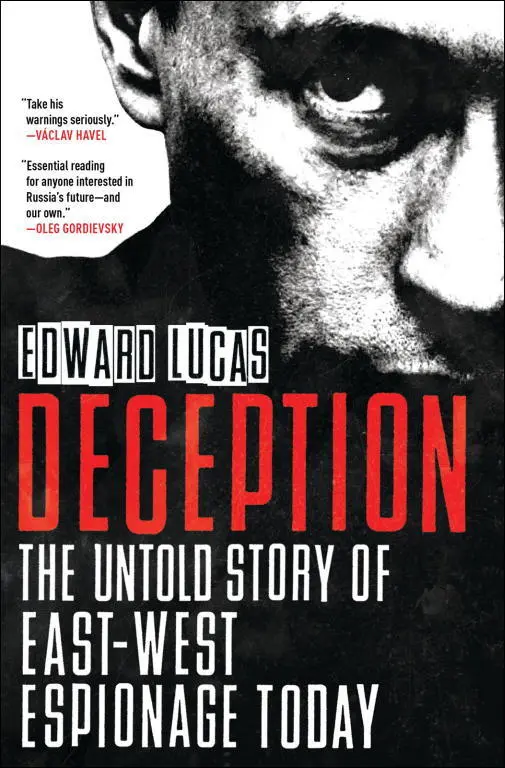
- Название:Deception
- Автор:
- Издательство:Walker & Company
- Жанр:
- Год:2012
- Город:New York
- ISBN:9780802713056
- Рейтинг книги:4 / 5. Голосов: 1
-
Избранное:Добавить в избранное
- Отзывы:
-
Ваша оценка:
Deception: краткое содержание, описание и аннотация
Предлагаем к чтению аннотацию, описание, краткое содержание или предисловие (зависит от того, что написал сам автор книги «Deception»). Если вы не нашли необходимую информацию о книге — напишите в комментариях, мы постараемся отыскать её.
In
Edward Lucas uncovers the real story of Chapman and her colleagues in Britain and America, unveiling their clandestine missions and the spy-hunt that led to their downfall. It reveals unknown triumphs and disasters of Western intelligence in the Cold War, providing the background to the new world of industrial and political espionage. To tell the story of post-Soviet espionage, Lucas draws on exclusive interviews with Russia’s top NATO spy, Herman Simm, and unveils the horrific treatment of a Moscow lawyer who dared to challenge the ruling criminal syndicate there.
Once the threat from Moscow was international communism, now it comes from the
, Russia’s ruthless “men of power.” “The outcome,” Lucas argues, “will determine whether the West brings Russia toward its standards of liberty, legality, and cooperation, or whether Russia will shape the West’s future as we accommodate (or even adopt) the authoritarian crony capitalism that is the Moscow regime’s hallmark.”
Deception — читать онлайн бесплатно полную книгу (весь текст) целиком
Ниже представлен текст книги, разбитый по страницам. Система сохранения места последней прочитанной страницы, позволяет с удобством читать онлайн бесплатно книгу «Deception», без необходимости каждый раз заново искать на чём Вы остановились. Поставьте закладку, и сможете в любой момент перейти на страницу, на которой закончили чтение.
Интервал:
Закладка:
That was an overstatement. Britain was ruined by the cost of the war. America was unwilling to face up to the new challenge in Europe. The mood began to change only after the Soviet blockade of Berlin in 1948. On 18 June of that year President Harry Truman signed a fateful order in the National Security Council, tasking the newly created CIA with:
propaganda, economic warfare, preventative direct action, including sabotage, anti-sabotage, demolition and evacuation measures, subversion against hostile states, including assistance to underground resistance movements, guerrillas and refugee liberation groups, and support of indigenous anti-communist elements in the threatened countries of the free world. 14
The first Soviet atom bomb test in August 1949 and the outbreak of the Korean War in June 1950 stoked interest further. In the days before spy satellites (or even spy planes, which started in 1952) and with Western diplomats in Moscow effectively imprisoned in their embassies, the outside world was acutely short of information about Soviet intentions and capabilities. Panicky politicians put huge pressure on the spymasters to do something. This was something that could be done. So they did it.
Superficially the Baltic states seemed an ideal base for anti-communist activities. The populations were solidly anti-communist. Partisan forces in the forests supposedly numbered many tens of thousands. The region was accessible by boat and plane. It was a forward bastion of Soviet military strength: if an attack on the West were pending, the signs in the Baltic would be unmistakable. The human means were plentiful: émigrés in western Germany, Britain and the United States provided a highly motivated and plentiful source of agents. In short, Estonia, Latvia and Lithuania looked like places where it was possible both to fight communism and spy on it. The disastrous results of this wishful thinking were the SIS Operation Jungle and its CIA counterpart, initially called Operation Tilestone. 15Failure is an orphan, and nowhere more so than in espionage. When something works, it looks like an act of genius. Had Stalin died earlier and the collapse of the Soviet Union ensued, the operations could have gone down in history as prescient and brave endeavours, worthy successors to the work of SOE in occupied Europe. In fact the disaster that followed was hushed up for thirty years. Secrecy has its uses.
The CIA developed a big training facility for émigrés in Kaufbeuren in Germany. In place of makeshift camps in neutral Sweden SIS set up a spy school for its Baltic recruits at 110 Old Church St, Chelsea (now a luxury townhouse). Among those in charge was Alfons Rebane, who had led a fierce but doomed resistance to the Red Army’s re-conquest of Estonia in 1944. [52] az His Lithuanian and Latvian counterparts were Stasys Žymantas, an Oxford-educated émigré lawyer, and Rūdolfs Silarājs, an airman.
Firearms practice took place in a quarry some twenty miles from London, while parachute training was based at an airport near Abingdon. The trainees practised landing from small boats on the Isle of Wight, learned unarmed combat at Fort Monckton and honed survival techniques at a commando-training base in Scotland near Ben Nevis. The training, ranging from memorisation to Morse code, secret writing, woodcraft and close combat, was excellent. The agents’ abilities in communications, tactics, weapons-handling, evasion and escape techniques and other elements of covert operations and spycraft were incomparably higher than their counterparts back home. After the first few years of fighting had thinned the ranks of the veterans, the partisans were mainly farm boys, wise in the ways of the countryside, but no match for the battle-hardened counter-insurgency troops of the KGB. Other bits of the Baltic operations were sloppier. Anthony Cavendish, a former SIS dispatch officer in Germany, recalls:
We took the agents down to the Reeperbahn, the red-light district of Hamburg, to a little bar we had selected beforehand… We were soon joined by heavily made-up girls and, as the serious drinking began, I headed back. About 3 am, there was violent banging on my front door… Two of our agents had returned but Peter [an SIS officer] and the other agent had got into a fight… It was only because of… long-standing contacts with the police that we were able to get Peter and the Latvian released into our custody. 16
SIS seems not to have pondered the lessons of this incident for its selection procedures and security routines. It should also have questioned the flawed assumptions behind the whole operation.
The first of these was that the Soviet Union was indeed planning a military assault on the West, rather than struggling to deal with its colossal internal problems. Another was that the existing networks were sound. In fact they were a trap. The idea that outside agents would gain useful information about Soviet military activities in the region, let alone any insights into the authorities’ decision-making, was far-fetched. That they could engage in combat operations inside the Soviet Union was even more dubious. Were the trainees spies or commandos? Was their job to monitor Soviet troop movements or to sabotage them? From 1949 onwards, SIS tried to downplay the trainees’ role in resistance operations and stressed the importance of espionage, but this risked denting their motivation. Going home to fight the occupiers and free the homeland was a powerful incentive, but risking torture and death to snoop around for a foreign power was less compelling.
A second element of treachery was in play too. Until 1947 Kim Philby, the most senior KGB spy in the West, was the head of SIS’s Section 9, in charge of all British operations against the Soviet Union. At that point he moved to Washington, DC, to an even more sensitive role: as liaison officer between SIS and the newly formed CIA. As he later wrote:
In order to avoid the dangers of overlapping and duplication, the British and Americans exchanged precise information about the timing and geographical coordinates of their operations. I do not know what happened to the parties concerned. But I can make an informed guess. 17
As Britain and America marched deeper into the bog, the KGB became bolder. In October 1948 Lukaševičs organised the bogus ‘escape’ of a seasoned agent called Vidvuds Šveics, who claimed to be a representative of the Latvian resistance. In retrospect, that seems an obvious dangle and a leading Latvian activist in Stockholm working with SIS was immediately suspicious. 18But in another grotesque breach of tradecraft, Šveics was put in charge of a six-strong group (two from each of the three countries) trained by SIS. Worse, he was given a list of local sympathisers – just the people that the KGB most wished to catch. When his team landed near the Lithuanian resort of Palanga on 1 May Šveics separated from the others and alerted the border guards, who killed both Estonians and one of the Latvians. The others fled. Šveics sent a cipher message telling SIS that he had made a miraculous escape. By the year-end the entire network was under KGB control, though still, in the eyes of the British spymasters, operating and intact. The next expedition of the beefed-up operation was in October 1949, when a group of the elaborately trained recruits landed in Latvia to be met by KGB agents posing as resistance fighters. In London, SIS celebrated a successful landing.
The Americans were making mistakes too. They were starting from ‘virtually empty’ files: little more than whatever pre-war reference books and press cuttings could be found in the Library of Congress. Harry Rositzke, a senior CIA officer, noted: ‘Even the most elementary facts were unavailable – on roads and bridges, on the location and production of factories, on city plans and airfields.’ 19Incoming intelligence was little help. ‘Most of it was trivial, much of it spotty, garbled or out of date.’ Amid the ignorance grew panic. Western military planners believed, wrongly, that Soviet forces were capable of reaching the English Channel in a matter of weeks. By late 1949, they reckoned that Soviet bombers could drop nuclear weapons on America. Rositzke recalls a military officer banging the table in the Pentagon and shouting: ‘I want an agent with a radio on every goddamn airfield between Berlin and the Urals!’ Faced with utterly impractical demands, America’s spy chiefs too threw caution (and ethics) to the winds, 20recruiting hundreds of émigrés for parachute drops into communist-ruled Europe, from the Baltic to the Black Sea. Among them were some notorious Nazi war criminals, including senior Nazis such as Otto von Bolschwing, a close associate of Adolf Eichmann, the architect of the Holocaust. 21This was not an oversight: German wartime intelligence had been excellent, and retained useful assets and insights in the East. The price was American moral credibility. It became a lot easier for Soviet propagandists to say that the West was crawling with fascists when Nazi collaborators were facing promotion, not punishment.
Читать дальшеИнтервал:
Закладка:
Похожие книги на «Deception»
Представляем Вашему вниманию похожие книги на «Deception» списком для выбора. Мы отобрали схожую по названию и смыслу литературу в надежде предоставить читателям больше вариантов отыскать новые, интересные, ещё непрочитанные произведения.










Обсуждение, отзывы о книге «Deception» и просто собственные мнения читателей. Оставьте ваши комментарии, напишите, что Вы думаете о произведении, его смысле или главных героях. Укажите что конкретно понравилось, а что нет, и почему Вы так считаете.