Edward Lucas - Deception
Здесь есть возможность читать онлайн «Edward Lucas - Deception» весь текст электронной книги совершенно бесплатно (целиком полную версию без сокращений). В некоторых случаях можно слушать аудио, скачать через торрент в формате fb2 и присутствует краткое содержание. Город: New York, Год выпуска: 2012, ISBN: 2012, Издательство: Walker & Company, Жанр: Публицистика, на английском языке. Описание произведения, (предисловие) а так же отзывы посетителей доступны на портале библиотеки ЛибКат.
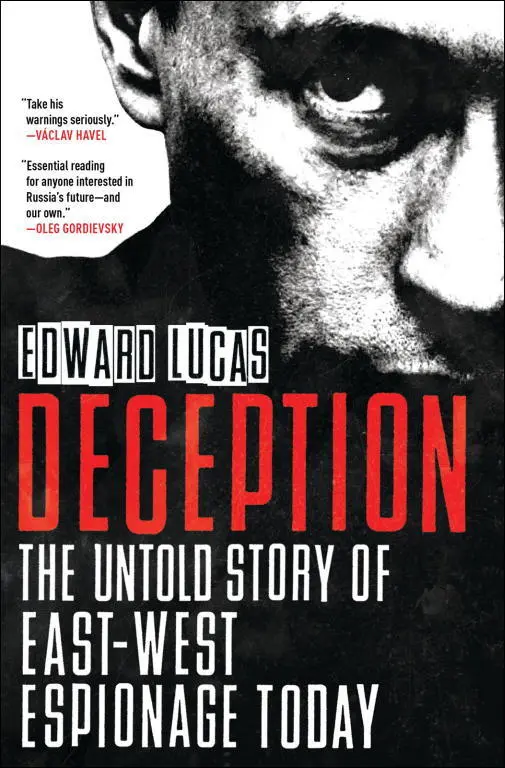
- Название:Deception
- Автор:
- Издательство:Walker & Company
- Жанр:
- Год:2012
- Город:New York
- ISBN:9780802713056
- Рейтинг книги:4 / 5. Голосов: 1
-
Избранное:Добавить в избранное
- Отзывы:
-
Ваша оценка:
Deception: краткое содержание, описание и аннотация
Предлагаем к чтению аннотацию, описание, краткое содержание или предисловие (зависит от того, что написал сам автор книги «Deception»). Если вы не нашли необходимую информацию о книге — напишите в комментариях, мы постараемся отыскать её.
In
Edward Lucas uncovers the real story of Chapman and her colleagues in Britain and America, unveiling their clandestine missions and the spy-hunt that led to their downfall. It reveals unknown triumphs and disasters of Western intelligence in the Cold War, providing the background to the new world of industrial and political espionage. To tell the story of post-Soviet espionage, Lucas draws on exclusive interviews with Russia’s top NATO spy, Herman Simm, and unveils the horrific treatment of a Moscow lawyer who dared to challenge the ruling criminal syndicate there.
Once the threat from Moscow was international communism, now it comes from the
, Russia’s ruthless “men of power.” “The outcome,” Lucas argues, “will determine whether the West brings Russia toward its standards of liberty, legality, and cooperation, or whether Russia will shape the West’s future as we accommodate (or even adopt) the authoritarian crony capitalism that is the Moscow regime’s hallmark.”
Deception — читать онлайн бесплатно полную книгу (весь текст) целиком
Ниже представлен текст книги, разбитый по страницам. Система сохранения места последней прочитанной страницы, позволяет с удобством читать онлайн бесплатно книгу «Deception», без необходимости каждый раз заново искать на чём Вы остановились. Поставьте закладку, и сможете в любой момент перейти на страницу, на которой закончили чтение.
Интервал:
Закладка:
This knee-jerk nationalism is a perfect antidote to public apathy and disgruntlement. Ms Chapman also contrasts sharply with the ranks of United Russia, mostly filled with balding middle-aged men. Sergei Markov, a Duma deputy with close Kremlin ties, says:
People are bored with the talking heads on the TV; they are interested in adventure and in action. Spies like these are really popular in the country. She fits the bill perfectly and she is really attractive.
He also sees Putinesque qualities in Ms Chapman’s curves:
Vladimir Putin is regarded as a sexual champion as he is very cool and very sexy. Both [Ms Chapman and Putin] are spies – both of them young, healthy, energetic, sexually attractive – and they met publicly. This is about making United Russia sexier and cooler… a successful political message needs to be combined with a successful non-political message.
This linking of Putin and Chapman has already started to sink into the popular consciousness. In May 2011 a shoot-em-up game called Voinushka (Punch-up) was launched on popular Russian social networking websites. A youthful-looking khaki-clad Mr Putin features as the commander, setting tasks for the person playing the undemanding game. He has a redheaded assistant, showing voluptuous décolleté, wearing a Soviet-style military hat and toting a rifle. The game’s designers say they did not consciously choose Ms Chapman as a model.
It would be easy to dismiss this as harmless fun and games – a kind of circus in which an exotic bout of public service turns into an equally exotic private-sector phenomenon. If Ms Chapman and her colleagues seem to have done no real harm in the West, except perhaps to our image of invulnerability, then maybe it is time for bygones to be bygones. Outsiders may ogle her lightly clad figure, but must be resigned to the fact that her most interesting feature – her career in intelligence – is forever cloaked in shadow. Moreover, that someone who embodies superficiality rather than achievement has become a female role model speaks volumes about Russian femininity. Ms Chapman also embodies the contradiction between the regime’s xenophobic attitude to the West in general, and its senior members’ personal enjoyment of foreign fleshpots. As the journalist Ms Latynina notes caustically: ‘This great heroine of the Putin youth was crying, crying buckets when she was told she was going to be banned from Great Britain.’
Sleazy and sex-crazed, crass yet sinister, xenophobic yet obsessed with the West, an artificial creation of an ailing regime: Ms Chapman is emblematic of the country that recruited, ran and promoted her. She exemplifies too the threats and the failings of Russian intelligence: nepotistic in recruitment, with an increasingly blurred line between the professional and private duties of its officers, but still able to plant undetectable and effective agents in our midst.
I have explained Russia’s motivation for spying, how it spies, and why we should mind. The next section of the book looks at the history of Western espionage efforts against Russia. Despite some occasional successes, these have in many respects been feebly focused and disastrously executed, something of which British and other Western taxpayers are largely unaware. The biggest losers in this saga of fiascos have been not the Western spymasters and their staff, but the locals who trusted them. This section also sets the scene for the final part of the book, looking at one of the most serious and damaging episodes in recent years: the case of the Estonian Hermann Simm. In both the Western bungles and Russian triumphs, the Baltic states of Estonia, Latvia and Lithuania play a central role. Too small to be able to determine their own destiny, [40] an Compared to Russia, the Baltic states are tiny. But so are most countries. Their combined land area is around the size of California; the total population of the three countries is just under 7m, rather less than Greater London (7.8m). Lithuania, with 3.2m, is the largest, Latvia has 2.2m people and Estonia has 1.3m.
they are also too important for outsiders to ignore. That has been a fateful combination: both Russia and the West have tussled for influence in the Baltic region and states, and used them as springboards for espionage efforts elsewhere.
8
The Cockpit of Europe
A Hollywood blockbuster would hardly do justice to the stories. A masterspy disguised as a ragged pianist plays in his foes’ canteen – and receives a knighthood for his efforts. A blundering colleague believes his enemies’ tale of a vast underground army just waiting for his visit, and pays for his credulity with his life. Bungling spymasters dismiss espionage scoops that could change history. Souped-up torpedo boats, once the pride of Hitler’s navy, rocket across the sea on moonless nights, their heavily armed passengers bearing ciphers, radios, treasure – and cyanide pills. Hidden in forest bunkers, desperate men risk death by torture in a forgotten and futile war. A star military commander in the Waffen-SS becomes a top man in British intelligence. Among his superiors is an undercover KGB colonel. Neglected and misunderstood, these events from past decades are the background to the spy wars of the present day.
Big countries’ interests collide in the Baltic, often secretly and mostly tragically. In the past hundred years the region has been the front line of two big wars and several small ones, with coups, uprisings, pogroms and guerrilla struggles as footnotes. 1The tides of history have swept the Estonians, Latvians and Lithuanians along, just as they have drowned their now-forgotten ethnic cousins. [41] ao The Kreevians died out in the nineteenth century in Latvia. Probably the last mother-tongue speaker of Livonian died in 2009. The Prussian language became extinct in the eighteenth century, though German colonisers adopted the placename. Around ten thousand Vepsians survive, mostly in Russia. The Vends ceased to be a distinct ethnic group in the sixteenth century.
The region was one of the central killing grounds of the Holocaust: Germans and local collaborators murdered around 228,000 Jews, around 90 per cent of the pre-war population. 2It is also a spies’ playground. Trade, tourism, culture and family ties make foreign visitors plentiful and inconspicuous, whether they have really come to admire the architecture, do a business deal, see relatives – or empty a dead-letter box. Targets are plentiful and loyalties fluid: locals know from bitter experience that fortunes shift and that many irons in the fire are better than one.
The stories include colourful characters such as Arthur Ransome, better known as a best-selling author of children’s stories in which the plentiful clues to his previous espionage career have long remained unnoticed. 3Among others are Sidney Reilly, Britain’s ‘ace of spies’; Paul Dukes, the only MI6 officer to be knighted for his work in the field, and traitors such as Kim Philby. Shadows still cloak the region’s intelligence history. 4Details in an official British account are skimpy and stop in 1947. 5American records are mostly still classified. Swedish records were allegedly destroyed, though they later turned up in the basement of a retired general. 6But the outlines are clear. The Baltic was the hub of Western spymasters’ botched efforts to topple the Bolshevik leadership in Russia in the five years following the revolution. After the Second World War they backed a bogus underground partisan movement there. In the 1990s they barged back into the region, believing it to be an ideal springboard for intelligence operations against Russia.
The story starts with the Bolshevik revolution. In Britain, France and America politicians wanted Russia’s secretive and fanatical new rulers explained. Could they be enticed back into the war with Germany, or at least prevent the Kaiser’s high command switching forces from the East to frustrate the allied advance in the West? Were the Bolsheviks really hell-bent on fomenting revolution elsewhere, or just prone to verbal flourishes about it? As spies sought answers, Mansfield Cumming, founder of MI6 (and in spy jargon the Chief of the Secret Intelligence Service) proposed on 18 January 1918 the creation of a new ‘Baltic area’ division dealing with Russia. 7By 1923 the British espionage effort centred on the Estonian capital, Tallinn, with networks of agents run from substations in the Latvian capital Riga, and Kaunas (Lithuania’s ‘provisional capital’ since the loss of the historic capital, Vilnius, to Poland). 8The governments of the three newborn states, foreshadowing a similar reaction in 1991, were glad to see the British presence grow. [42] ap Britain had longstanding commercial and cultural ties with the region. An Anglican church in Riga opened in 1859, built on English soil specially imported by the wealthy merchants who traded furs and timber. A Scot, George Armitstead (known as Džordžs Armitsteds in Latvian), was even the city’s mayor in 1901–1912.
Too weak to manage their own security, they welcomed an outsider with similar geopolitical interests but no direct desire to meddle in their affairs. America, in those days, was an untried newcomer in European security. Sweden was too close and too self-interested, Germany too familiar and too weak. France, though a great power, had no historical ties to the region. The simultaneous weakness of both Russia and Germany gave a unique chance to start, or re-start, a history harshly interrupted by centuries of colonial rule. 9But for Russian leaders both then and now the loss of the Baltic provinces seemed an unfair, costly and temporary sacrifice. 10
Интервал:
Закладка:
Похожие книги на «Deception»
Представляем Вашему вниманию похожие книги на «Deception» списком для выбора. Мы отобрали схожую по названию и смыслу литературу в надежде предоставить читателям больше вариантов отыскать новые, интересные, ещё непрочитанные произведения.








Обсуждение, отзывы о книге «Deception» и просто собственные мнения читателей. Оставьте ваши комментарии, напишите, что Вы думаете о произведении, его смысле или главных героях. Укажите что конкретно понравилось, а что нет, и почему Вы так считаете.