Edward Lucas - Deception
Здесь есть возможность читать онлайн «Edward Lucas - Deception» весь текст электронной книги совершенно бесплатно (целиком полную версию без сокращений). В некоторых случаях можно слушать аудио, скачать через торрент в формате fb2 и присутствует краткое содержание. Город: New York, Год выпуска: 2012, ISBN: 2012, Издательство: Walker & Company, Жанр: Публицистика, на английском языке. Описание произведения, (предисловие) а так же отзывы посетителей доступны на портале библиотеки ЛибКат.
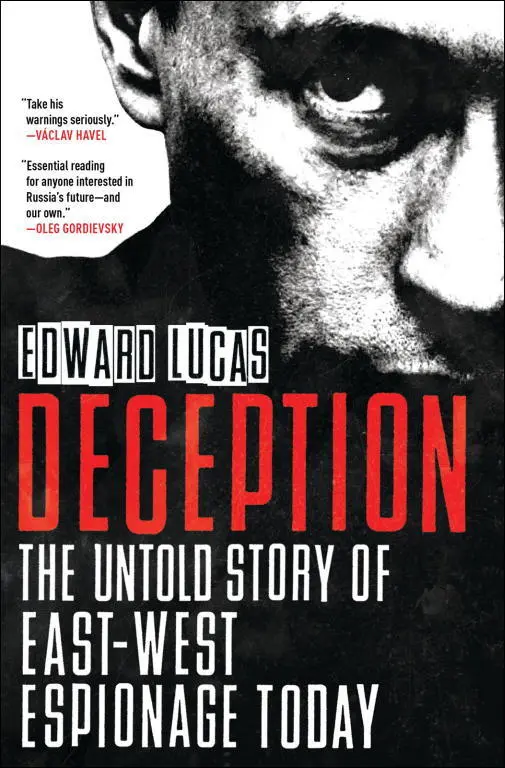
- Название:Deception
- Автор:
- Издательство:Walker & Company
- Жанр:
- Год:2012
- Город:New York
- ISBN:9780802713056
- Рейтинг книги:4 / 5. Голосов: 1
-
Избранное:Добавить в избранное
- Отзывы:
-
Ваша оценка:
Deception: краткое содержание, описание и аннотация
Предлагаем к чтению аннотацию, описание, краткое содержание или предисловие (зависит от того, что написал сам автор книги «Deception»). Если вы не нашли необходимую информацию о книге — напишите в комментариях, мы постараемся отыскать её.
In
Edward Lucas uncovers the real story of Chapman and her colleagues in Britain and America, unveiling their clandestine missions and the spy-hunt that led to their downfall. It reveals unknown triumphs and disasters of Western intelligence in the Cold War, providing the background to the new world of industrial and political espionage. To tell the story of post-Soviet espionage, Lucas draws on exclusive interviews with Russia’s top NATO spy, Herman Simm, and unveils the horrific treatment of a Moscow lawyer who dared to challenge the ruling criminal syndicate there.
Once the threat from Moscow was international communism, now it comes from the
, Russia’s ruthless “men of power.” “The outcome,” Lucas argues, “will determine whether the West brings Russia toward its standards of liberty, legality, and cooperation, or whether Russia will shape the West’s future as we accommodate (or even adopt) the authoritarian crony capitalism that is the Moscow regime’s hallmark.”
Deception — читать онлайн бесплатно полную книгу (весь текст) целиком
Ниже представлен текст книги, разбитый по страницам. Система сохранения места последней прочитанной страницы, позволяет с удобством читать онлайн бесплатно книгу «Deception», без необходимости каждый раз заново искать на чём Вы остановились. Поставьте закладку, и сможете в любой момент перейти на страницу, на которой закончили чтение.
Интервал:
Закладка:
The GRU has played a big role in Chechen counter-insurgency operations. A GRU operation killed the first president of the breakaway republic (a terrorist leader in Russian eyes), Jokar Dudayev. A missile blew him up when he unwisely emerged from hiding to make a call on his satellite telephone. Another high-profile killing was the car-bomb assassination of the exiled Chechen president Zelimkhan Yandarbiyev in the Qatari capital Doha in February 2004. This killed the Chechen leader and two bodyguards, as well as seriously injuring his 12-year-old son Daud. Shortly afterwards the infuriated Qatari authorities arrested three Russians (possibly because Russia’s foreign-intelligence agency, the SVR, which often has poor relations with the GRU, botched part of the follow-up). One of the arrested men, a first secretary at the Russian embassy named Aleksandr Fetisov, was released shortly afterwards either because of his diplomatic immunity, or possibly in exchange for two Qatari wrestlers arrested on trumped-up charges while in transit at Moscow airport. The other two men were identified as GRU agents, Anatoly Yablochkov and Vasily Pugachev. Both men received emphatic public support from Russian officials; their defence attorney was Nikolai Yegorov, a friend and former university classmate of Vladimir Putin. Both were sentenced to life imprisonment, but were extradited to Russia in December to serve their sentence there. On arrival, they received a hero’s welcome and disappeared from public view. The Russian authorities said that the Qatari sentence was ‘not relevant’.
Many Russians see the Chechen fighters as mere bandits and welcomed these operations. For Western countries worried about global jihadist violence, the nuances of Chechen insurrectionist politics paled against the need to maintain solidarity between big countries in counter-terrorism. But the GRU’s operations in Georgia are quite different. They are directed against a country that has not attacked Russia. Its only crime is to see its history and future differently. The GRU armed and trained Abkhaz and South Ossetian forces that resisted Georgian independence in the early 1990s. The reluctance was understandable: Georgia’s ethnonationalist leadership at the time made little effort to accommodate the views of the country’s minorities. But the Abkhaz and Ossetian separatist militias also perpetrated ethnic cleansing against people in their territories, mainly Georgians, who disagreed.
After those civil wars ended in uneasy truces, many in Moscow assumed that Georgia could be maintained as a weak and pliant neighbour. History proved otherwise. Georgia stabilised under the rule of Eduard Shevardnadze, a former Soviet foreign minister, and then accelerated its reforms under the leadership of the American-educated lawyer Mikheil Saakashvili. Seen (perhaps rather romantically) as a lone outpost of Atlanticist sentiments in the region, and (hard-headedly) as a vital part of plans to bring oil and gas from the Caspian and Central Asian regions to world markets, Georgia benefited from a huge CIA and Pentagon aid programme. Georgian intelligence and security officers received fast-track training in the United States and in other NATO allied countries. The Georgian military received subsidised or donated equipment, ranging from sophisticated battlefield radios to portable anti-aircraft missiles (provided secretly by Poland in 2007). 10The hope was to make Georgia a bastion of Western influence on Russia’s southern flank. But in the rivalry between the GRU and its adversaries, the Russian side has so far been the winner.
The biggest disaster for the West was the war of August 2008. The aim of foreign assistance to Georgia had been to make a conflict less likely, by calming and reassuring the Georgian leadership in the face of escalating military provocations from Russia. Instead, it produced the opposite result. Georgian politicians wildly overestimated both their own military strength and Western support. This was a colossal intelligence failure. NATO countries failed to read Russia’s intentions, and the way that their Georgian protégés would behave under pressure. Intelligence officers in the region reported the increasingly dangerous situation regularly and accurately to their controllers. But analysts blurred or misinterpreted those reports, controllers failed to pass them on with sufficient urgency, and the services’ political masters failed to appreciate the implications of what they were being told. That the whole affair happened when many top decision makers were on holiday did not help. A particularly striking and systemic failure was in America’s CIA. The small analysis division dealing with Russia has attracted particular criticism (belatedly) from its ‘customers’ elsewhere in the US government for interpreting raw intelligence in a framework that took great account of Russian sensitivities, fears and interests, but discounted other interpretations.
The American, British and Estonian training of Georgian human and electronic intelligence resources created structures that still lacked the clout and insight to interpret or influence events adequately. Decision-making circles were thoroughly penetrated, certainly by electronic means and possibly through the use of witting traitors or unwitting intelligence assets, recruited and run under the noses of the agencies responsible for security. Russia knew what Georgia knew, and how Georgia would react. It was therefore able to provoke the Georgian leadership successfully into attacking the breakaway province of South Ossetia, in the belief that a short victorious war would topple the separatist regime there and forestall a Russian troop build-up that the Tbilisi authorities believed was a prelude to a full-scale and potentially devastating military offensive.
That proved a disastrous miscalculation. Russia counterattacked, and the expensively equipped Georgian forces performed, for the most part, poorly (though to be fair the best part of the armed forces were in Iraq, or on leave having just returned from duty there). Command and control broke down. Expensive battlefield radios didn’t work (leaving officers to communicate by insecure personal mobile phones). The reserve forces fared particularly poorly. 11Russia’s victory owed more to weight of numbers than to military prowess. But it was a triumph for the Russian intelligence agencies, which had a startlingly clear picture of events on the Western side. In one revealing cameo, telephones at a major NATO military facility in Europe became unusable: the NATO Office of Security (NOS) was aware that they were penetrated, but was unable to take immediate countermeasures. Officials instead had to use their personal mobile phones (which may have been even less secure than the landlines). Russia knew to a high degree of certainty that America would not go to war to defend a friendly country that was under attack; it also knew that the European Union was in no state to act as a decisive, well-informed mediator. It was able to follow in detail the zigzag diplomacy of the French president, Nicolas Sarkozy, and the evolution of the amateurishly imprecise ceasefire document that he finally produced with a triumphant flourish on 13 August.
Since the war, many in the West have come to see Georgia as a faraway country of which they never knew much and would now like to know less. Certainly Mr Saakashvili’s erratic behaviour in the run-up to the war in 2008 did little to boost his country’s credibility. It will be a long time before any NATO country’s spymaster sticks his neck out on behalf of a Georgian leadership that has gained a reputation for chaos and unreliability. Politicians in the EU and America still maintain rhetorical support for Georgia’s territorial integrity, but have produced scant support in practical terms. Foreign assistance efforts in Georgia have wound down, as have Georgian efforts to meet Western concerns about the rule of law and political pluralism.
Читать дальшеИнтервал:
Закладка:
Похожие книги на «Deception»
Представляем Вашему вниманию похожие книги на «Deception» списком для выбора. Мы отобрали схожую по названию и смыслу литературу в надежде предоставить читателям больше вариантов отыскать новые, интересные, ещё непрочитанные произведения.










Обсуждение, отзывы о книге «Deception» и просто собственные мнения читателей. Оставьте ваши комментарии, напишите, что Вы думаете о произведении, его смысле или главных героях. Укажите что конкретно понравилось, а что нет, и почему Вы так считаете.