Roberto Bolaño - Between Parentheses - Essays, Articles and Speeches, 1998-2003
Здесь есть возможность читать онлайн «Roberto Bolaño - Between Parentheses - Essays, Articles and Speeches, 1998-2003» весь текст электронной книги совершенно бесплатно (целиком полную версию без сокращений). В некоторых случаях можно слушать аудио, скачать через торрент в формате fb2 и присутствует краткое содержание. Год выпуска: 2011, Издательство: New Directions, Жанр: Публицистика, Критика, на английском языке. Описание произведения, (предисловие) а так же отзывы посетителей доступны на портале библиотеки ЛибКат.
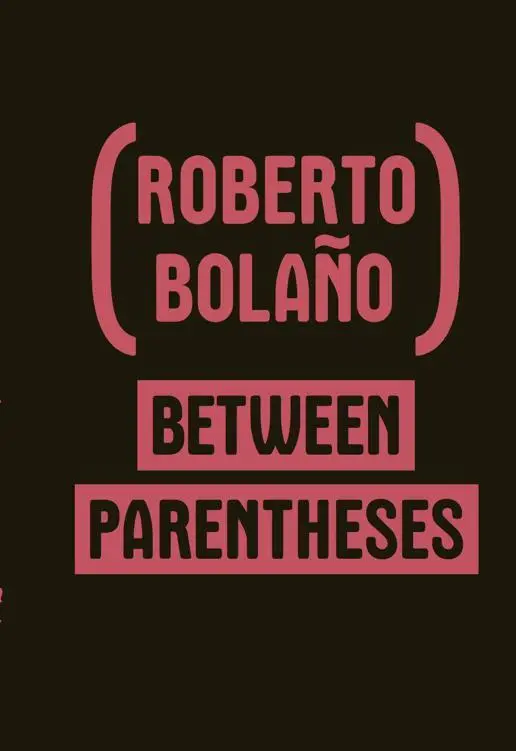
- Название:Between Parentheses: Essays, Articles and Speeches, 1998-2003
- Автор:
- Издательство:New Directions
- Жанр:
- Год:2011
- ISBN:нет данных
- Рейтинг книги:4 / 5. Голосов: 1
-
Избранное:Добавить в избранное
- Отзывы:
-
Ваша оценка:
Between Parentheses: Essays, Articles and Speeches, 1998-2003: краткое содержание, описание и аннотация
Предлагаем к чтению аннотацию, описание, краткое содержание или предисловие (зависит от того, что написал сам автор книги «Between Parentheses: Essays, Articles and Speeches, 1998-2003»). Если вы не нашли необходимую информацию о книге — напишите в комментариях, мы постараемся отыскать её.
The Savage Detectives
Between Parenthese
Between Parentheses: Essays, Articles and Speeches, 1998-2003 — читать онлайн бесплатно полную книгу (весь текст) целиком
Ниже представлен текст книги, разбитый по страницам. Система сохранения места последней прочитанной страницы, позволяет с удобством читать онлайн бесплатно книгу «Between Parentheses: Essays, Articles and Speeches, 1998-2003», без необходимости каждый раз заново искать на чём Вы остановились. Поставьте закладку, и сможете в любой момент перейти на страницу, на которой закончили чтение.
Интервал:
Закладка:
In Search of the Torico of Teruel
I left Blanes for Teruel, where I was going to be on the jury for a short-story prize, without knowing very well whether Teruel exists (as they like to claim in Teruel) or not. Of course, I was inclined to think that it existed, but an inner voice — the rapturous voice of desire, which frightens us all — told me that it was possible that Teruel, in fact, didn’t exist. The trip along the highway from Barcelona to Valencia was uneventful. The driver — whose name I unfortunately can’t recall, just as I’m unable to recall the names of anyone else I met on that trip, except Ana María Navales, who more than anything else is a force of nature — talked to me about how good life was in Teruel, about its 30,000 inhabitants (Teruel is the same size as Blanes), about the unemployment rate (notably low), about the happy and well-documented possibility of crossing the whole city from end to end in twenty minutes. The driver was an exemplary citizen of Teruel, an excellent driver, and one could tell that he loved his city. The problems began when we turned off the highway and began to climb towards Teruel. The landscape was very beautiful, with that austere and mocking beauty of certain parts of Aragón; but there were also curves, and for a while now curves have made me sick to my stomach, which meant that several times we had to take breaks at roadside restaurants, places that vaguely reminded me of another time, when my father was a truck driver and we pulled into lost truckstops to eat fried eggs, because the roads of Teruel are lost in time and I began to feel that all zigzagging roads somehow led to Teruel, no matter where they were situated geographically or whether the roads were Chilean or Mexican or even Central American, which was rather disturbing, because everyone knows that nausea plus melancholia tends to be the harbinger of impending illness, and that made me a little sad, because not only did we have to stop at roadside restaurants, we also had to stop out in the open, which gave us the chance to gaze at the towns along the way to Teruel, sad, beautiful little towns, towns that are gradually being abandoned, the driver told me, as I gagged and retched at the side of the road, because the young people are leaving for the cities, for Valencia, Barcelona, Zaragoza, and Madrid, as if the battle of Teruel hadn’t ended and the winter in which the battle was enveloped hadn’t ended either.
So I was still sick when I caught a glimpse of the towns just outside Teruel and I continued to be sick when we got to the city, crossed a bridge, and looked down into a very deep gorge, like the dry bed of an enormous river, but with houses and buildings where the river once flowed, something which now that I’m no longer sick and able to think more clearly, strikes me as suspiciously wonderful. How could anything have been built there, in that giant ravine? It was an astonishing sight. Like the favelas of Rio de Janeiro, but the mirror image, with a bridge even passing over the houses. It was like Aragonese cubism in an age when no one makes cubist art anymore, let alone so obstinately. And at the other end of the bridge, Teruel rose like a minimalist labyrinth on a promontory or hill or mesa. This city is much better than people say, was what I thought. I was also thinking that I was sick, and that when I got to the hotel I’d better go straight to bed.
Then two friends appeared as I got out of the car and they took me to see several Mudejar towers, one after the other, and some of the towers were fake and others were real, and they were saying: this one is fake and this one is real, but so fast that I was never sure which were the fake ones and which were the real ones, which is odd anyway, because the name Teruel (Tirwal) means watchtower, and those giant watchtowers were used to sight enemy armies or parties coming from the west or the east, depending: if you climb to the top of an authentic Mudejar tower, you’ll surely spy a dream, and if you climb to the top of a fake Mudejar tower, you’ll surely spy a nightmare. And then there was Ana María Navales, a chain-smoker with a pronounced limp, and she sent me straight to my room in a hotel that has rooms of utter luxury in branches in other provincial capitals, but that in Teruel only has very sad and dignified rooms, as if in the rooms of that hotel — whose name I choose to forget — the din and silence of the battle of Teruel were still something real and terrifying. And it wasn’t only the room that was modest, even timid, but also the receptionist and the men who strolled idly (or so it seemed) along the corridors and looked at you as if to inquire about the course of the battle. A cubist battle, evidently, in which time and space, at least as we understand them, didn’t count for much.
When I came out of my room — still slightly feverish, I think, and feeling as sick as I had during the car trip — Ana María Navales was waiting for me, and we went off with the rest of the jury to decide which story should win the contest. As I expected, the winning story was about the civil war. Then we went out for a walk around the city, upon which night had already fallen. I remember the Mudejar towers, which appeared and disappeared in the most unlikely places. I remember streets with the names of saints. I remember priests rubbing their hands together or clasping them tight as they walked, as if they’d just received news of Buñuel’s death. I remember Aragonese voices coming from the most surprising places (even from beneath the cobblestones). I remember fortress-churches and I remember a girl with short hair, no more than twenty, who passed me without a glance. I remember the Calle de los Amantes and the Plaza del Seminario, which is crammed with ghosts. I remember the faces of two colonels, Rey d’Harcourt, who surrendered, and Colonel Barba, who didn’t. I remember the 20th corps of the Republican army, and the 18th and the 22nd, which launched the offensive in December 1937. And I remember Buñuel’s brother, Alfonso Buñuel — few people rememember him; he made disturbing collages — who was born in 1915 and died in 1961, and whose work was shown to me in Teruel, where they have the custom of remembering precisely those who are remembered by no one, or hardly anyone. I also remember a warm cardoon salad and Ana María Navales talking to me about English women writers until three in the morning, both of us chain-smoking. And I remember that Juan Villoro, in Barcelona, had told me his family came from Teruel, and I remember my vain efforts, as a result, to buy him a bottle of wine to take back to Mexico to drink with Margarita.
But the main thing, the thing I remember best, I had yet to see. I saw it that night. All of a sudden we were in the Plaza del Torico. And there, on a column sturdy enough to hold a Greek hero or Franco’s horse, was the Torico. Here was Teruel, I knew it right away, and here also was the skeptical and indomitable spirit of Aragón. The Torico is tiny, as its name indicates, a toy for an eight-year-old child; but it isn’t a toy, it’s a miniature bull. It possesses a calm elegance not devoid of pride and indifference. It’s one of the most beautiful statues I’ve seen in my life, if not the most beautiful. On the way home I got sick again and then I fell asleep. I dreamed that the Torico was walking along beside me. “Did you like Teruel?” it asked me, though only to be polite, because in reality the Torico couldn’t care less whether I had liked his city or not. “Very much,” I said. “And does it exist or not, do you think?” it asked me. Just as I was about to answer that I thought it did, the Torico turned away and I heard it say: “No, I’d rather not know.” Then I dreamed that someone in a huge dark dance hall put on an album of the pasodoble Suspiros de España , and by the time the music began, the ghost that had set it playing was gone.
Читать дальшеИнтервал:
Закладка:
Похожие книги на «Between Parentheses: Essays, Articles and Speeches, 1998-2003»
Представляем Вашему вниманию похожие книги на «Between Parentheses: Essays, Articles and Speeches, 1998-2003» списком для выбора. Мы отобрали схожую по названию и смыслу литературу в надежде предоставить читателям больше вариантов отыскать новые, интересные, ещё непрочитанные произведения.





Обсуждение, отзывы о книге «Between Parentheses: Essays, Articles and Speeches, 1998-2003» и просто собственные мнения читателей. Оставьте ваши комментарии, напишите, что Вы думаете о произведении, его смысле или главных героях. Укажите что конкретно понравилось, а что нет, и почему Вы так считаете.