Roberto Bolaño - Between Parentheses - Essays, Articles and Speeches, 1998-2003
Здесь есть возможность читать онлайн «Roberto Bolaño - Between Parentheses - Essays, Articles and Speeches, 1998-2003» весь текст электронной книги совершенно бесплатно (целиком полную версию без сокращений). В некоторых случаях можно слушать аудио, скачать через торрент в формате fb2 и присутствует краткое содержание. Год выпуска: 2011, Издательство: New Directions, Жанр: Публицистика, Критика, на английском языке. Описание произведения, (предисловие) а так же отзывы посетителей доступны на портале библиотеки ЛибКат.
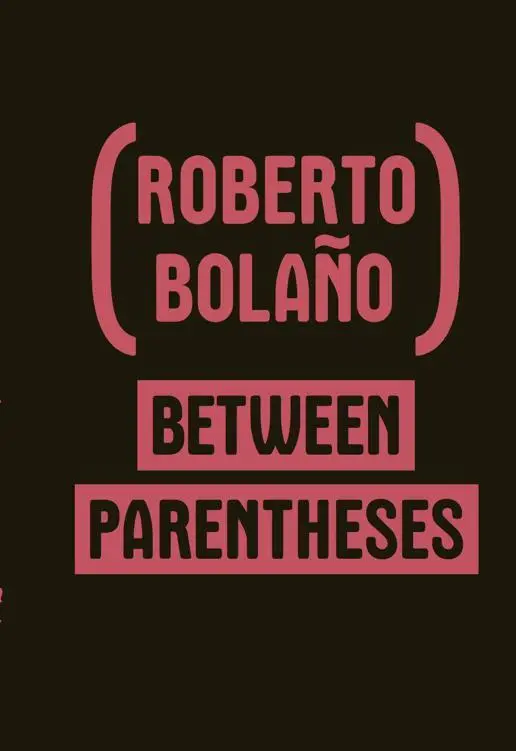
- Название:Between Parentheses: Essays, Articles and Speeches, 1998-2003
- Автор:
- Издательство:New Directions
- Жанр:
- Год:2011
- ISBN:нет данных
- Рейтинг книги:4 / 5. Голосов: 1
-
Избранное:Добавить в избранное
- Отзывы:
-
Ваша оценка:
Between Parentheses: Essays, Articles and Speeches, 1998-2003: краткое содержание, описание и аннотация
Предлагаем к чтению аннотацию, описание, краткое содержание или предисловие (зависит от того, что написал сам автор книги «Between Parentheses: Essays, Articles and Speeches, 1998-2003»). Если вы не нашли необходимую информацию о книге — напишите в комментариях, мы постараемся отыскать её.
The Savage Detectives
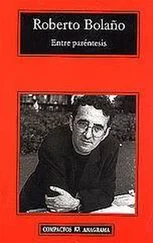
Between Parenthese
Between Parentheses: Essays, Articles and Speeches, 1998-2003 — читать онлайн бесплатно полную книгу (весь текст) целиком
Ниже представлен текст книги, разбитый по страницам. Система сохранения места последней прочитанной страницы, позволяет с удобством читать онлайн бесплатно книгу «Between Parentheses: Essays, Articles and Speeches, 1998-2003», без необходимости каждый раз заново искать на чём Вы остановились. Поставьте закладку, и сможете в любой момент перейти на страницу, на которой закончили чтение.
Интервал:
Закладка:
This modesty only grew, if possible, when he was awarded this year’s prize for best editor in Spain. Which has done nothing to prevent him from continuing to visit bookstores as bizarre as the restaurants where he eats, or from talking to unpublished writers who other houses would write off in half a minute, or from embarking (stealthily but also boldly) on ventures of the sort that are only embarked upon, to the best of my knowledge, by Catalans, some Catalans. In fact, I’d go even further and say: some Catalan publishers.
I’ve had the satisfaction of meeting three of them. One has taught me a lot. The other is an enchanting person, in the medieval sense of the term, as the long-suffering Rudel would have it. The third is Jaume Vallcorba. I can’t predict his fate, but I thank God for his presence. Not for my own sake, because I don’t believe in God and I’ve already done the reading I was meant to do, but for the sake of all readers. Though also for my own sake.
TITIAN PAINTS A SICK MAN
At the Uffizi, in Florence, is this odd painting by Titian. For a while, no one knew who the artist was. First the work was attributed to Leonardo and then to Sebastiano del Piombo. Though there’s still no absolute proof, today the critics are inclined to credit it to Titian. In the painting we see a man, still young, with long dark curly hair and a beard and mustache perhaps slightly tinged with red, who, as he poses, gazes off toward the right, probably toward a window that we can’t see, but still a window that somehow one imagines is closed, yet with curtains open or parted enough to allow a yellow light to filter into the room, a light that in time will become indistinguishable from the varnish on the painting.
The young man’s face is beautiful and deeply thoughtful. He’s looking toward the window, if he’s looking anywhere, though probably all he sees is what’s happening inside his head. But he’s not contemplating escape. Perhaps Titian told him to turn like that, to turn his face into the light, and the young man is simply obeying him. At the same time, one might say that all the time in the world stretches out before him. By this I don’t mean that the young man thinks he’s immortal. On the contrary. The young man knows that life renews itself and that the art of renewal is often death. Intelligence is visible in his face and his eyes, and his lips are turned down in an expression of sadness, or maybe it’s something else, maybe apathy, none of which excludes the possibility that at some point he might feel himself to be master of all the time in the world, because true as it is that man is a creature of time, theoretically (or artistically, if I can put it that way) time is also a creature of man.
In fact, in this painting, time — sketched in invisible strokes — is a kitten perched on the young man’s hands, his gloved hands, or rather his gloved right hand which rests on a book: and this right hand is the perfect measure of the sick man, more than his coat with a fur collar, more than his loose shirt, perhaps of silk, more than his pose for the painter and for posterity (or fragile memory), which the book promises or sells. I don’t know where his left hand is.
How would a medieval painter have painted this sick man? How would a non-figurative artist of the twentieth century have painted this sick man? Probably howling or wailing in fear. Judged under the eye of an incomprehensible God or trapped in the labyrinth of an incomprehensible society. But Titian gives him to us, the spectators of the future, clothed in the garb of compassion and understanding. That young man might be God or he might be me. The laughter of a few drunks might be my laughter or my poem. That sweet Virgin is my friend. That sad-faced Virgin is the long march of my people. The boy who runs with his eyes closed through a lonely garden is us.
PAGES WRITTEN ON JACOB'S LADDER
I’d like to buy all the books by Tolstoy and Dostoevsky that I’ve read but I don’t own. Also everything by Daudet. And Victor Hugo. Sometimes I ask myself what I did with those books, how I could have lost them, where I lost them. Other times I ask myself why I want them if I’ve already read them, when reading books is the only way to hold on to them forever. The only plausible answer is that I want them for my children. But I know that’s not a fair answer: you have to leave home to find the books that are waiting for you.
I still remember my old copy of Crime and Punishment , published in two columns (by Thor, of Buenos Aires) as if it were a work of pulp fiction, and maybe it was; a cheap book to read and then leave in a bus station or some café that doesn’t close until four in the morning. What did I do with that book? I don’t know. Probably the minute I read the last page it suddenly seemed less important and then I abandoned it somewhere. I didn’t treasure it the way I treasure my books now. But I read it when I was very young and I couldn’t lose Raskolnikov even if I wanted to.
I had the same problem with Petrus Borel and De Quincy. And also Baudelaire (of whose Fleurs du mal I’ve owned more than ten copies) and Mallarmé. If I could find an old Argentine or Mexican edition of Igitur again, I know it would make me happy. I didn’t have the same problem with Rimbaud, or at least I didn’t want to have the same problem with Rimbaud, or Lautréamont, but in the end I lost those books too.
To search for those copies or similar copies, the same font, the same layout, the same plot, the dark or bright syntax, somehow forces me to remember a time when I was young and poor and careless, though I know that the same copies, the exact same ones, will never be found, and to set myself such a task would be like marching into Florida in search of El Dorado.
Even so, I often browse used bookstores, sorting through stacks of books left behind by others or sold in a dark moment, and in corners like these I try to find the books that I lost or forgot more than thirty years ago on another continent, with the hope and dedication and bitterness of those who search for their first lost books, books that if found I wouldn’t read anyway, because I’ve already read them over and over, but that I would look at and touch just as the miser strokes the coins under which he’s buried.
But books have nothing to do with greed, though they do have something to do with coins. Books are like ghosts. Another tray of empanadas! Happy 2003! Music, maestro!
TRANSLATION IS AN ANVIL
What is it that makes an author, so beloved by those of us who speak Spanish, a figure of the second or third rank, if not an absolute unknown, among those who speak other languages? The case of Quevedo, as Borges reminds us, is perhaps the most flagrant. Why isn’t Quevedo a living poet, by which I mean a poet worthy of being reread and reinterpreted and imitated in spheres outside of Spanish literature? Which leads directly to another question: Why do we ourselves consider Quevedo to be our greatest poet? Or why are Quevedo and Góngora our two greatest poets?
Cervantes, who in his lifetime was disparaged and looked down upon, is our greatest novelist. Regarding this there is almost no debate. He’s also the greatest novelist — and according to some, the inventor of the novel — in lands where Spanish isn’t spoken and where the work of Cervantes can for the most part only be read in translation. The various translations may be good or they may not be, which hasn’t prevented the essence of Don Quixote from being imprinted on or filtered into the imagination of thousands of readers, who don’t care about the verbal riches or the rhythm or force of Cervantine prose, a prose that any translation, no matter how good, obviously distorts or dissolves.
Читать дальшеИнтервал:
Закладка:
Похожие книги на «Between Parentheses: Essays, Articles and Speeches, 1998-2003»
Представляем Вашему вниманию похожие книги на «Between Parentheses: Essays, Articles and Speeches, 1998-2003» списком для выбора. Мы отобрали схожую по названию и смыслу литературу в надежде предоставить читателям больше вариантов отыскать новые, интересные, ещё непрочитанные произведения.



Обсуждение, отзывы о книге «Between Parentheses: Essays, Articles and Speeches, 1998-2003» и просто собственные мнения читателей. Оставьте ваши комментарии, напишите, что Вы думаете о произведении, его смысле или главных героях. Укажите что конкретно понравилось, а что нет, и почему Вы так считаете.