Array Slash - Slash
Здесь есть возможность читать онлайн «Array Slash - Slash» — ознакомительный отрывок электронной книги совершенно бесплатно, а после прочтения отрывка купить полную версию. В некоторых случаях можно слушать аудио, скачать через торрент в формате fb2 и присутствует краткое содержание. Город: New York, Год выпуска: 2007, ISBN: 2007, Издательство: HarperCollins, Жанр: Биографии и Мемуары, на английском языке. Описание произведения, (предисловие) а так же отзывы посетителей доступны на портале библиотеки ЛибКат.

- Название:Slash
- Автор:
- Издательство:HarperCollins
- Жанр:
- Год:2007
- Город:New York
- ISBN:9780061752353
- Рейтинг книги:5 / 5. Голосов: 1
-
Избранное:Добавить в избранное
- Отзывы:
-
Ваша оценка:
Slash: краткое содержание, описание и аннотация
Предлагаем к чтению аннотацию, описание, краткое содержание или предисловие (зависит от того, что написал сам автор книги «Slash»). Если вы не нашли необходимую информацию о книге — напишите в комментариях, мы постараемся отыскать её.
(
) “Entertaining and educational… a crash course for aspiring rock gods.”
(
magazine)
From one of the greatest rock guitarists of our era comes a memoir that redefines sex, drugs, and rock ’n’ roll He was born in England but reared in L.A., surrounded by the leading artists of the day amidst the vibrant hotbed of music and culture that was the early seventies. Slash spent his adolescence on the streets of Hollywood, discovering drugs, drinking, rock music, and girls, all while achieving notable status as a BMX rider. But everything changed in his world the day he first held the beat-up one-string guitar his grandmother had discarded in a closet.
The instrument became his voice and it triggered a lifelong passion that made everything else irrelevant. As soon as he could string chords and a solo together, Slash wanted to be in a band and sought out friends with similar interests. His closest friend, Steven Adler, proved to be a conspirator for the long haul. As hairmetal bands exploded onto the L.A. scene and topped the charts, Slash sought his niche and a band that suited his raw and gritty sensibility.
He found salvation in the form of four young men of equal mind: Axl Rose, Izzy Stradlin, Steven Adler, and Duff McKagan. Together they became Guns N’ Roses, one of the greatest rock ’n’ roll bands of all time. Dirty, volatile, and as authentic as the streets that weaned them, they fought their way to the top with groundbreaking albums such as the iconic
and
and
.
Here, for the first time ever, Slash tells the tale that has yet to be told from the inside: how the band came together, how they wrote the music that defined an era, how they survived insane, never-ending tours, how they survived themselves, and, ultimately, how it all fell apart. This is a window onto the world of the notoriously private guitarist and a seat on the roller-coaster ride that was one of history’s greatest rock ’n’ roll machines, always on the edge of self-destruction, even at the pinnacle of its success. This is a candid recollection and reflection of Slash’s friendships past and present, from easygoing Izzy to ever-steady Duff to wild-child Steven and complicated Axl.
It is also an intensely personal account of struggle and triumph: as Guns N’ Roses journeyed to the top, Slash battled his demons, escaping the overwhelming reality with women, heroin, coke, crack, vodka, and whatever else came along.
He survived it all: lawsuits, rehab, riots, notoriety, debauchery, and destruction, and ultimately found his creative evolution. From Slash’s Snakepit to his current band, the massively successful Velvet Revolver, Slash found an even keel by sticking to his guns.
Slash
Slash — читать онлайн ознакомительный отрывок
Ниже представлен текст книги, разбитый по страницам. Система сохранения места последней прочитанной страницы, позволяет с удобством читать онлайн бесплатно книгу «Slash», без необходимости каждый раз заново искать на чём Вы остановились. Поставьте закладку, и сможете в любой момент перейти на страницу, на которой закончили чтение.
Интервал:
Закладка:
Axl and Izzy were a unit, so any other players coming into their band had to work well with both of them, and Izzy had left Hollywood Rose too quickly to get to know me at all. I liked Izzy. He was, after all, the first guy I met and I enjoyed his style and admired his talent. In dealing directly with Izzy, I’d have something of a buffer with Axl. Axl and I got along in so many ways but we had innate personality differences. We were attracted to each other and worked together tremendously well yet we were a study in polar opposites. Izzy (and later Duff ) would help. At the time, Izzy was enough to take the pressure off.
I showed up at Izzy’s apartment a few days later and he was working on a song called “Don’t Cry,” which I immediately took to. I wrote some guitar parts for it and we fine-tuned it for the rest of the evening. It was a cool session; we both got a lot out of jamming with each other.
We found ourselves a rehearsal space in Silverlake: Duff, Izzy, Axl, Rob Gardner, and myself. Everyone knew one another, so we started throwing songs together that evening and it just gelled quickly; it was one of those magic moments that musicians speak of where every player naturally complements the other and a group becomes an organic collective. I had never felt it that intensely in my life. It was all about the kind of music I was into: ratty rock and roll like old Aerosmith, AC/ DC, Humble Pie, and Alice Cooper. Everyone in the band wore their influences on their sleeves and there was not a bit of the typical L.A. vibe going on where the goal is to court a record deal. There was no concern for the proper poses or goofy choruses that might spell pop-chart success; which ultimately guaranteed endless hot chicks. That type of calculated rebellion wasn’t an option for us; we were too rabid a pack of musically like-minded gutter rats. We were passionate, with a common goal and a very distinct sense of integrity. That was the difference between us and them.
6. You Learn to Live Like an Animal
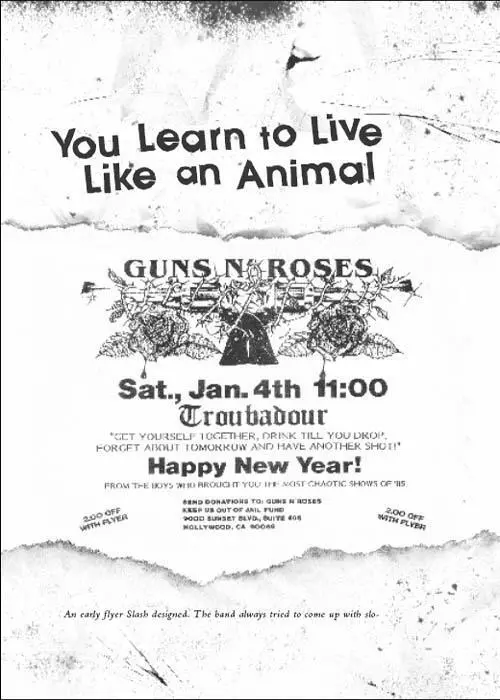
We weren’t exactly the type of people who took no for an answer. We were much more likely to give no for an answer. As individuals, each of us was street-smart, self-sufficient, and used to doing things his way only—death before compromise. When we became a unit that quality multiplied by five because we’d have one another’s backs as fiercely as we’d stood up for ourselves. All three of the common definitions of the word gang definitely applied to us: 1) we were a group who associated closely for social reasons such as delinquent behavior; 2) we were a collection of people with compatible tastes and mutual interests who gathered to work together; and 3) we were a group of persons who associated for criminal or other antisocial purposes. We had a gang’s sense of loyalty, too: we only trusted our oldest friends, and found everything we needed to get by in one another.
Our group willpower drove us to succeed on our own terms but never made the ride any easier. We were unlike the other bands of the day; we didn’t take kindly to criticism from anyone—not our peers, not the charlatans that tried to sign us to unfair management contracts, not the A&R reps vying to hand us a deal. We did nothing to court acceptance and we shunned easy success. We waited for our popularity to speak for itself and for the industry to take notice. And when it did, we made them pay.
We rehearsed every day, working up songs that we knew and liked from one another’s bands, like “Move to the City” and “Reckless Life,” which were written by some version or another of Hollywood Rose. We had a piece of shit PA, so we composed most of the music without Axl actually singing with us. He’d sing under his breath and listen and provide feedback on what we were talking about in the arrangements.
After three nights we had a fully realized set that also included “Don’t Cry” and “Shadow of Your Love,” and so we unanimously decided that we were now fit for public consumption. We could have booked a gig locally, because, collectively, we all knew the right people, but no, we decided that after three rehearsals, we were ready for a tour . And not just a long weekend tour of clubs close to L.A.; we took Duff up on his offer to book us a jaunt that stretched from Sacramento all the way up to his hometown of Seattle. It was completely improbable but to us it seemed like the most sensible idea in the world.
We planned to pack the gear and leave in a few days, but our zeal scared the shit out of our drummer, Rob Gardner, so much that he more or less quit the band on the spot. It didn’t surprise anyone because Rob could play well enough but he didn’t fit in from the start; he wasn’t of the same ilk, he wasn’t one of us: he just wasn’t the sell-your-soul-for-rock-and-roll type. It was a polite departure—we couldn’t imagine anyone who had played those last three rehearsals not wanting to tour the coast as an unknown band with nothing but our gear and the clothes on our backs, but we accepted his decision. We would not be stopped, however, so I called the one drummer that I knew who would leave that night if we asked him to: Steven Adler.
We watched as Steven set up both of his silver-blue bass drums and loosened up with a few typical double-bass fills at rehearsal the next day. His aesthetic touchstones were off, but it wasn’t an insurmountable problem. It was a situation rectified in a typically Guns fashion: when Steven ducked out to take a piss, Izzy and Duff hid one of his bass drums, a floor tom, and some small rack toms. Steven returned, sat down, and started counting in the next song before he realized what was missing.
“Hey, where’s my other bass drum?” he asked, looking around as if he’d dropped them on the way to the bathroom or something. “I came here with two… and my other drums?
“Don’t worry about it, man. You don’t need them, just count off the song,” Izzy said.
Steven never got his extra bass drum back and it was the best thing that ever happened to him. Of the five of us, he was the most conventionally contemporary, which, all things considered, lent a key element to our sound—but we weren’t going to let him hammer that point home all night long. We bullied him into being a straight-ahead, 4/4 rock-and-roll drummer, which complemented and easily locked in with Duff’s bass style, while allowing Izzy and me the freedom to mesh blues-driven rock and roll with the neurotic edge of first-generation punk. Not to mention what Axl’s lyrics and delivery brought to it. Axl had a unique voice; it was brilliant in range and tone, but even though it was often intense and in your face, it had an amazingly soulful, bluesy quality to it because he had a choir background from singing in church when he was in grade school.
By the end of his tryout, Steven was hired and the original Guns N’ Roses lineup was locked and loaded. Duff had booked the tour; all that we needed was wheels. Anyone who knows a musician well, successful or otherwise, knows this: generally, they are adept at “borrowing” from their friends. It took one phone call and very minor convincing for us to enlist our friends Danny and Joe, whose car and loyalty we made use of very regularly. To sweeten the deal, we christened Danny our tour manager and Joe our roadie and the next morning drove Danny’s weathered green tank of an Oldsmobile out to the Valley to pick up a U-Haul trailer that we filled with the amps, guitars, and drum kit.
Seven of us packed into this mid-seventies Olds and set out on what I don’t think anyone but Duff realized was a trip of over a thousand miles. We were outside of Fresno, two hundred miles from L.A. and two hundred short of Sacramento, when the car broke down. Danny wasn’t the type of guy to have splurged for AAA, so luckily we broke down within pushing distance of a gas station, where we discovered that it would take four days to get the necessary parts to fix a beast that old. At that rate, we wouldn’t make any of the shows.
Читать дальшеИнтервал:
Закладка:
Похожие книги на «Slash»
Представляем Вашему вниманию похожие книги на «Slash» списком для выбора. Мы отобрали схожую по названию и смыслу литературу в надежде предоставить читателям больше вариантов отыскать новые, интересные, ещё непрочитанные произведения.



![Сол Слэш Хадсон - Slash. Демоны рок-н-ролла в моей голове [litres]](/books/387912/sol-slesh-hadson-slash-demony-rok-n-thumb.webp)


Обсуждение, отзывы о книге «Slash» и просто собственные мнения читателей. Оставьте ваши комментарии, напишите, что Вы думаете о произведении, его смысле или главных героях. Укажите что конкретно понравилось, а что нет, и почему Вы так считаете.