Dan Hampton - Viper Pilot
Здесь есть возможность читать онлайн «Dan Hampton - Viper Pilot» весь текст электронной книги совершенно бесплатно (целиком полную версию без сокращений). В некоторых случаях можно слушать аудио, скачать через торрент в формате fb2 и присутствует краткое содержание. Город: New York, Год выпуска: 2012, ISBN: 2012, Издательство: William Morrow, Жанр: Биографии и Мемуары, nonf_military, на английском языке. Описание произведения, (предисловие) а так же отзывы посетителей доступны на портале библиотеки ЛибКат.
- Название:Viper Pilot
- Автор:
- Издательство:William Morrow
- Жанр:
- Год:2012
- Город:New York
- ISBN:978-0-06-213035-8
- Рейтинг книги:4 / 5. Голосов: 1
-
Избранное:Добавить в избранное
- Отзывы:
-
Ваша оценка:
Viper Pilot: краткое содержание, описание и аннотация
Предлагаем к чтению аннотацию, описание, краткое содержание или предисловие (зависит от того, что написал сам автор книги «Viper Pilot»). Если вы не нашли необходимую информацию о книге — напишите в комментариях, мы постараемся отыскать её.
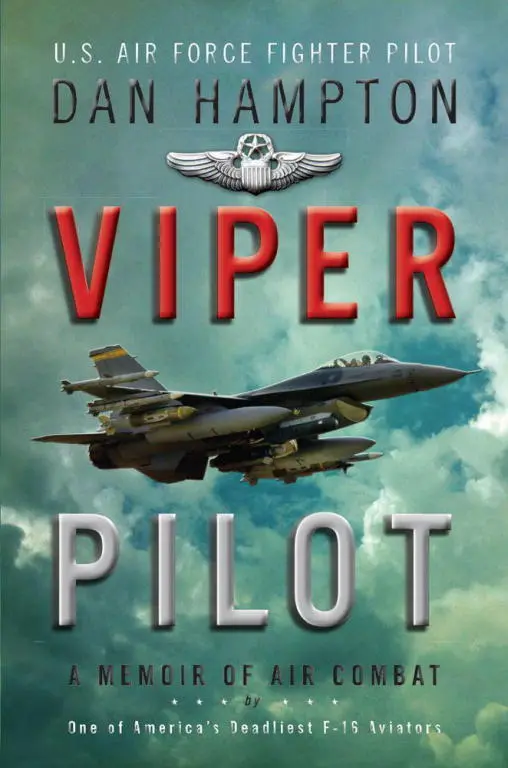
is the electrifying memoir of one of the most decorated F-16 pilots in American history: U.S. Air Force Lieutenant Colonel Dan Hampton, who served for twenty years, flying missions in the Iraq War, the Kosovo conflict, and the first Gulf War.
Both a rare look into the elite world of fighter pilots and a thrilling first-person account of contemporary air combat,
soars—a true story of courage, skill, and commitment that will thrill U.S. Special Forces buffs, aviation and military history aficionados, and fans of the novels of Tom Clancy and Dale Brown.
Viper Pilot — читать онлайн бесплатно полную книгу (весь текст) целиком
Ниже представлен текст книги, разбитый по страницам. Система сохранения места последней прочитанной страницы, позволяет с удобством читать онлайн бесплатно книгу «Viper Pilot», без необходимости каждый раз заново искать на чём Вы остановились. Поставьте закладку, и сможете в любой момент перейти на страницу, на которой закончили чтение.
Интервал:
Закладка:
The first flight in this, or any local training program, was called a Local Area Orientation (LAO). Sort of a wake up, look around, learn the procedures and local landmarks type of ride. It was always done with an instructor pilot (IP), and, like all training sorties, it was graded. As this was a mixed squadron, the lead aircraft was an F-4G, so I got an instructor pilot and an instructor EWO. Again, something I’d never seen before.
Planning for tactical mission starts at least one day in advance, and being a typical Type-A FNG, I wanted to make a good first impression. So, for days prior to the flight, I pored over maps, talked to other pilots, and did all the other FNG things. There are lots of booby traps in any elite unit, and fighter squadrons are certainly no different. Anyone new is treated with wary politeness until he proves himself, which I was intent on doing in a hurry.
Now, older guys who had been in other squadrons have less of a row to hoe than someone like me. Yet still, until the performance matches the paperwork, no one gets a break. And that’s the way it should be. There are too many lives and too much insanely expensive equipment at stake. So people were nice enough, but in a distant sort of way, because FNGs could get you hurt.
After planning, briefing, and going through the complicated dance of getting a fighter started up, checked out, and to a runway, I was finally airborne. It was exhilarating to be here, and I was determined to make no mistakes.
Germany was green, and the rolling, continuous hills of the Mosel Valley were dotted with clean little red-roofed towns. We zipped around, practiced flying in formation, flying at low level and getting oriented to the area. I was just a wingman, which meant I would almost always fly with a flight lead. My somewhat limited responsibilities included not losing sight of the leader, not hitting him, and not flying into the ground. Just as with any mission, everything that occurred, from the first radio call to my landing, would be graded, evaluated, and discussed.
After ninety minutes of this, we came back, landed, and met up again in the same room to debrief. I was sweaty, a bit pumped up, and fairly pleased with myself. Most of the mission had taken place at 450 knots, and I’d spent the majority of my time staring at the Phantom and keeping position. This meant I didn’t really have a great awareness of where I’d been exactly, but I never lost sight of him or did anything stupid. In the extremely unforgiving world of flying fighters that was good enough for a new guy on his first sortie. At least, I thought so.
So, when the instructor EWO, not the pilot, leaned across the table and began jabbing his finger at me and listing my inevitable transgressions, I didn’t quite know what to do. I mean, here was a guy who couldn’t fly an airplane giving me instruction on flying. I don’t remember how it started, but after a few minutes this is how it ended.
He said, “Your tactical formation was a little wide… and you were too far behind the wing line. You’ve got to stay completely line abreast.”
“Why?”
“Why?” He looked surprised and I noticed a vein in his forehead began throbbing. “Because that’s where I expect to see you, and if you’re not there, then I’ve got to find you. That takes up valuable time and pisses me off.”
“Why does it matter if you see me at all?”
“Excuse me?” His eyes went kind of pointy and his mouth tightened. Out of the corner of my eye, I saw the F-4 instructor stop writing on the grade sheet and look up.
“Well… you’re not a pilot so why does it matter if you see me or not?” The EWO’s lips disappeared and I clearly remember that his face turned a deep, dusky red color. Like every blood vessel he had just exploded beneath his skin. “I mean, aren’t you busy doing something in the backseat?” Like winding the clock? I didn’t say that but I was thinking it.
It really was an innocent question; not contentious, because you had to earn the right to argue. I was just confused. However, the EWO made a little choking sound as he struggled to comprehend the enormity of what I just said. I saw his mouth open and close like a guppy, and he sat there with a stupid, stunned expression on his face. Lots of F-4 guys, this one included, had a cheesy mustache left over from the 1970s, and his was pointed straight out with rage and indignation. From his point of view, I was a peon. A Fucking New Guy. And in his world, he was a minor deity who dispensed knowledge to peanuts like me. If he’d been a pilot, I would’ve listened without question or comment. But he wasn’t a pilot, and in my world that meant you didn’t tell me how to do my job.
When the F-4 instructor pilot blinked a couple of times and managed to clear his throat, I was all ears, but it was too late to salvage the situation. As he pulled me out of the briefing room, I swear I saw the soles of the EWO’s boots sticking out from the ceiling, the rest of him having just shot up through the roof.
So it was a rocky start.
F-4 guys would also end every flight brief by adding, “Remember your crew coordination items,” and then the pilot and EWOs would talk among themselves. A few days after the exploding EWO incident, I was sitting in a four-ship briefing when the flight lead closed with that statement. The other F-16 pilot, also a lieutenant, with fantastic comedic flair but very bad timing, started talking to his fingers. I mean, they were his crew, right? The F-4 guys were not amused at all, but it got me off the hook. See, I wasn’t the only one.
Some of these EWOs were bitter wash-outs hanging on by their teeth to a doomed profession. A few of them just lived to belittle young fighter pilots, because we were a constant reminder of something they could never be. However, many EWOs were truly gifted, and I came to appreciate that fairly fast. They could listen to a few seconds of the audio signal from our Threat Warning Receiver (RWR) and instantly tell what type of enemy radar was trying to bite you. The good ones knew everything about the enemy systems we thought we’d face one day. A few could even identify individual radars by their unique sounds, and they were happy to share the secrets of their art. It was truly amazing to a young officer like me, and I soaked it in because, until technology caught up, the EWO was the heart of the Wild Weasel mission.
THE ORIGINAL SA-2, AND ITS FANSONG RADAR, HAD BEEN built to kill bombers and reconnaissance aircraft. Jammers, countermeasures, and threat-warning equipment had leveled the playing field somewhat, but the most expedient countertactic was low-altitude flying.
You see, radars all have a gap, a blind spot in coverage, called a “notch.” FANSONG’s blind spot was its inability to separate the radar return of the target from the much larger return generated by Earth. If you flew low enough, you could hide in the ground “clutter,” and the radar would never see you—like wearing a black T-shirt to hide in the dark. If the radar can’t see you, then it can’t track and kill you. And if it had already launched and exposed its position, you could defeat the system by dropping down and flying very low. This kind of flight is impractical for most big aircraft, but it’s ideal for fighters.
Einstein, ever the father of tactics, correctly stated that every action has an opposite reaction. Everyone started going low after Vietnam, so, to counter the low-altitude threat, Soviet and American engineers developed systems that had no real clutter notch, because they tracked an aircraft’s velocity. These missiles could also be launched visually using TV cameras, since a fighter at low altitude was easier to see than one at 20,000 feet.
The new radars were designed to be faster and more accurate, because they had to acquire, track, and launch in seconds rather than minutes. They were also mobile. Big, fixed SAM sites like the SA-2 were easy to see and therefore simple to avoid unless they were deployed around high-value targets we needed to destroy. The Soviets were aware of this, so they’d developed a particularly nasty family of mobile SAMs and greatly improved anti-aircraft guns. These systems filled in the gaps in distance and altitude coverage and were deployed around the larger strategic sites for overlapping coverage. They were highly mobile and attached to ground forces for air defense. This meant there were lots of them, and they could be anywhere.
Читать дальшеИнтервал:
Закладка:
Похожие книги на «Viper Pilot»
Представляем Вашему вниманию похожие книги на «Viper Pilot» списком для выбора. Мы отобрали схожую по названию и смыслу литературу в надежде предоставить читателям больше вариантов отыскать новые, интересные, ещё непрочитанные произведения.








Обсуждение, отзывы о книге «Viper Pilot» и просто собственные мнения читателей. Оставьте ваши комментарии, напишите, что Вы думаете о произведении, его смысле или главных героях. Укажите что конкретно понравилось, а что нет, и почему Вы так считаете.