Ed Macy - Apache
Здесь есть возможность читать онлайн «Ed Macy - Apache» — ознакомительный отрывок электронной книги совершенно бесплатно, а после прочтения отрывка купить полную версию. В некоторых случаях можно слушать аудио, скачать через торрент в формате fb2 и присутствует краткое содержание. Город: London, Год выпуска: 2008, ISBN: 2008, Издательство: HarperPress, Жанр: Биографии и Мемуары, nonf_military, на английском языке. Описание произведения, (предисловие) а так же отзывы посетителей доступны на портале библиотеки ЛибКат.
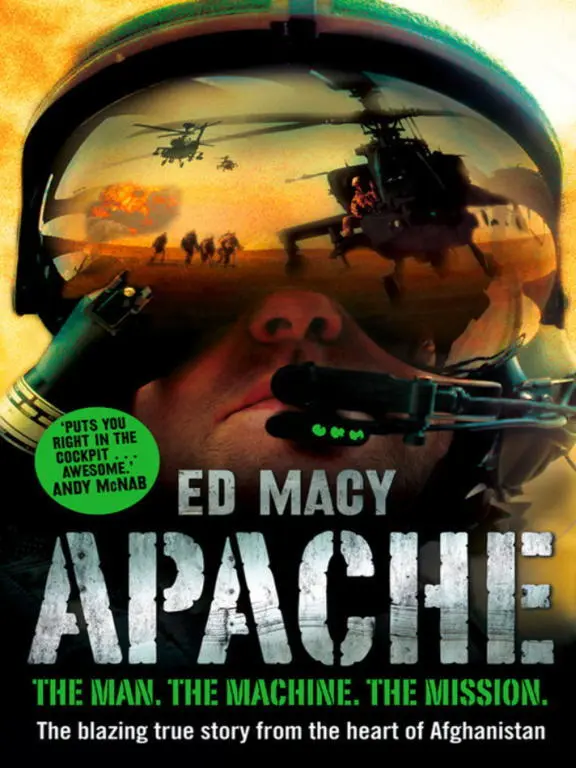
- Название:Apache
- Автор:
- Издательство:HarperPress
- Жанр:
- Год:2008
- Город:London
- ISBN:978-0007307470
- Рейтинг книги:5 / 5. Голосов: 1
-
Избранное:Добавить в избранное
- Отзывы:
-
Ваша оценка:
Apache: краткое содержание, описание и аннотация
Предлагаем к чтению аннотацию, описание, краткое содержание или предисловие (зависит от того, что написал сам автор книги «Apache»). Если вы не нашли необходимую информацию о книге — напишите в комментариях, мы постараемся отыскать её.
http://www.harperplus.com/apache
Apache — читать онлайн ознакомительный отрывок
Ниже представлен текст книги, разбитый по страницам. Система сохранения места последней прочитанной страницы, позволяет с удобством читать онлайн бесплатно книгу «Apache», без необходимости каждый раз заново искать на чём Вы остановились. Поставьте закладку, и сможете в любой момент перейти на страницу, на которой закончили чтение.
Интервал:
Закладка:
‘Saving the best ones for yourself, eh Boss?’ Nick said. ‘What a coincidence it just happened to be HQ Flight’s turn for a deliberate task.’
Trigger just smiled knowingly. But Nick’s turn would come.
At lunchtime on the 10th, the ministerial permission we needed for Op Glacier 1 finally came through. We were hitting the place cold and firing the first shots, which we very seldom did. With all the paperwork in place, the brigade confirmed it as a go.
The four of us had a kip after lunch, since we weren’t going to get much sleep later. At sunset we went down to the flight line for a final walk around the Apaches and loaded our kit.
‘Just double check your LSJs, chaps,’ Trigger said.
It was a good point. Our survival jackets were vital if we got shot down; they contained everything we might need to keep us alive on the ground apart from our personal weapons. I went through every last pouch.
To squeeze so much into one man’s waistcoat was a masterpiece of design, and the reason they were so bloody heavy. The deep left front pocket was easiest to grab for a right-handed pilot like me. That’s why it contained the most important piece of kit – a very powerful multi-frequency ground-to-air radio with which we could talk securely to anyone above us or at a distance, through burst transmissions. It was also fitted with a GPS system and a homing beacon that could be picked up by satellite.
Three pockets were sewn into the front right-hand side of the jacket. The top one contained a signalling pack – an infrared or white light strobe and a signalling mirror. The middle held a survival pack: a matchless fire set – cotton wool and magnesium metal with a saw blade to ignite it (matches ran out and could get wet) – fuel blocks, a nylon fishing line, hooks and flies, a foil blanket, high energy sweets, tablets to purify dirty water, a polythene bag, tampons to soak up water, two Rocco-sized condoms that could each carry a gallon of water, a compass, a candle, parachute cord to rig up shelters, three snares, a wire saw, a needle and thread, camouflage cream and a medium-sized Swiss Army knife. The lowest pocket was packed with the things you hoped you’d never need: antibiotics, morphine-based painkillers, three elastic dressings and adhesives, two standard dressings, a safety pin, Imodium tablets to stop the shits, a razor blade, dextrose high energy tablets, sun block, insect repellent and a pair of forceps.
We kept a six-inch-long Maglite torch and an emergency extraction strap with a black karabiner in another small pocket, just next to the zip. A large pouch sewn into the back of the jacket contained a metre-square waterproof, tear-resistant nylon escape map that you could also use to shelter from the sun or rain. Alongside it we kept two litre-sized foil sachets of clean water.
Back up at the JHF we formulated an escape plan for the mission. We had one for every location we went to, and for every pre-planned sortie we flew. If we did go down over Koshtay, we’d all know exactly what to do.
Apache pilots underwent the most intensive escape and evasion training of anyone in the UK military, alongside Harrier pilots and Special Forces personnel. All three worked behind or over enemy lines, so faced the greatest risk. It was a gruelling sixteen-week course, and as the squadron’s Survive, Evade, Resist and Extract Officer, Geordie gave us regular refreshers
The first emergency drill was always the same – talk to your wingman and tell him where you are. He’d know you’d gone down, and would be doing his damnedest to keep you alive. If the threat on the ground allowed it, he’d swoop down, land next to your aircraft and you’d have about three seconds to strap yourself onto a grab handle forward of the engine air intakes with your own strap and karabiner.
We practised the drill every now and then, but no Apache pilot in the world had ever done it on operations; it was fraught with danger for everyone concerned. Putting an aircraft on the ground in a battle made it incredibly vulnerable, which was why the MoD pencil-necks had written into the Release To Service rules that it was only to be used in dire emergencies. If they had it their way, it would have been out of the RTS altogether.
First, of course, we had to survive going down. There were no ejection seats in an Apache; it was dangerous enough standing beneath a turning rotor blade. If our aircraft went down, we went down with it. It concentrated the mind. So much so, that experienced pilots would always subconsciously scope for the safest place to crash-land.
Should the worst happen and we found ourselves on the ground, it was going to be immediately obvious if Trigger and Billy were going to be able to pick us up at Koshtay. If they couldn’t – which was almost inevitable – we’d try to get as far away from the aircraft as possible. The Apache would act like a magnet for the enemy, so we wouldn’t even hang around to destroy its clandestine equipment; someone else with a big bomb would take care of that.
It would be dark, which was a great advantage. Maybe only a handful of Taliban would see us go down. Five minutes later though, the word would have gone round. By daybreak, we’d be the focus of a massive and coordinated hunt.
Once clear of the aircraft, we’d head due north or south and then west as soon as we could. Our best hope of escape would be the GAFA desert, preferably by dawn. We’d either find the BRF there or get picked up. It was only four klicks away – but we’d have to cross the raging Helmand River and possibly the canal on the way.
We’d move at night and hide in daylight. We’d keep switching on the radios to speak to anyone we could see or hear above us. They’d be up there, waiting for our call. And above all, we had to stick together – two pairs of eyes and ears were always better than one, and one of us might be injured.
After the 8pm brief, we tried to get a few hours’ sleep. The Boss took the cot next to mine so we wouldn’t wake anyone in his tent.
‘It’s strange, isn’t it?’ he said as he climbed into his sleeping bag. ‘I’m going to bed now, knowing that when I wake up, I will deliberately go out and kill people.’
The Boss grappled with this idea for a few moments as the opening credits of 24 rolled on the laptop beside him – but only for a couple of minutes. The next time I looked, he was fast asleep, his head tucked into the crook of his arm.
I couldn’t sleep a wink. I just lay on my back in the darkness, going over every eventuality again and again, trying to visualise how I would deal with them. How to get out of the Green Zone if we went down was the challenge that preoccupied me most. There’d be no chance of a rescue. How fast was the current in the Helmand River? Would we reach the GAFA by dawn? If not, where would we lie up? Must remember to keep away from livestock, especially dogs; they’d give us away immediately. What if I was incapacitated and Carl was okay? Carl would have to run. I’d make him. He’d get nowhere trying to carry me. What if he was injured? I’d have a tough time lifting him and all that strawberry cheesecake. But I couldn’t leave him – I’d never be able to live with myself. No; I’d stay and fight to the end – and save the last two rounds for ourselves.
It didn’t matter how hard I tried, I couldn’t get one picture out of my head: me standing alongside a burning aircraft with Carl unconscious at my feet and the Taliban swarming towards us… Wouldn’t it just be Sod’s Law if I got it tonight? Emily was four and a half months pregnant… I saw the look on my kids’ faces as they were told that this time their dad wasn’t coming back… And I knew for certain that this had to be my last tour.
But would I have ducked out of it there and then, given the choice? Not for all the tea in China.
Читать дальшеИнтервал:
Закладка:
Похожие книги на «Apache»
Представляем Вашему вниманию похожие книги на «Apache» списком для выбора. Мы отобрали схожую по названию и смыслу литературу в надежде предоставить читателям больше вариантов отыскать новые, интересные, ещё непрочитанные произведения.







Обсуждение, отзывы о книге «Apache» и просто собственные мнения читателей. Оставьте ваши комментарии, напишите, что Вы думаете о произведении, его смысле или главных героях. Укажите что конкретно понравилось, а что нет, и почему Вы так считаете.