Joan Didion - Salvador
Здесь есть возможность читать онлайн «Joan Didion - Salvador» весь текст электронной книги совершенно бесплатно (целиком полную версию без сокращений). В некоторых случаях можно слушать аудио, скачать через торрент в формате fb2 и присутствует краткое содержание. Год выпуска: 2011, Издательство: Vintage, Жанр: Биографии и Мемуары, на английском языке. Описание произведения, (предисловие) а так же отзывы посетителей доступны на портале библиотеки ЛибКат.
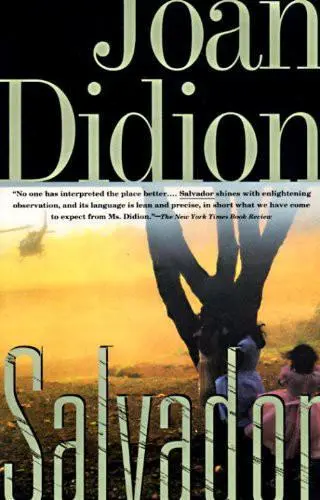
- Название:Salvador
- Автор:
- Издательство:Vintage
- Жанр:
- Год:2011
- ISBN:нет данных
- Рейтинг книги:4 / 5. Голосов: 1
-
Избранное:Добавить в избранное
- Отзывы:
-
Ваша оценка:
Salvador: краткое содержание, описание и аннотация
Предлагаем к чтению аннотацию, описание, краткое содержание или предисловие (зависит от того, что написал сам автор книги «Salvador»). Если вы не нашли необходимую информацию о книге — напишите в комментариях, мы постараемся отыскать её.
Salvador — читать онлайн бесплатно полную книгу (весь текст) целиком
Ниже представлен текст книги, разбитый по страницам. Система сохранения места последней прочитанной страницы, позволяет с удобством читать онлайн бесплатно книгу «Salvador», без необходимости каждый раз заново искать на чём Вы остановились. Поставьте закладку, и сможете в любой момент перейти на страницу, на которой закончили чтение.
Интервал:
Закладка:
In such a climate the fact of being in El Salvador comes to seem a sentence of indeterminate length, and the prospect of leaving doubtful. On the night before I was due to leave I did not sleep, lay awake and listened to the music drifting up from a party at the Camino Real pool, heard the band play “Malaguena” at three and at four and again at five A.M., when the party seemed to end and light broke and I could get up. I was picked up to go to the airport that morning by one of the embassy vans, and a few blocks from the hotel I was seized by the conviction that this was not the most direct way to the airport, that this was not an embassy guard sitting in front with the Remington on his lap; that this was someone else. That the van turned out in fact to be the embassy van, detouring into San Benito to pick up an AID official, failed to relax me: once at the airport I sat without moving and averted my eyes from the soldiers patrolling the empty departure lounges.
When the nine A.M. TACA flight to Miami was announced I boarded without looking back, and sat rigid until the plane left the ground. I did not fasten my seat belt. I did not lean back. The plane stopped that morning at Belize, setting down on the runway lined with abandoned pillboxes and rusting camouflaged tanks to pick up what seemed to be every floater on two continents, wildcatters, collectors of information, the fantasts of the hemisphere. Even a team of student missionaries got on at Belize, sallow children from the piney woods of Georgia and Alabama who had been teaching the people of Belize, as the team member who settled down next to me explained, to know Jesus as their personal savior.
He was perhaps twenty, with three hundred years of American hill stock in his features, and as soon as the plane left Belize he began filling out a questionnaire on his experience there, laboriously printing out the phrases, in obedience to God, opportunity to renew commitment, most rewarding part of my experience, most disheartening part . Somewhere over the Keys I asked him what the most disheartening part of his experience had been. The most disheartening part of his experience, he said, had been seeing people leave the Crusade as empty as they came. The most rewarding part of his experience had been renewing his commitment to bring the Good News of Jesus as personal savior to all these different places. The different places to which he was committed to bring the Good News were New Zealand, Iceland, Finland, Colorado, and El Salvador. This was la solución not from Washington or Panama or Mexico but from Belize, and the piney woods of Georgia. This flight from San Salvador to Belize to Miami took place at the end of June 1982. In the week that I am completing this report, at the end of October 1982, the offices in the Hotel Camino Real in San Salvador of the Associated Press, United Press International, United Press International Television News, NBC News, CBS News, and ABC News were raided and searched by members of the El Salvador National Police carrying submachine guns; fifteen leaders of legally recognized political and labor groups opposing the government of El Salvador were disappeared in San Salvador; Deane Hinton said that he was “reasonably certain” that these disappearances had not been conducted under Salvadoran government orders; the Salvadoran Ministry of Defense announced that eight of the fifteen disappeared citizens were in fact in government custody; and the State Department announced that the Reagan administration believed that it had “turned the corner” in its campaign for political stability in Central America.
About the Author
Joan Didion was born in California and lives in New York City. She is the author of five novels and seven previous books of nonfiction, including The Year of Magical Thinking . Her collected nonfiction, We Tell Ourselves Stories in Order to Live , was published by Everyman’s Library in September 2006.
Интервал:
Закладка:
Похожие книги на «Salvador»
Представляем Вашему вниманию похожие книги на «Salvador» списком для выбора. Мы отобрали схожую по названию и смыслу литературу в надежде предоставить читателям больше вариантов отыскать новые, интересные, ещё непрочитанные произведения.








Обсуждение, отзывы о книге «Salvador» и просто собственные мнения читателей. Оставьте ваши комментарии, напишите, что Вы думаете о произведении, его смысле или главных героях. Укажите что конкретно понравилось, а что нет, и почему Вы так считаете.