Anthony Horowitz - Russian Roulette
Здесь есть возможность читать онлайн «Anthony Horowitz - Russian Roulette» весь текст электронной книги совершенно бесплатно (целиком полную версию без сокращений). В некоторых случаях можно слушать аудио, скачать через торрент в формате fb2 и присутствует краткое содержание. Жанр: Триллер, на английском языке. Описание произведения, (предисловие) а так же отзывы посетителей доступны на портале библиотеки ЛибКат.
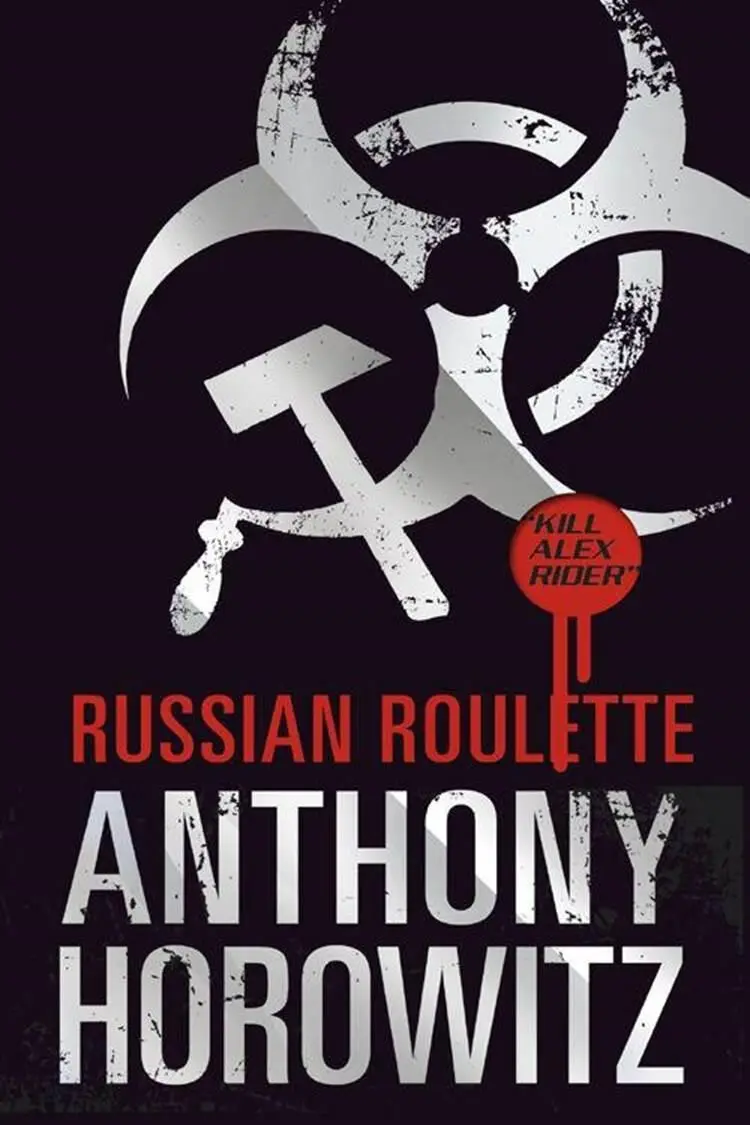
- Название:Russian Roulette
- Автор:
- Жанр:
- Год:неизвестен
- ISBN:нет данных
- Рейтинг книги:3 / 5. Голосов: 3
-
Избранное:Добавить в избранное
- Отзывы:
-
Ваша оценка:
Russian Roulette: краткое содержание, описание и аннотация
Предлагаем к чтению аннотацию, описание, краткое содержание или предисловие (зависит от того, что написал сам автор книги «Russian Roulette»). Если вы не нашли необходимую информацию о книге — напишите в комментариях, мы постараемся отыскать её.
Russian Roulette — читать онлайн бесплатно полную книгу (весь текст) целиком
Ниже представлен текст книги, разбитый по страницам. Система сохранения места последней прочитанной страницы, позволяет с удобством читать онлайн бесплатно книгу «Russian Roulette», без необходимости каждый раз заново искать на чём Вы остановились. Поставьте закладку, и сможете в любой момент перейти на страницу, на которой закончили чтение.
Интервал:
Закладка:
Morning lessons took place in the classrooms. We learned about guns and knives, how to create a booby trap, and how to make a bomb using seven different ingredients that you could find in any supermarket. There was one teacher – he was red-headed, scrawny and had tattoos all over his upper body – who brought in a different weapon for us to practice with every day: not just guns but knives, swords, throwing spikes, ninja fighting fans and even a medieval crossbow… he actually insisted on firing an apple off Marat’s head. His name was Gordon Ross and he came from a city called Glasgow, in Scotland. He had briefly been assistant to the Chief Armourer at MI6 until Scorpia had tempted him away at five times his original salary.
The first time we met, I impressed him by stripping down an AK-47 machine gun in eighteen seconds. My old friend Leo, of course, would have done it faster. Ross was actually a knife man. His two great heroes were William Fairbairn and Eric Sykes, who together had created the ultimate fighting knife for British commandos during the Second World War. Ross was an expert with throwing knives and he’d had a set specially designed and weighted for his hand. Put him twenty metres from a target and there wasn’t a student on the island who could beat him for speed or accuracy, even when he was competing against guns.
Ross also had a fascination with gadgets. He didn’t manufacture any himself but he had made a study of the secret weaponry provided by all the different intelligence services and he had managed to steal several items, which he brought in for us to examine. There was a credit card developed by the CIA. One edge was razor-sharp. The French had come up with a string of onions… several of them were grenades. His own employers, MI6, had provided an antiseptic cream that could eat through metals, a fountain pen that fired a poisoned nib, and a Power Plus battery that concealed a radio transmitter. You simply gave the whole thing a half-twist and it would set off a beacon to summon immediate help. All these devices amused him but at the end of the day he dismissed them as toys. He preferred his knives.
Weapons and self-defence were only part of my training. I was surprised to find myself going back to school in the old-fashioned sense; I learned maths, English, Arabic, science – even classical music, art and cookery. Oliver d’Arc took some of these classes. However, I will not forget the day I was introduced to the unsmiling Italian woman who never told anyone her name but called herself the Countess. It may well be that she was a true aristocrat. She certainly behaved like one, insisting that we stand when she entered and always address her as “ma’am”. She was about fifty, exquisitely dressed, with expensive jewellery and perfect manners. When she stood up, she expected us to do so too. The Countess took us shopping and to art galleries in Venice. She made us read newspapers and celebrity magazines and often talked about the people in the photographs. At first, I had absolutely no idea what she was doing on the island.
It was only later that I understood. A killer is not just someone who lies on a roof with a 12.7mm sniper rifle, waiting for his prey to walk out of a restaurant. Sometimes it is necessary to be inside that restaurant. To pin down your target, you have to get close to him. You have to wear the right clothes, walk in the right way, demand a good table in a restaurant, understand the food and the wine. How could a boy from a poor Russian village have been able to do any of these things if he had not been taught? I have been to art auctions, to operas, to fashion shows and to horse races. I have sipped champagne with bankers, professors, designers and multimillionaires. I have always felt comfortable and nobody has ever thought I was out of place. For this, I have the Countess to thank.
The toughest part of the day came after lunch. The afternoons were devoted to hand-to-hand combat and three-hour classes were taken either by the headmaster, Mr Nye, or a Japanese instructor, Hatsumi Saburo. We all called him HS and he was an extraordinary man. He must have been seventy years old but he moved faster than a teenager, certainly faster than me. If you weren’t concentrating, he would knock you down so hard and so fast that you simply wouldn’t be aware of what had happened until you were on the floor, and he would be standing above you, gazing at the ceiling, as if it had been nothing to do with him. Sefton Nye taught judo and karate but it was Hatsumi Saburo who introduced me to a third martial art, ninjutsu, and it is this that has always stayed with me.
Ninjutsu was the fighting method developed by the ninjas, the spies and the assassins who roamed across Japan in the fifteenth century. It was taught to them by the priests and the warriors who were in hiding in the mountains. What I learned from HS over the next five months was what I can only describe as a total fighting system that encompassed every part of my body including my feet, my knees, my elbows, my fists, my head, even my teeth. And it was more than that. He used to talk about nagare , the flow of technique… knowing when to move from one form of attack to the next. Ultimately, everything came down to mental attitude. “You cannot win if you do not believe you will win,” he once said to me. He had a very heavy Japanese accent and barked like a dog. “You must control your emotions. You must control your feelings. If there is any fear or insecurity, you must destroy it before it destroys you. It is not the size or the strength of your opponent that matters. These can be measured. It is what cannot be measured… courage, determination… that count.”
I felt great reverence for Hatsumi Saburo but I did not like him. Sometimes we would fight each other with wooden swords that were known as bokken . He never held back. When I went to bed, my whole body would be black and blue, while I would never so much as touch him. “You have too many emotions, Yas-sen!” he would crow, as he stood over me. “All that sadness. All that anger. It is the smoke that gets into your eyes. If you do not blow it away how can you hope to see?”
Was I sad about what had happened to me? Was I angry? I suppose Scorpia would know better than me because, just as Mrs Rothman had promised, I was given regular psychological examinations by a doctor called Karl Steiner who came from South Africa. I disliked him from the start; the way he looked at me, his eyes always boring into mine as if he suspected that everything I said was a lie. I don’t think I ever heard Dr Steiner say anything that wasn’t a question. He was a very neat man, always dressed in a suit with a carnation in his lapel. He would sit there with one leg crossed over the other, occasionally glancing at a gold pocket watch to check the time. His office was completely bare… just a white space with two armchairs. It had a window that looked out over the firing range and I would sometimes hear the crack of the rifles outside as he fired his own questions my way.
I regretted now that I had told Mrs Rothman so much about myself. She had passed all the information to him and he wanted me to talk about my parents, my grandmother, my childhood in Estrov. The more we talked, the less I wanted to say. I felt empty, as if the life I was describing was something that no longer belonged to me. And the strange thing is, I think that was exactly what he wanted. In his own way he was just like Hatsumi Saburo. My old life was smoke. It had to be blown away.
We were given a couple of hours of rest before dinner but we were always expected to use the time productively. My tutor, Oliver d’Arc, insisted that I read books… and in English, not Russian. Some evenings we had political discussions. I learned more about my own country while I was on the island than I had the whole time I was living there.
Читать дальшеИнтервал:
Закладка:
Похожие книги на «Russian Roulette»
Представляем Вашему вниманию похожие книги на «Russian Roulette» списком для выбора. Мы отобрали схожую по названию и смыслу литературу в надежде предоставить читателям больше вариантов отыскать новые, интересные, ещё непрочитанные произведения.

Обсуждение, отзывы о книге «Russian Roulette» и просто собственные мнения читателей. Оставьте ваши комментарии, напишите, что Вы думаете о произведении, его смысле или главных героях. Укажите что конкретно понравилось, а что нет, и почему Вы так считаете.