Anthony Horowitz - Russian Roulette
Здесь есть возможность читать онлайн «Anthony Horowitz - Russian Roulette» весь текст электронной книги совершенно бесплатно (целиком полную версию без сокращений). В некоторых случаях можно слушать аудио, скачать через торрент в формате fb2 и присутствует краткое содержание. Жанр: Триллер, на английском языке. Описание произведения, (предисловие) а так же отзывы посетителей доступны на портале библиотеки ЛибКат.
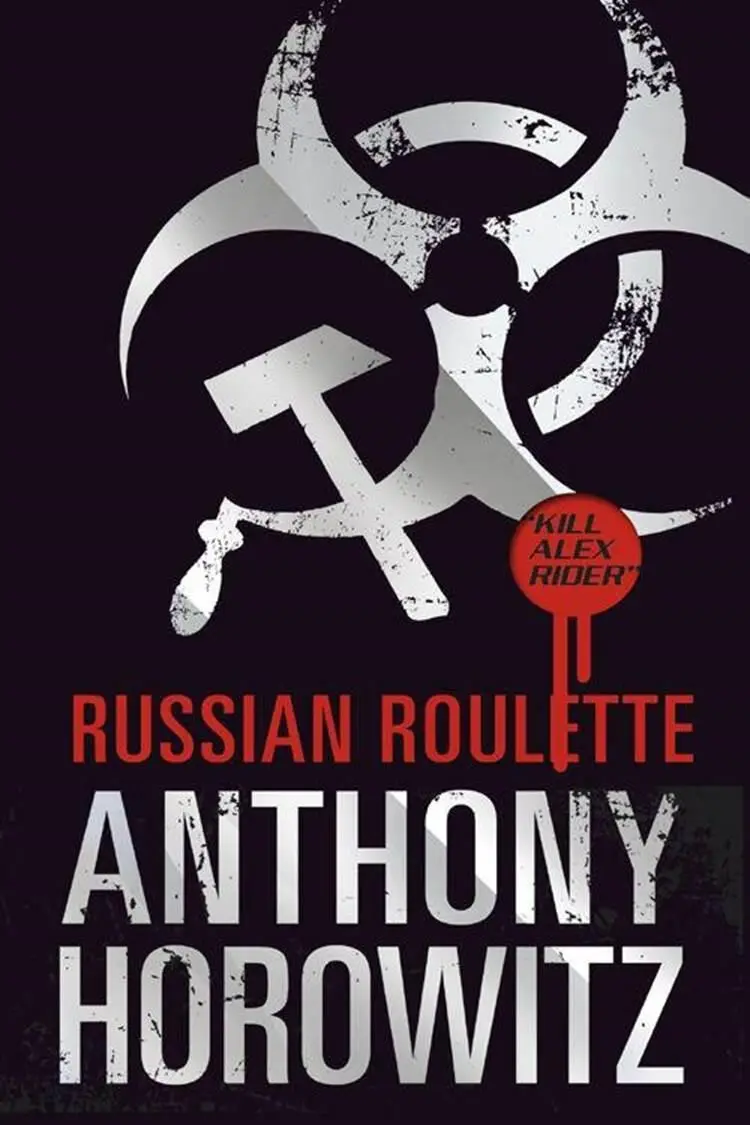
- Название:Russian Roulette
- Автор:
- Жанр:
- Год:неизвестен
- ISBN:нет данных
- Рейтинг книги:3 / 5. Голосов: 3
-
Избранное:Добавить в избранное
- Отзывы:
-
Ваша оценка:
Russian Roulette: краткое содержание, описание и аннотация
Предлагаем к чтению аннотацию, описание, краткое содержание или предисловие (зависит от того, что написал сам автор книги «Russian Roulette»). Если вы не нашли необходимую информацию о книге — напишите в комментариях, мы постараемся отыскать её.
Russian Roulette — читать онлайн бесплатно полную книгу (весь текст) целиком
Ниже представлен текст книги, разбитый по страницам. Система сохранения места последней прочитанной страницы, позволяет с удобством читать онлайн бесплатно книгу «Russian Roulette», без необходимости каждый раз заново искать на чём Вы остановились. Поставьте закладку, и сможете в любой момент перейти на страницу, на которой закончили чтение.
Интервал:
Закладка:
Rykov took me to a café around the corner from his flat, an old-fashioned place with a tiled floor, a long counter and a giant-sized coffee machine that blew out clouds of steam. We sat together at a little antique table and he ordered cappuccinos, orange juice and tramezzini – little sandwiches, made out of soft bread with smoked ham and cheese. I hadn’t eaten for about twenty hours and this was my first taste of Italian food. I wolfed them down and didn’t complain when he ordered a second plate. There was a canal running past outside and I was fascinated to see the different boats passing so close to the window.
“So your name is Yassen Gregorovich,” he said. He had been speaking in English ever since we had arrived in Venice. Perhaps he was testing me – although it was more likely that he had decided to leave the Russian language behind… along with the rest of the character he had been. “How old are you?”
I thought for a moment. “Eighteen,” I said.
“Sharkovsky kidnapped you in Moscow. He kept you his prisoner for three years. You were his food taster. Is that true?”
“Yes.”
“You’re lucky. We tried to poison him once and we were considering a second attempt. Your parents are dead?”
“Yes.”
“Arkady Zelin told me about you in the helicopter. And about Sharkovsky. I don’t know why you put up with it so long. Why didn’t you just put a knife into the bastard?”
“Because I wanted to live,” I said. “Karl or Josef would have killed me if I’d tried.”
“You were prepared to spend the rest of your life working for him?”
“I did what I had to to survive. Now he’s dead and I’m here.”
“That’s true.”
Rykov took out a cigarette and lit it. He did not offer me one but nor did I want it. This was the one good thing that had come out of my time at the dacha . I had not been allowed to have cigarettes and so I had been forced to give up smoking. I have never smoked since.
“Who are you?” I asked. “And who are Scorpia? Did they pay you to kill Sharkovsky?”
“I’ll give you a piece of advice, Yassen. Don’t ask questions and never mention that name again. Certainly not in public.”
“I’d like to know why I’m here. It would have been easier for you to kill me when we were in Boltino.”
“Don’t think I wasn’t tempted. As it is, it may be that I’ve made a bad mistake. We’ll see.” He drew on the cigarette. “The only reason I didn’t kill you is because I owed you. It was stupid of me not to see the second bodyguard. I don’t usually make mistakes and I’d be dead if it wasn’t for you. But before you get any fancy ideas, we’re quits. The debt is cancelled. From now on, you’re nothing to me. You’re not going to work for me. And I don’t really care whatever happens to you.”
“So why am I here?”
“Because the people I work for want to see you. We’re going there now.”
“There?”
“The Widow’s Palace. We’ll get a boat.”
From the name, I expected somewhere sombre, an old, dark building with black curtains drawn across the windows. But in fact the Widow’s Palace was an astonishing place, like something out of the story books I had read as a child, built out of pink and white bricks with dozens of windows glittering in the sun. There was a covered walkway on the level of the first floor, stretching from one end to the other, held up by slender pillars with archways below. And the palace wasn’t standing beside the canal. It was actually sinking into it. The water was lapping at the front door with the white marble steps disappearing below the murky surface.
We pulled in and stepped off the boat. There was a man standing at the entrance with thick shoulders and folded arms, wearing a white shirt and a black suit. He examined us briefly, then nodded for us to continue forward. Already I was regretting this. As I passed from the sunlight to the shadows of the interior, I was thinking of what Zelin had said as he left the helicopter. You don’t know these people. They will kill you . Maybe three long years of taking orders from Vladimir Sharkovsky had clouded my judgement. I was no longer used to making decisions.
It would have been better if I had run away before breakfast. I could have sneaked on a train to another city. I could have gone to the police for help. I remembered something my grandmother used to say when she was cooking: out of the latki , into the fire.
A massive spiral staircase – white marble with wrought-iron banisters – rose up, twisting over itself. Rykov went first and I followed a few steps behind, neither of us speaking. I was nervous but he was completely at ease, one hand in his trouser pocket, taking his time. We came to a corridor lined with paintings: portraits of men and women who must have died centuries before. They stood in their gold frames, watching us pass. We walked down to a pair of doors and before he opened them, Rykov turned and spoke briefly, quietly.
“Say nothing until you are spoken to. Tell the truth. She will know if you’re lying.”
She? The widow?
He knocked and without waiting for an answer opened the doors and went through.
The woman who was waiting for us was surely too young to have married and lost a husband. She couldn’t have been more than twenty-six or twenty-seven and my first thought was that she was very beautiful. My second was that she was dangerous. She was quite short, with long, black hair, tied back. It contrasted with the paleness of her skin. She wore no make-up apart from a smear of crimson lipstick that was so bright it was almost cruel. She was dressed in a black silk shirt, open at the neck. A simple gold necklace twisted around her neck. She could have been a model or an actress but there was something that danced in her eyes and told me she was neither.
She was sitting behind a very elegant, ornate table with a line of windows behind her, looking out over the Grand Canal. Two chairs had been placed in front of her and we took our places without waiting to be told. She had not been doing anything when we came in. It was clear that she had simply been waiting for us.
“Mr Grant,” she said, and it took me a moment to realize she was talking to Rykov. “How did it go?” Her voice was very young. She spoke English with a strange accent which I couldn’t place.
“There was no problem, Mrs Rothman,” Rykov – or Grant – replied.
“You killed Sharkovsky?”
“Three bullets. I got into the compound, thanks to the helicopter pilot. He flew me out again. Everything went according to plan.”
“Not quite.” She smiled and her eyes were bright but I knew something bad was coming and I was right. Slowly she turned to face me as if noticing me for the first time. Her eyes lingered on me. I couldn’t tell what was in her mind. “I do not remember asking you to bring me a Russian boy.”
Grant shrugged. “He helped me and I brought him here because it seemed the easiest thing to do. It occurred to me that he might be useful to you… and to Scorpia. He has no background, no family, no identity. He’s shown himself to have a certain amount of courage. But if you don’t need him, I’ll get rid of him for you. And of course there’ll be no extra charge.”
I had been struggling to follow all this. My teacher, Nigel Brown, had done a good job – my English was very advanced. But still, it was the first time I had heard it spoken by other people, and there were one or two words I didn’t understand. But nor did I need to. I fully understood the offer that Grant had just made and knew that once again my life was in the balance. The worst of it was that there was nothing I could do. I had nothing to say. I’d never be able to fight my way out of this house. I could only sit there and see what this woman decided.
Читать дальшеИнтервал:
Закладка:
Похожие книги на «Russian Roulette»
Представляем Вашему вниманию похожие книги на «Russian Roulette» списком для выбора. Мы отобрали схожую по названию и смыслу литературу в надежде предоставить читателям больше вариантов отыскать новые, интересные, ещё непрочитанные произведения.


Обсуждение, отзывы о книге «Russian Roulette» и просто собственные мнения читателей. Оставьте ваши комментарии, напишите, что Вы думаете о произведении, его смысле или главных героях. Укажите что конкретно понравилось, а что нет, и почему Вы так считаете.