Anthony Horowitz - Russian Roulette
Здесь есть возможность читать онлайн «Anthony Horowitz - Russian Roulette» весь текст электронной книги совершенно бесплатно (целиком полную версию без сокращений). В некоторых случаях можно слушать аудио, скачать через торрент в формате fb2 и присутствует краткое содержание. Жанр: Триллер, на английском языке. Описание произведения, (предисловие) а так же отзывы посетителей доступны на портале библиотеки ЛибКат.
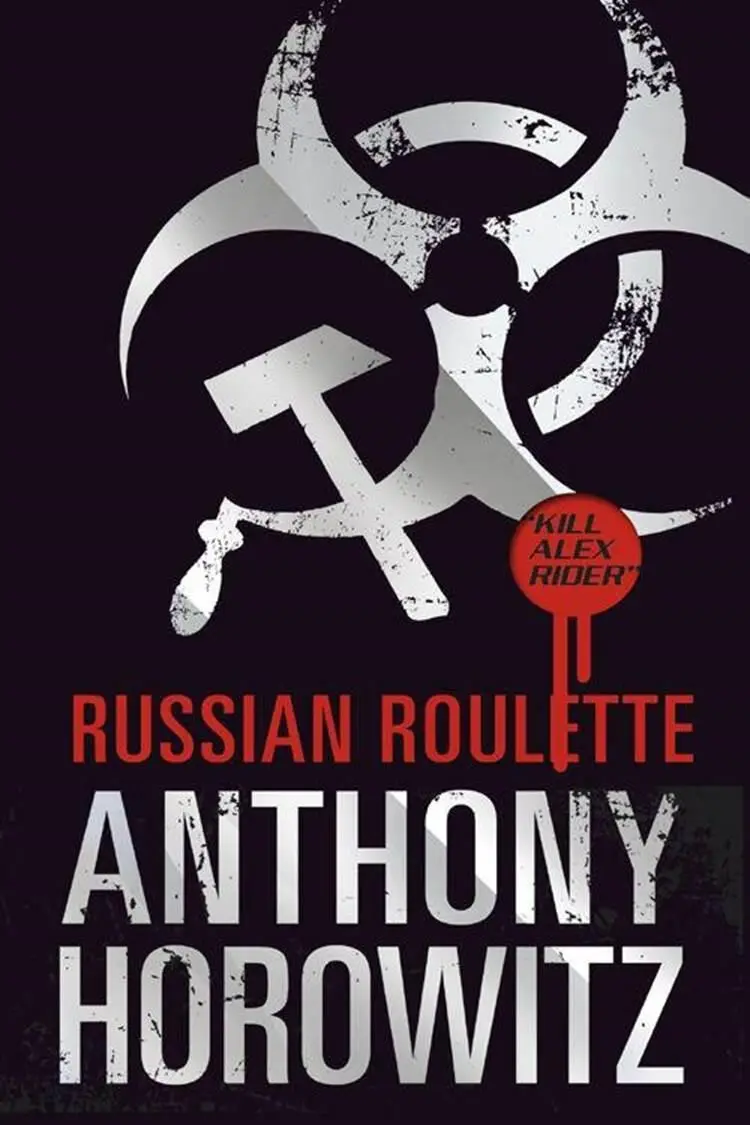
- Название:Russian Roulette
- Автор:
- Жанр:
- Год:неизвестен
- ISBN:нет данных
- Рейтинг книги:3 / 5. Голосов: 3
-
Избранное:Добавить в избранное
- Отзывы:
-
Ваша оценка:
Russian Roulette: краткое содержание, описание и аннотация
Предлагаем к чтению аннотацию, описание, краткое содержание или предисловие (зависит от того, что написал сам автор книги «Russian Roulette»). Если вы не нашли необходимую информацию о книге — напишите в комментариях, мы постараемся отыскать её.
Russian Roulette — читать онлайн бесплатно полную книгу (весь текст) целиком
Ниже представлен текст книги, разбитый по страницам. Система сохранения места последней прочитанной страницы, позволяет с удобством читать онлайн бесплатно книгу «Russian Roulette», без необходимости каждый раз заново искать на чём Вы остановились. Поставьте закладку, и сможете в любой момент перейти на страницу, на которой закончили чтение.
Интервал:
Закладка:
It was Nigel Brown who told me what little I knew about Sharkovsky.
“How did he make all his money?” I once asked. It was a warm evening about six months after I had arrived. There was no breeze and the mosquitoes were whining beneath the electric lights.
“Ah, well, that’s all politics,” he replied. We had been talking in English but now he slipped back into Russian, which he spoke fluently. “The end of Communism in your country created a sort of vacuum. A few men stepped in and he was one of them. They’ve sucked all the money out of your country, every last ruble. Some of them have made billions! Mr Sharkovsky invested in companies. Scrap metal, chemicals, cars… He bought and he sold and the money flowed in.”
“But why does he need so much protection?”
“Because he’s an evil bastard.” He smiled as if was surprised by what he had just said but decided to continue anyway. “Mr Sharkovsky is connected with the police. He’s connected with the politicians. He’s connected with the mafia. He’s a very dangerous man. God knows how many people he’s killed to get to where he is. But the trouble is, you can’t go on like that without making enemies. He really is a shark .” He repeated the last word in English. “Do you know the word ‘shark’, Yassen? It’s a big fish. A dangerous fish. It will gobble you up. Now, let’s get back to these irregular verbs, past tense. I buy, you bought. I see, you saw. I speak, you spoke… ”
Sharkovsky must have had plenty of enemies. We lived our life under siege at the dacha , and as I had discovered, painfully, there was no way in or out. There were X-ray machines and metal detectors at the main gates – just like at a modern airport – and nobody was allowed in or out without being searched. The gardeners arrived empty-handed and were expected to leave their tools behind when they finished work. The tutors, the drivers, the housekeepers… each person’s background had been checked except for mine, but then my background didn’t matter. Josef and Karl always stayed close to their boss. The CCTV cameras were on at all times. Everyone watched everyone else. Other businessmen in Russia were careful but none of them went to these extremes. Sharkovsky was paranoid but, as I had seen for myself in that basement refrigerator, he had good reason to be.
He was extremely careful about what he ate and drank. For example, he only accepted mineral water from bottles that he had opened himself after checking that the seal had not been broken. The bottles always had to be glass. His enemies might be able to contaminate a plastic one using a hypodermic syringe. He sometimes ate food straight from the packet or the tin, pronging it into his mouth with no sign of pleasure, but if it arrived on a plate, I would have to taste it first.
Most times, I would report to the kitchen before the meals were sent out and I would eat straight out of the pans, with Josef or Karl watching over me and Pavel standing nervously to one side. It’s hard to describe how I felt about this. On one level, I have to admit that there was a part of me that enjoyed it. As I have said, the food was superb. But at the same time, it was still an unpleasant experience. First of all, one mouthful was all I was allowed and I was always aware that one mouthful might be enough to kill me. In a way, every tasting session was the same as the Russian roulette I had been forced to play on my first night. I learned to attune my senses to look out for the acrid taste of poison or simply the suspicion that something might not be right. The trouble was, by the time I detected it, it might well have killed me.
After a while, I put the whole thing out of my mind. I simply did what I was told, robotically, without complaining. You might say that I had a very strange relationship with death. The two of us were constantly together, side by side. And yet we ignored each other. In this way, we were able to get by.
What I most dreaded were the formal dinners that I was forced to attend in the huge dining room with its brilliant chandeliers, gold and white curtains, antique French table and chairs, and countless flickering candles. Sharkovsky often invited business associates and friends… people he knew well. To begin with, I was worried that Misha Dementyev, the professor from Moscow State University, might show up. He knew Sharkovsky. Indeed he – along with my own stupidity – was the reason I was here. What would happen if he recognized me? Would it make my situation worse? But he never did appear and it occurred to me that he was probably a minor employee in Sharkovsky’s empire and that it was very unlikely that he would receive an invitation. Nearly all the guests arrived in expensive cars. Some even came in their own helicopters. They were as rich and as vicious as Sharkovsky himself.
I had been given a grey suit with a white shirt and a black tie for these events – the same uniform as his bodyguards – and I would stand behind him as I had been instructed, looking down at the floor with my hands held behind my back. I was not allowed to speak. As each course was served, I would step forward and, using my own cutlery, would take a sample directly from his plate, eat it, nod and step back again. There was no doubt that Sharkovsky was afraid for his life but at the same time he was enjoying himself. He loved playing the Roman emperor, showing me off to his other guests, deliberately humiliating me in front of them.
But if the father was bad, his son was much, much worse. Ivan Sharkovsky first became aware of me at one of those dinners and although I wasn’t supposed to look at the guests, I noticed him examining me out of the corner of my eye. Ivan, a year older than me, resembled his father in many ways. He had the same dark qualities but they had been distributed differently – in his curly black hair, his heavy jowls, his down-turned mouth. He seemed to be constantly brooding about something. His father was solid and muscular. He was fat with puffy cheeks, thick lips and eyelids that were slightly too large for his eyes. Sitting hunched over the table, spooning food into his mouth, he had something brutish about him.
“Papa?” he asked. “Where did you get him from?”
“Who?” Sharkovsky was at the head of the table with Maya sitting next to him. She was wearing a huge diamond necklace that sparkled in the light. Whenever there were guests, he insisted that she smothered herself in jewellery.
“The food taster!”
“From Moscow.” Sharkovsky dismissed the question as if he had simply picked me up in a shop.
“Can he taste my food?”
Shakovsky leant forward and jabbed a fork in the direction of his son. He had been drinking heavily – champagne and vodka – and although he wasn’t drunk, there was a looseness about the way he spoke. “You don’t need a food taster. You’re not important. Nobody would want to kill you.”
The other guests all took this as a joke and laughed uproariously, but Ivan scowled and I knew that I would be hearing from him soon.
And the very next day, he came outside and found me. It was a cold afternoon. I was washing one of his father’s cars, spraying it with a hose. As soon as I saw him coming, I stopped my work and looked down. This was what I had been taught. We had to treat the whole family as if they were royalty. Part of me hoped he would simply walk on, but I could see it wasn’t going to happen. I knew straight away that I was in trouble.
“What is your name?” he asked, although of course he knew.
“Yassen Gregorovich,” I answered. That was the name I always used now.
“I’m Ivan.”
“Yes,” I said. “I know.”
He looked at me questioningly and I could feel the sense of menace hanging in the air. “But you don’t call me that, do you?”
Читать дальшеИнтервал:
Закладка:
Похожие книги на «Russian Roulette»
Представляем Вашему вниманию похожие книги на «Russian Roulette» списком для выбора. Мы отобрали схожую по названию и смыслу литературу в надежде предоставить читателям больше вариантов отыскать новые, интересные, ещё непрочитанные произведения.


Обсуждение, отзывы о книге «Russian Roulette» и просто собственные мнения читателей. Оставьте ваши комментарии, напишите, что Вы думаете о произведении, его смысле или главных героях. Укажите что конкретно понравилось, а что нет, и почему Вы так считаете.