Anthony Horowitz - Russian Roulette
Здесь есть возможность читать онлайн «Anthony Horowitz - Russian Roulette» весь текст электронной книги совершенно бесплатно (целиком полную версию без сокращений). В некоторых случаях можно слушать аудио, скачать через торрент в формате fb2 и присутствует краткое содержание. Жанр: Триллер, на английском языке. Описание произведения, (предисловие) а так же отзывы посетителей доступны на портале библиотеки ЛибКат.
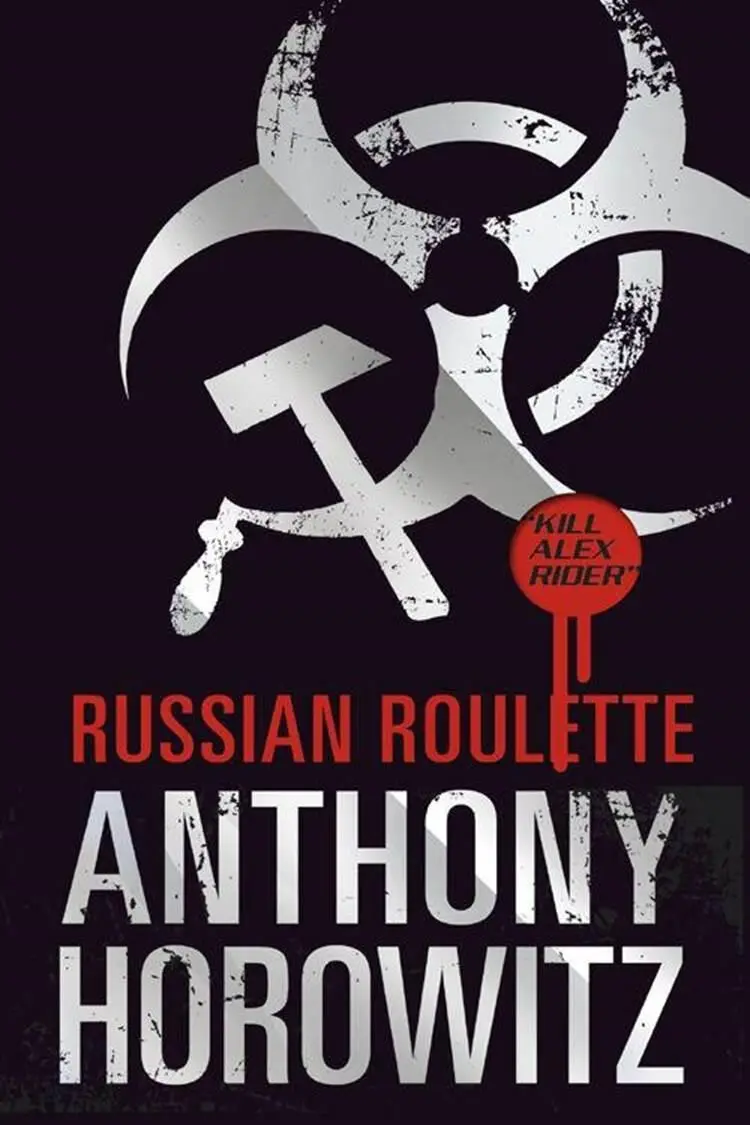
- Название:Russian Roulette
- Автор:
- Жанр:
- Год:неизвестен
- ISBN:нет данных
- Рейтинг книги:3 / 5. Голосов: 3
-
Избранное:Добавить в избранное
- Отзывы:
-
Ваша оценка:
Russian Roulette: краткое содержание, описание и аннотация
Предлагаем к чтению аннотацию, описание, краткое содержание или предисловие (зависит от того, что написал сам автор книги «Russian Roulette»). Если вы не нашли необходимую информацию о книге — напишите в комментариях, мы постараемся отыскать её.
Russian Roulette — читать онлайн бесплатно полную книгу (весь текст) целиком
Ниже представлен текст книги, разбитый по страницам. Система сохранения места последней прочитанной страницы, позволяет с удобством читать онлайн бесплатно книгу «Russian Roulette», без необходимости каждый раз заново искать на чём Вы остановились. Поставьте закладку, и сможете в любой момент перейти на страницу, на которой закончили чтение.
Интервал:
Закладка:
“Excuse me,” I said.
Two pairs of very sly and malevolent eyes turned on me. One of the children had snot running out of his nose. Both of them looked worn out, unhealthy.
“I’m looking for someone I was talking to earlier,” I went on. “He was wearing a black leather jacket. His name is Dima.”
The boys glanced at each other. “You got any money?” one of them asked.
“No.”
“Then get lost!” Those weren’t his actual words. This little boy, whose voice hadn’t even broken, used the filthiest language I’d ever heard. I saw that he had terrible teeth with gaps where half of them had fallen out. His friend hissed at me like an animal and at that moment the two of them weren’t children at all. They were like horrible old men, not even human. I was glad to leave them on their own.
I tried to ask some of the other street kids the same question but as I approached them, they moved away. It was as if they all knew that I was from out of town, that I wasn’t one of them, and for that reason they would have nothing to do with me. And now the light really was beginning to disappear. I was starting to feel the threat of nightfall and knew that I couldn’t stay here for much longer. I would have to find a doorway – or perhaps I could sleep in one of the subways beneath the streets. I had four kopecks left in my pocket. Barely enough for a cup of hot tea.
And then, quite unexpectedly, I saw him. Dima – with his oversized leather jacket and his half-handsome, half-ugly face – had turned the corner, smoking a cigarette, flicking away the match. There was another boy with him and I recognized him too. He had been one of the two who had robbed me. Dima said something and they laughed. It looked as if they were heading for the Metro, presumably on their way home.
I didn’t hesitate. It was now or never. I crossed the concourse in front of the station and stood in their path.
Dima saw me first and stopped with the cigarette halfway to his lips. I had taken him by surprise and he thought I was going to make trouble. I could see it at once. He was tense, wary. But I was completely relaxed. I’d already worked it out. He’d tricked me. He’d robbed me. But I had to treat him as my friend.
“Hi, Dima.” I greeted him as if the three of us had arranged to meet here for coffee.
He smiled a little but he was still suspicious. And there was something else. I wasn’t quite sure what it was but he was looking at me almost as if he had expected me to come back, as if there was something he knew that I didn’t. “Soldier!” he exclaimed. “How are you doing? What happened to your hair?”
“I got it cut.”
“Did you meet your friend?”
“No. He wasn’t there. It seems he’s left Moscow.”
“That’s too bad.”
I nodded. “In fact, I’ve got a real problem. He was going to put me up but now I don’t have anywhere to go.”
I was hoping he might offer to help. That was the idea, anyway. Why not? He was seventy rubles richer than me. Thanks to him, I had nothing. He could at least have offered me a bed for the night. But he didn’t speak and I realized I was wasting my time. He was street-hardened, the sort of person who would have never helped anyone in his life. His friend muttered something and pushed past me, disappearing into the Metro, but I stood my ground. “Can you help me?” I said. “I just need somewhere to stay for a few nights.” And then – my last chance. “I can pay you.”
“You’ve got money?” That surprised him. He thought he’d taken it all already.
“Not any more,” I said. I shrugged as if to let him know that it didn’t matter, that I’d already forgotten about it. “But I’ve got this.” I went on. I took out the black velvet bag that my mother had given me and that I’d used to trick Dementyev. I opened it and poured the contents – the necklace, the ring and the earrings – into my hand. “There must be a pawnshop somewhere. I’ll sell them and then I can pay you for a room.”
Dima examined the jewellery, the brightly coloured stones in their silver and gold settings, and I could already see the light stirring in his eyes as he made the calculations. How much were they worth and how was he going to separate them from me? He dropped his cigarette and reached out, picking up one of the earrings. He let it hang from his finger and thumb. “This won’t get you much,” he said. “It’s cheap.”
Right then, I thought of my mother and I could feel the anger rising in my blood. I wanted to punch him but still I forced myself to stay calm. “I was told they were valuable,” I said. “That’s gold. And those stones are emeralds. Take me to a pawnshop and we can find out.”
“I don’t know…” He was pretending otherwise but he knew that the jewels were worth more than the money he had already stolen. “Give me the stuff and I’ll take it to a pawnbroker for you. But I don’t think you’ll get more than five rubles.”
He’d get fifty. I’d get five… if I was lucky. I could see how his mind worked. I held out my hand and, reluctantly, he gave me the earring back. “I can find a pawnbroker on my own,” I said.
“There’s no need to be like that, soldier! I’m only trying to help.” He gave me a crooked smile, made all the more crooked by his broken nose. “Listen, I’ve got a room and you’re welcome to stay with me. You know… we’re all friends, here in Moscow, right? But you’ll have to pay rent.”
“How much rent?”
“Two rubles a week.”
I pretended to consider. “I’ll have to see it first.”
“Whatever you say. We can go there now if you like.”
“Sure. Why not?”
He took me back down into the Metro. He even paid my fare again. I knew I was taking a risk. He could lead me to some faraway corner of the city, take me into an alleyway, put a knife into me and steal the jewels. But I had a feeling that wasn’t the way he worked. Dima was a hustler, a thief – but at the end of the day, he just didn’t have the look of someone who was ready to kill. He would get the jewellery in the end anyway. I would pay it to him as rent or he would steal it from me while I slept. My plan was simply to make myself useful to him, to become part of his gang. If I could do this quickly enough, he might let me stay with him, even when I had nothing more to give. That was my hope.
He took me to a place just off Tverskaya Street, one of the main thoroughfares in Moscow, which leads all the way down to the Kremlin and Red Square. Today, there is a hotel on that same corner – the nine-storey Marriott Grand, where American tourists stay in total luxury. But when I came there, following Dima and still wondering if I wasn’t making another bad mistake, it was very different. Moscow has changed so much, so quickly. It was another world back then.
Dima lived in what had once been a block of flats but which had long been abandoned and left to rot. All the colour had faded from the brickwork, which was damp and mouldy, and covered with graffiti – not artwork but political slogans, swear words, and the names of city football teams. The windows were so dirty that they looked more like rusting metal than glass. The building rose up twelve floors, three more than the hotel that would one day replace it, and whole thing seemed to be sagging in on itself, hardly bothering to stay upright. It was surrounded by other blocks that were similar… they looked like old men standing out in the cold, having a last cigarette together before they died. The streets here were very narrow; more like alleyways, twisting together in the darkness, covered with rubbish and mud. The block of flats had shops on the ground floor – an empty grocery store, a chemist and a massage parlour – but the further up you went, the more desolate it became. It had no lifts, of course. Just a concrete staircase that had been used as a toilet so many times that it stank. By the time you got to the top, there was no electricity, no proper heating. The only water came dribbling, cold, out of the taps.
Читать дальшеИнтервал:
Закладка:
Похожие книги на «Russian Roulette»
Представляем Вашему вниманию похожие книги на «Russian Roulette» списком для выбора. Мы отобрали схожую по названию и смыслу литературу в надежде предоставить читателям больше вариантов отыскать новые, интересные, ещё непрочитанные произведения.


Обсуждение, отзывы о книге «Russian Roulette» и просто собственные мнения читателей. Оставьте ваши комментарии, напишите, что Вы думаете о произведении, его смысле или главных героях. Укажите что конкретно понравилось, а что нет, и почему Вы так считаете.