William Lashner - Bitter Truth
Здесь есть возможность читать онлайн «William Lashner - Bitter Truth» весь текст электронной книги совершенно бесплатно (целиком полную версию без сокращений). В некоторых случаях можно слушать аудио, скачать через торрент в формате fb2 и присутствует краткое содержание. Жанр: Триллер, на английском языке. Описание произведения, (предисловие) а так же отзывы посетителей доступны на портале библиотеки ЛибКат.
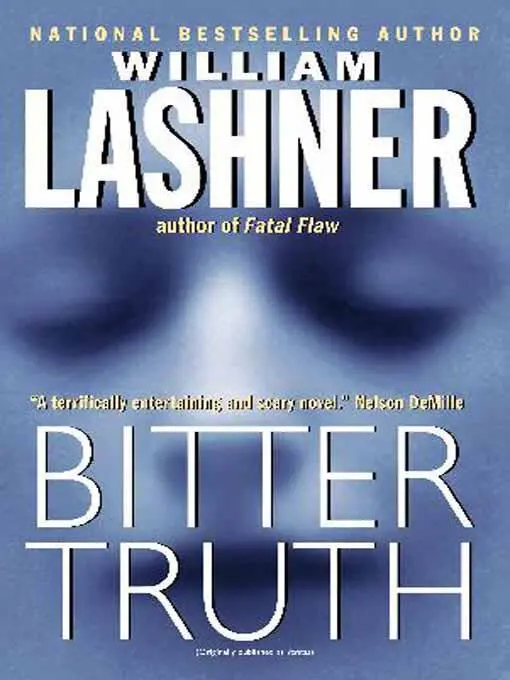
- Название:Bitter Truth
- Автор:
- Жанр:
- Год:неизвестен
- ISBN:нет данных
- Рейтинг книги:3 / 5. Голосов: 1
-
Избранное:Добавить в избранное
- Отзывы:
-
Ваша оценка:
Bitter Truth: краткое содержание, описание и аннотация
Предлагаем к чтению аннотацию, описание, краткое содержание или предисловие (зависит от того, что написал сам автор книги «Bitter Truth»). Если вы не нашли необходимую информацию о книге — напишите в комментариях, мы постараемся отыскать её.
Bitter Truth — читать онлайн бесплатно полную книгу (весь текст) целиком
Ниже представлен текст книги, разбитый по страницам. Система сохранения места последней прочитанной страницы, позволяет с удобством читать онлайн бесплатно книгу «Bitter Truth», без необходимости каждый раз заново искать на чём Вы остановились. Поставьте закладку, и сможете в любой момент перейти на страницу, на которой закончили чтение.
Интервал:
Закладка:
Wills for widows and orphans at a price, no doubt, with Peter Carp conveniently named as executor. I shook my head. “Nothing too complicated or lucrative, I’m afraid.”
“Because if you need any help on the intricacies of Pennsylvania trusts and estates law, I’d be glad to help.”
“All I really need to know, Mr. Carp, is if your father’s records are still available.”
He looked at me and I looked at him and then he turned his attention to the invoice and flicked it once with his finger. “I’m not sure the records that are available go this far back,” he said, “and even if they did, to find something this far back would take a lot of man hours.”
“I’d be willing to help you look.”
“And then there is the question of confidentiality. Without a waiver it is not really proper to hand over the information. And Mrs. Shaw would appear to be in no condition to grant a waiver.”
Did I have the same clever gleam in my eye, sitting in my office, plotting how to grab a few bucks here and a few bucks there whenever opportunity reared its shapely neck? If I did, I never before realized how transparent it was, and how ugly. Looking at Peter Carp for me was like looking at an unflattering snapshot and wincing. “I’m sure, Mr. Carp, that if the records are available we could work something out.”
“Exactly how much are we talking about?”
“Let’s find the records before we discuss details.”
“I suppose there would be no harm in looking,” he said with a smile. His tongue darted quickly out of his mouth, wetting his thick lower lip. “You wouldn’t have any trouble, would you, in making the check out to cash?”
“None at all,” I said.
“Well then, Vic,” said Peter Carp. “Let’s go for a ride.”
The Carp estate was in Wynnewood, an old suburb not too far from the western border of the city. Old stone houses, wet basements, tall trees growing too close to the sidewalk, planted fifty years before as seedlings and now listing precariously over the street. Carp took me to a decaying dark Tudor on a nice wooded plot of land going now to seed. “This was my father’s house,” he said, “but I live here now.”
The inside was dark and dusty, half empty of furniture. Paint peeled from the wood trim in strips and the wallpaper was faded and oily. It felt like the place had been abandoned years before. Carp’s father had evidently maintained it well but after his death his son had done nothing to the place except sell off the better pieces of furniture. I wondered if this was what Dr. Wesley Karpas had in mind when he changed his name to Carp and sought to rise in society, this decrepit and rundown house, this money-sucking semifailure of a son.
He took me downstairs to a basement area and pushed open a door that was partly cobwebbed over. Inside the doorway was an old doctor’s office, white metal cabinets with glass fronts, an examination table, a desk. Still scattered about were strange metal instruments sitting in stainless steel pans. In the corner were piles of medical journals. The place was full of dust and the leavings of animals and with the pointed metal instruments it looked like a discarded torture chamber.
“My father stopped his surgical practice when he turned sixty,” said Carp, “but he saw patients as a GP in his home office until the final stroke.”
Through the examination room was another room, a waiting room of sorts, with a door to the backyard where the patients would enter. And then, in another room, off from the waiting room, were boxes piled one atop the other and file cabinets lined up like a row of soldiers at attention.
“He kept his files religiously,” said Carp, as he climbed over the boxes, heading for the file cabinets. “Every so often he would clear out the files of patients he no longer saw and put them in boxes, but he made sure to keep everything. I would tell him to throw the stuff out but he said you never know, and look how right he was.”
Carp opened one of the file cabinets and searched it and shook his head.
“It’s not in the cabinets,” he said. “Why don’t we start looking through the boxes together? Each box should be labeled with the letters of the files and year they were taken out of the main cabinets.”
I removed my suit jacket and laid it carefully over a chair and then started at the boxes, shoving cartons here and there in search of the elusive “S.” We found two cartons with “S” files, one cleared from the cabinets in 1986 and one from 1978. Carp, refusing to let me so much as peek inside for what he claimed were reasons of confidentiality, examined each and declared there was no file for Mrs. Christian Shaw in either. After thirty minutes more I found a box labeled “Re-Th, 1973” and Carp told me to stand back as he took a look inside.
“I don’t see anything for a Mrs. Christian Shaw here,” he said.
“How about Faith Reddman Shaw?”
“Reddman, huh.”
“A distant impoverished line from the Pickle baron.”
“No Faith Reddman Shaw, but here’s something.” He took a file out and spread it open atop the box. “When exactly was the date of that invoice?”
“June 9, 1966.”
“Yes that’s it, and the amount?”
“Six hundred, thirty-eight dollars and ninety cents.”
“All right, that’s it exactly, but you had it wrong.”
“Wrong?”
“The patient. It wasn’t this Mrs. Christian Shaw, she was just the party billed for the service. The patient was a Kingsley Shaw.”
“What was the procedure?”
“Nothing too serious,” he said. “Just two minor incisions, a few snips of the vasa deferentia and then a few sutures to clean up.”
“What are you talking about?”
“A vasectomy. My father gave this Kingsley Shaw a vasectomy in June of 1966. Apparently it was a clean operation with no complications. No big deal. Why, is this Kingsley Shaw anybody?”
“No,” I said. “Nobody at all.”
After I had written out the check to cash for a thousand dollars, I asked Carp if I could use the phone. I picked up the receiver, turned my back to the hungry eyes of Peter Carp, and called my apartment.
“Hi,” I said when Caroline answered.
“That cop, McDeiss is looking for you,” she said. “He called your office and he just called here.”
“You didn’t tell him who you were, did you?”
“No, but he says if you get a chance you should show up at Front and Ellsworth, by the hockey rink. Do you know where it is?”
“I can find it. Thanks. Let me ask you something, Caroline. What’s your birthday?”
“You getting me a present?”
“Sure. Just tell me.”
“June 11,” she said.
“What year?”
“Nineteen sixty-eight. Why?”
“Not important. If McDeiss calls back,” I said, “tell him I’m on my way.”
40
WHEN I GOT TO THERalph R. Rizzo Sr. Ice Skating Rink at Front and Ellsworth there was already a crowd behind the yellow tape. Across the street from the tape was Interstate 95, which hacks through the eastern edge of Philadelphia like a blunt cleaver. The ice rink, with its facade of blue-and-white tile, was squeezed beneath the elevated highway and beside the tiled building was an outdoor roller rink, this too in the highway’s shadow. Between the two rinks was a wedgelike opening with a solitary bench and in that opening five or six cops mingled around a large black thing that sat squat and smoldering. Parked on Front Street were two fire trucks, lights still flashing. Firemen, in black slickers, huddled with one another, smoking cigarettes.
The crowd behind the yellow tape held the usual crew of wide-eyed onlookers who congregate with a sort of muted glee at the situs of a tragedy. They shook their heads and cracked wise out of the sides of their mouths and shucked their weight from one foot to the other and fought to keep from laughing because it wasn’t them this time. Along with the onlookers were a few parasitic reporters, asking questions, and the inevitable television cameras readying the live feed for their insatiable news machines.
Читать дальшеИнтервал:
Закладка:
Похожие книги на «Bitter Truth»
Представляем Вашему вниманию похожие книги на «Bitter Truth» списком для выбора. Мы отобрали схожую по названию и смыслу литературу в надежде предоставить читателям больше вариантов отыскать новые, интересные, ещё непрочитанные произведения.



Обсуждение, отзывы о книге «Bitter Truth» и просто собственные мнения читателей. Оставьте ваши комментарии, напишите, что Вы думаете о произведении, его смысле или главных героях. Укажите что конкретно понравилось, а что нет, и почему Вы так считаете.