William Lashner - Bitter Truth
Здесь есть возможность читать онлайн «William Lashner - Bitter Truth» весь текст электронной книги совершенно бесплатно (целиком полную версию без сокращений). В некоторых случаях можно слушать аудио, скачать через торрент в формате fb2 и присутствует краткое содержание. Жанр: Триллер, на английском языке. Описание произведения, (предисловие) а так же отзывы посетителей доступны на портале библиотеки ЛибКат.
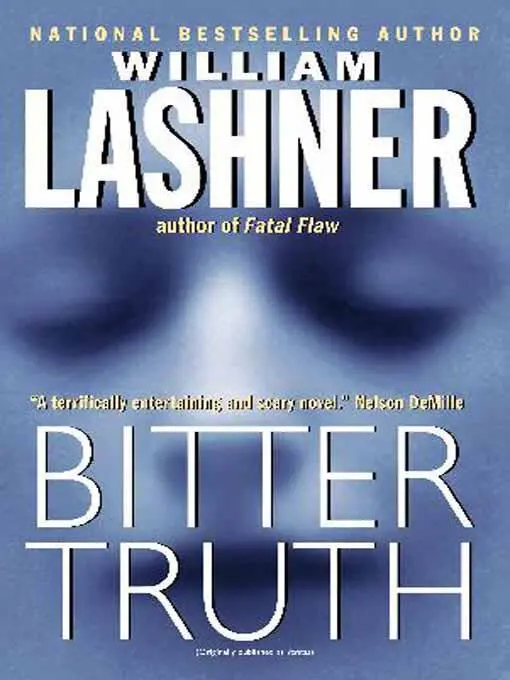
- Название:Bitter Truth
- Автор:
- Жанр:
- Год:неизвестен
- ISBN:нет данных
- Рейтинг книги:3 / 5. Голосов: 1
-
Избранное:Добавить в избранное
- Отзывы:
-
Ваша оценка:
Bitter Truth: краткое содержание, описание и аннотация
Предлагаем к чтению аннотацию, описание, краткое содержание или предисловие (зависит от того, что написал сам автор книги «Bitter Truth»). Если вы не нашли необходимую информацию о книге — напишите в комментариях, мы постараемся отыскать её.
Bitter Truth — читать онлайн бесплатно полную книгу (весь текст) целиком
Ниже представлен текст книги, разбитый по страницам. Система сохранения места последней прочитанной страницы, позволяет с удобством читать онлайн бесплатно книгу «Bitter Truth», без необходимости каждый раз заново искать на чём Вы остановились. Поставьте закладку, и сможете в любой момент перейти на страницу, на которой закончили чтение.
Интервал:
Закладка:
“Speaking of cults of personality,” I said, rapping on the window.
Morris Kapustin, who had been walking down the street, stopped and turned and waved when he recognized us. He was wearing a dark suit without a tie, his white shirt open to show his silk undershirt, his broad black hat propped back on his head so that the round brim acted as a sort of halo. Four white tzitzit flowed over his belt. Through his mostly gray beard he smiled and there was about Morris’s smile something so genuinely pleased at seeing me that it was almost heartbreaking. I didn’t often draw out that reaction, never, in fact, except from Morris. It was how a father might react upon unexpectedly running into his successful son in the middle of the day in the middle of the city, not my father of course, being as he was not prone to smiles and I was not truly successful, but someone else’s father, a kind, loving father, a father like Morris.
“Your secretary,” said Morris after he made his way inside, “Ellie,” as if I didn’t know my secretary’s name, “she said I would find you here. Such a fancy place for a cup of coffee.”
“You want something, Morris?” I asked. “My treat.”
“So generous you are, Victor, but no, thank you. I can’t drink now coffee with my stomach like it is.”
“What’s wrong with your stomach?”
“Other than that it is too big? It’s begun to hurt at night, mine boichik, and the gas. You know what I think it is? The doctor, he tells me to eat fiber, fiber, fiber for my prostrate.”
“Prostate,” said Beth.
“You too are having such problems?”
“No,” said Beth.
“All that fiber,” said Morris with a dismissive wave of his hand. “Our stomachs weren’t made for fiber. Kugel and kreplach and pastrami, yes. Fiber, no. It’s like eating wood and it is probably what’s wrong with everyone now. In my day there was no such thing as the prostrate, now it’s everywhere. Just last week on the cover of Time . That’s what you get from eating wood.”
“Beth was just telling me, Morris, that she is having doubts about her New Age church.”
“Really?” said Morris.
“It seems there is a nugget of truth surrounded by a lot of nonsense,” said Beth.
“A nugget of truth is not so bad,” said Morris. “How easy do you want it to be? Tell me how you eat a piece of corn. You take off the husk, you clean off the silk, you ignore the cob, and then, if it is cooked just right, a few minutes in boiling water, not too much, not too long, just right, there are a few perfect kernels. In the end, that’s a lot of garbage for so few kernels, but they are sweet as sugar, a mechaieh .”
“How do you know what’s real and what’s not?” asked Beth.
“If it was so easy, we would all be tzaddiks . Miss Beth, please, don’t give up. As Rebbe Tarfon, the great colleague of Akiba, said, ‘The day is short, the task is great, the workmen are lazy, the reward is great, and the Master is insistent.’ ”
“Are you calling me lazy?” I said.
“Spiritually, Victor, you are a couch potato, but I come here not to talk of the divine. Quite the opposite. The old books and ledgers your friend, Miss Caroline, she found. I was in your office, Victor, looking through them and I confess they are more ongepotchket than I could ever have thought. Normally with numbers I am pretty good, but these books, it is too much for a Kuni Lemmel like me. I need, I think, an accountant to review them for us. The accounting firm of Pearlman and Rabbinowitz, maybe you heard them? I want to hire Rabbinowitz.”
“Sure,” I said, “but tell him to keep his fees down. Without a contract I’m still springing for expenses and it is starting to add up. Any luck with finding what happened to the Poole daughter?”
“Such a thing is not so easy, Victor. Back then there were special places for pregnant women without husbands to go and I have Sheldon looking into that, but the records, they are either old or destroyed so don’t you now be expecting much.”
“I’ve learned not to,” I said. Morris’s face took on a pained expression and he was about to launch into a ringing defense of his work when he saw my smile. He sighed wearily.
“Sheldon also, I have him searching the whole of the country for persons named Wergeld. They have these computer directories on the Internet, places that have every phone number in all of America, which is astonishing, really. Everyone is in there, Victor. Everyone. Pretty soon they won’t be needing people like me anymore.”
“Isn’t technology grand?”
“Insulting me like you are, Victor, you must be in a very good mood.”
“He’s in love,” said Beth, “with a guiding light.”
I shrugged and ignored her smirk. “What has Sheldon found?”
“A few Wergelds scattered about.” He reached into his jacket pocket and pulled out his small notebook, crowded with disparate scraps of paper, the whole thing bound with a rubber band. He slipped off the rubber band and opened the book carefully, licking his thumb as he paged through until he found what he was looking for. “One Wergeld in Phoenix, one in a place called Pittsfield in Massachusetts, one in Milwaukee. Nothing yet about connecting them to your Reddmans. We’re still looking. And I was right about those numbers we found on the card, thank you, they are account numbers, for banks that hold much secret money. My friend he recognized some and verified others. But still, before we can learn any more, we must know the code words and get the proper signatures.”
“Which is unlikely.”
“I am not a miracle worker all the time, Victor, just some of the times.”
“I’m not getting very far myself,” I said. “I’m still looking for that doctor to check the medical invoice we found.”
“Who is the Master?” asked Beth. “In that quote from that rabbi you said the Master is insistent. Who is he?”
“For Victor and me, as Jews, such a question is easy. The master is Ha Shem, the Glorious One, King of the Universe, praised be He.”
“And for me?” asked Beth.
“That, Miss Beth, is for you to discover. But my guess, after all is said and done, after all your searching and questioning, my guess is your answer, it will be exactly the same.”
39
THERE WAS NO DR. KARPASlisted in the Philadelphia white pages, nor in the white pages for Eastern Montgomery County or the Main Line or Delaware County, all of which was not much of a surprise. The Dr. Karpas I was looking for, Dr. Wesley Karpas, performed some sort of procedure on Faith Reddman Shaw in 1966 and thirty years later I didn’t quite expect he’d still be practicing. Faith Reddman Shaw, I was sure, was not the type to let any but the most experienced slip a knife into her. Even in 1966 Dr. Wesley Karpas most likely had a fine gray head of hair and by now was probably long retired to some golf community in Arizona. There wasn’t much hope I’d ever discover for what Grammy Shaw had paid the $638.90. Still, I couldn’t help but wonder why an old lady would have retained an invoice for a medical procedure performed on her more than a quarter century before her death.
I had spent an hour calling every Karpas I could find in Philadelphia and the suburbs and getting nowhere. “ Hello, Mrs. Karpas? Mrs. Adrian Karpas? ” I figured my best chance at finding Dr. Karpas was to grab hold of a son or a cousin or some relative who might be able to give me even a clue as to where he might be. “ Hello, is this Mr. Bruce Karpas? ” The only problem then would be hoping the doctor remembered the procedure and would somehow be willing to tell me about it, all long shots, for sure. “ Hello, I’m looking for a Mrs. Colleen Karpas .” You would have thought Karpas to be a fairly unique name. “ Mrs. Kenneth Karpas? ” You would have thought that all the different Karpases in the phone book would have belonged to one extended family and known each other well. “ Miss Gwenneth Karpas? ” You would have thought. “ Hello, Mr. Angelo Karpas? ”
Читать дальшеИнтервал:
Закладка:
Похожие книги на «Bitter Truth»
Представляем Вашему вниманию похожие книги на «Bitter Truth» списком для выбора. Мы отобрали схожую по названию и смыслу литературу в надежде предоставить читателям больше вариантов отыскать новые, интересные, ещё непрочитанные произведения.










Обсуждение, отзывы о книге «Bitter Truth» и просто собственные мнения читателей. Оставьте ваши комментарии, напишите, что Вы думаете о произведении, его смысле или главных героях. Укажите что конкретно понравилось, а что нет, и почему Вы так считаете.