William Bernhardt - Capitol Murder
Здесь есть возможность читать онлайн «William Bernhardt - Capitol Murder» весь текст электронной книги совершенно бесплатно (целиком полную версию без сокращений). В некоторых случаях можно слушать аудио, скачать через торрент в формате fb2 и присутствует краткое содержание. Жанр: Триллер, на английском языке. Описание произведения, (предисловие) а так же отзывы посетителей доступны на портале библиотеки ЛибКат.
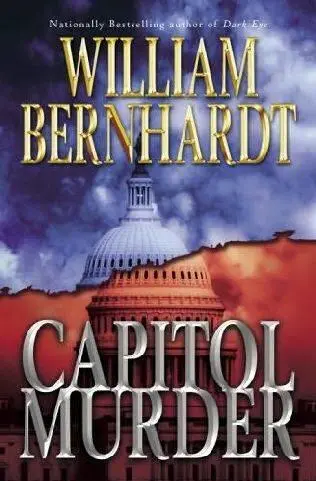
- Название:Capitol Murder
- Автор:
- Жанр:
- Год:неизвестен
- ISBN:нет данных
- Рейтинг книги:3 / 5. Голосов: 1
-
Избранное:Добавить в избранное
- Отзывы:
-
Ваша оценка:
Capitol Murder: краткое содержание, описание и аннотация
Предлагаем к чтению аннотацию, описание, краткое содержание или предисловие (зависит от того, что написал сам автор книги «Capitol Murder»). Если вы не нашли необходимую информацию о книге — напишите в комментариях, мы постараемся отыскать её.
Kincaid's legal success has earned him a dubious reward: a journey through the looking glass into the Beltway. Here, in the heart of the nation's capital, a powerful U.S. senator has been caught first in a sordid sex scandal, then in a case of murder.
Senate aide Veronica Cooper was found in a secret Senate office beneath the Capitol building, on Senator Todd Glancy's favorite couch, blood pouring from the knife wound in her throat. The young woman's death comes on the heels of the release of a sordid videotape depicting her and Senator Glancy in compromising positions.
With the senator's reputation in tatters, the evidence against him-as a sexual predator and possibly a killer-mounts. By the time a nationally televised murder trial begins, Kincaid and his team know they're facing the challenge of a lifetime. According to public opinion, and even in Kincaid's most private thoughts, Glancy is one more politician who cannot admit his own culpability.
But while a dramatic trial unfolds in the courtroom-loaded with pitfalls, traps, and an astounding betrayal-another trial is taking place on the mean streets of D.C., as Kincaid's investigator pursues a young woman who was a friend of Veronica Cooper's, plunging Kincaid into a bizarre world of Goths, sadomasochists, and a community of self-proclaimed vampires. Somewhere in this violent underworld lies the secret behind Veronica Cooper's demise… and the crux of Senator Glancy's innocence or guilt.
In a case that pits Kincaid and his freewheeling partner Christina McCall against the brutal machinery of Washington politics, the answers they seek are hidden in a murderous maze of lies and hidden motives. And in William Bernhardt's best novel yet, getting to the truth is an unparalleled experience in pure, satisfying suspense.
Capitol Murder — читать онлайн бесплатно полную книгу (весь текст) целиком
Ниже представлен текст книги, разбитый по страницам. Система сохранения места последней прочитанной страницы, позволяет с удобством читать онлайн бесплатно книгу «Capitol Murder», без необходимости каждый раз заново искать на чём Вы остановились. Поставьте закладку, и сможете в любой момент перейти на страницу, на которой закончили чтение.
Интервал:
Закладка:
She stopped, licked her lips. “Enough with the lecture. All this talk and no action is making me hungry. You ready to go yet?”
Loving looked at her blank-faced. “Go where?”
“You know what I mean. You must be curious. What do you say?” She leaned forward and brushed her lips against the side of his neck. “Ready for a little suck?”
“You mentioned the Alaskan wilderness bill, Mr. Melanfield,” Ben said. “Could you explain to the jury exactly what that is?”
Melanfield took in a deep breath, starting a spiel Ben knew he had delivered countless times before. “It’s a bipartisan bill designed to increase our domestic production of oil and thus reduce our reliance on foreign oil.”
“And how does this bill propose to do that?”
“By stimulating production in undeveloped fields.”
“Undeveloped-why?”
A tiny crease spread across Melanfield’s forehead. “I’m not sure what you mean.”
“Those oil fields you’re talking about haven’t been tapped in the past because they’re located in the federally protected Alaskan wilderness, correct?”
“That would, uh, technically be correct. The purpose of the bill, of course, would be to alleviate the federal protection.”
“And thus allow developers to destroy the last untouched wilderness area in the entire United States.”
Melanfield blew out his cheeks. “Look, Mr. Kincaid, I didn’t expect a rational response from you. I know about your past work for the eco-terrorist group.”
“Move to strike!” Ben rang out.
Judge Herndon gave the witness a stern look. “The lawyers are advocates, not defendants, sir. I will not permit any aspersions on counsel in my courtroom.” Especially, Ben thought, since it’s almost certain grounds for a mistrial or an appeal.
“Yes, your honor. I’m sorry. But as I said, I’ve worked with this company for a long time, and this is an issue I feel strongly about. I care about the environment as much as the next fellow. But I also care about this nation. And we need more oil. Our dependence on foreign oil has been disastrous. Fifty years of meddling in the Middle East have made us worldwide pariahs. How many governments have we propped up or torn down? How many times have we sent our troops into combat? And why? It isn’t about Israel, it isn’t about stabilizing the region, and it isn’t about weapons of mass destruction. It’s about oil.”
“That’s a lovely speech,” Ben said, “but you’re not answering my question.”
“I think I am.” Ben knew he was doing a lousy job of controlling the witness-the most important principle of cross-examination. But that was a difficult task when you were dealing with a man who talked persuasively for a living. “Studies have shown that if we could just reduce our energy consumption-or increase our production-by ten percent, we could eliminate our need for foreign oil. Problem is, we can’t. Good grief-Jimmy Carter asked us to drive slower and wear sweaters in the winter and we practically impeached him for it. No politician has had the guts to advocate conservation ever since-it’s considered political suicide. Americans think it’s their constitutional right to drive gas-guzzling SUVs and leave their lights on when no one is in the room. So we must increase domestic production. And the only way we can economically do that is by passing this bill. I regret the inevitable damage to the Alaskan wilderness, too. But I prefer that to sending more troops to die in the Middle East. Or God forbid, seeing a repeat of 9/11.”
“My purpose was not to give you a forum for your canned lobbying spiel,” Ben said. “My purpose was to find out why you haven’t been able to pass the bill.”
“I think you already know the answer to that question. Two words: Todd Glancy.”
“Despite your best efforts, Senator Glancy wouldn’t support the bill, right?”
“Worse. He led the opposition. And as a senator from a top oil-producing state, he had a lot of clout.”
“So it would be fair to say that your job would be a lot easier if Todd Glancy was out of the Senate.”
Melanfield looked as if he were taken aback by the very idea. “If you’re suggesting that I made my testimony up, I can-”
“Just answer the question, sir. Senator Glancy is your political opponent. And your job would be a lot easier if he was gone. Right?”
“I… suppose I can’t deny it.”
“And if he loses this trial, he will be gone. He’ll be replaced by an appointee of the Oklahoma governor, a Republican with deep ties to the oil industry, right?”
“I don’t know what the governor will-”
“What’s more, Brad Tidwell will become the senior senator from Oklahoma. And he already backs this bill, right?”
“He has had the foresight to lend us his support, yes.”
“So a conviction against Senator Glancy is a win-win for you, isn’t it?”
“Objection,” Padolino said. “This is becoming offensive.”
“Overruled,” Herndon said. “But I do think you’ve made your point, Mr. Kincaid. Is there anything else?”
“Yes. After this alleged eavesdropping incident, sir, did you tell anyone what you had heard?”
“No. Why would I?”
“You’re saying you caught a U.S. senator engaging in ethically and perhaps legally improper behavior. Implying that he either was blackmailing her and was being blackmailed. Did you report this to the Senate Ethics Committee?”
“Becoming a tattletale isn’t exactly the key to popularity for a lobbyist.”
“Did you tell the police?”
“No.”
“Did you tell anyone? A friend? Your boss? Your wife?”
“No.”
“But now, after all these months of silence, you expect the jury to believe this heretofore unmentioned story?”
“Look, it was one thing when I thought the man was diddling around with his intern. That’s not exactly unprecedented. But when she turned up dead, that was different. Of course I went to the authorities.”
“With what? Did you hear Senator Glancy make any threats against Veronica Cooper?”
“No.”
“According to your testimony, she threatened him.”
“Right. Said she was going to ruin him.”
“I submit, sir, that your testimony makes no sense. We knew from the videotape that, at or around the time you heard this alleged conversation, Veronica Cooper was having intimate relations with Senator Glancy. That she was even instigating the encounter, at least to some degree. That’s an odd way to ruin someone.”
Melanfield smiled. “My guess is she made the videotape.”
All at once, Ben felt as if the air had been sucked out of the room, as if his heart had stopped beating.
It hadn’t even occurred to him, but it made perfect sense. What was more likely, that the tape was made by a political opponent, or by one of the persons involved? She made the tape-and made sure it got out-to bury her boss. To set up a lawsuit that could make her rich for the rest of her life. If she had lived.
“Move to strike,” Ben said, much too late to be effective. “Witness is speculating. His testimony is not based upon personal knowledge.”
“Sustained,” the judge ruled. “The jury will disregard the witness’s statement.” But Ben knew it would make no difference. Whether Melanfield’s theory had any proof was irrelevant. It made sense. It fit. And even the most persuasive lawyer on earth would have a hard time convincing a jury to disregard their common sense.
“You’re tellin’ me you really suck people’s blood?” Loving asked, leaning as far away from Morticia as possible. He wished he’d worn a turtleneck.
“I wouldn’t lie to you,” she replied. “Why should I? There’s nothing new about it. Human beings have drunk blood since the dawn of time. Vampires were reported by the ancient Sumerians.” She scooted closer. “All my life, I’ve felt like an outsider. Someone who didn’t belong. But as soon as I was introduced to Circle Thirteen, I thought-I’ve found my tribe! These are my people. I don’t need scarification, now. I have something else to take its place.”
Читать дальшеИнтервал:
Закладка:
Похожие книги на «Capitol Murder»
Представляем Вашему вниманию похожие книги на «Capitol Murder» списком для выбора. Мы отобрали схожую по названию и смыслу литературу в надежде предоставить читателям больше вариантов отыскать новые, интересные, ещё непрочитанные произведения.



Обсуждение, отзывы о книге «Capitol Murder» и просто собственные мнения читателей. Оставьте ваши комментарии, напишите, что Вы думаете о произведении, его смысле или главных героях. Укажите что конкретно понравилось, а что нет, и почему Вы так считаете.